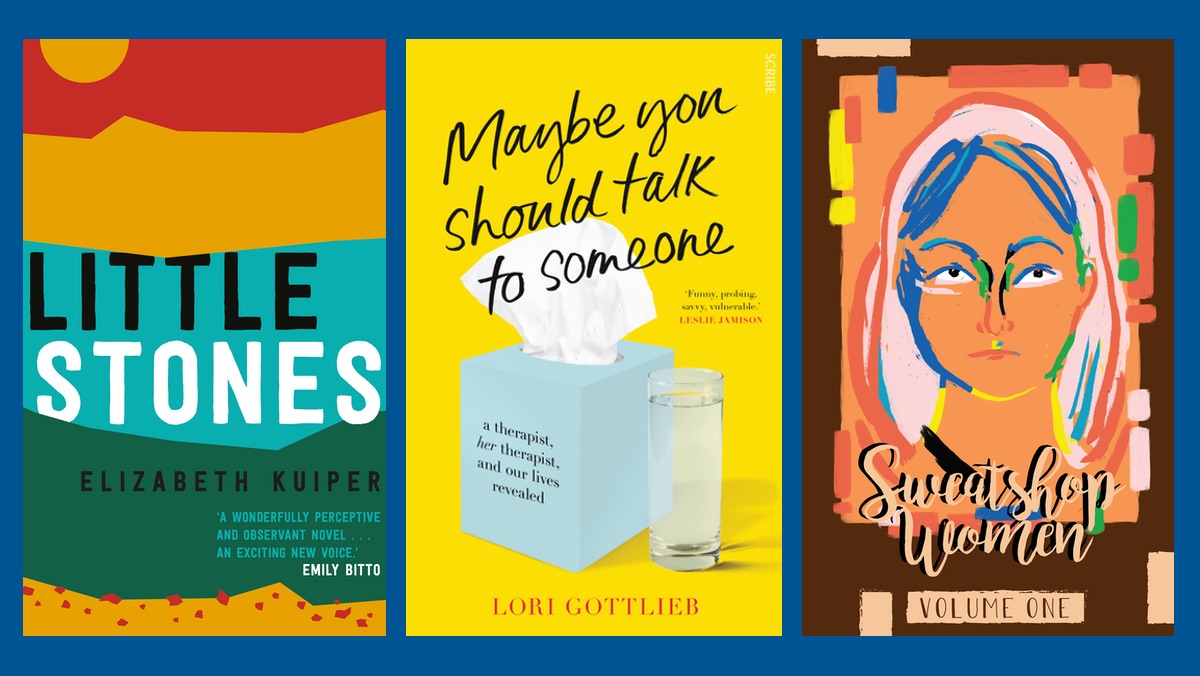


Little Stones
Elizabeth Kuiper (UQP, available now)
Little Stones is our First Book Club pick for June – join us on 25 June for a free in-conversation event with the author at Bargoonga Nganjin, North Fitzroy Library.
For Zimbabwe, the early 2000s were a time of social and political turbulence, as humanitarian and economic conditions worsened under president Robert Mugabe. In her debut novel Little Stones, Melbourne author Elizabeth Kuiper describes this period through the eyes of a child. Eleven-year-old white Zimbabwean Hannah lives in Harare with her mother and housekeeper. As Hannah takes spelling tests and bounces between her divorced parents’ homes, she also sees her homeland changing and facing major issues. She and her mum are regularly stuck in petrol lines, or in traffic behind Mugabe’s motorcades. Her grandparents are forced off their farm overnight by a group of men Hannah knows only as the ‘war vets’. She watches as her mum pays millions of dollars for groceries because of inflation. But while this political and social tension plays out around Hannah, she is more concerned about the conflict between her mother and father, who divorced when Hannah was a small baby. Hannah’s father is a controlling man, and it becomes clear as the novel progresses that his main desire is to make his ex-wife’s life difficult, using his daughter as a pawn in this mission.
Hannah is not yet fully aware of her privilege, but Kuiper certainly is: acknowledging the pain caused by colonialism, but not attempting to explain anything away.
Despite both sides of her family having access to wealth and leading comfortable lives, Hannah is not yet fully aware of her privilege. But Kuiper, who like her protagonist also grew up in Zimbabwe, certainly is. Little Stones contains many moments depicting the arbitrary racism of white Zimbabweans: the differences in the way Hannah and her non-white classmates are treated, the casual but highly bigoted utterances the white adults in her life drop into conversation, the misinformation and fear they spread among each other. Hannah doesn’t always understand the things people say, and relies on her mum to explain why some people seem to think they’re above others. Here, Kuiper’s authorial voice is most present: acknowledging the pain caused by colonialism, but not attempting to explain anything away.
Little Stones is at its strongest when Hannah is imperfect: imitating the behaviours of the adults she loves and respects, and navigating which of these behaviours are ‘good’ or ‘bad’; not knowing which parent’s side to pick, or even once or twice trying to use their conflict to benefit herself. While Little Stones is a work of fiction, it’s easy to imagine where Kuiper’s own upbringing in Harare inspired, or at least informed the events of the book, using the naivety of her protagonist to depict this period of Zimbabwe’s history in a way that feels highly personal and honest to the experiences of Hannah and girls like her.
– Ellen Cregan