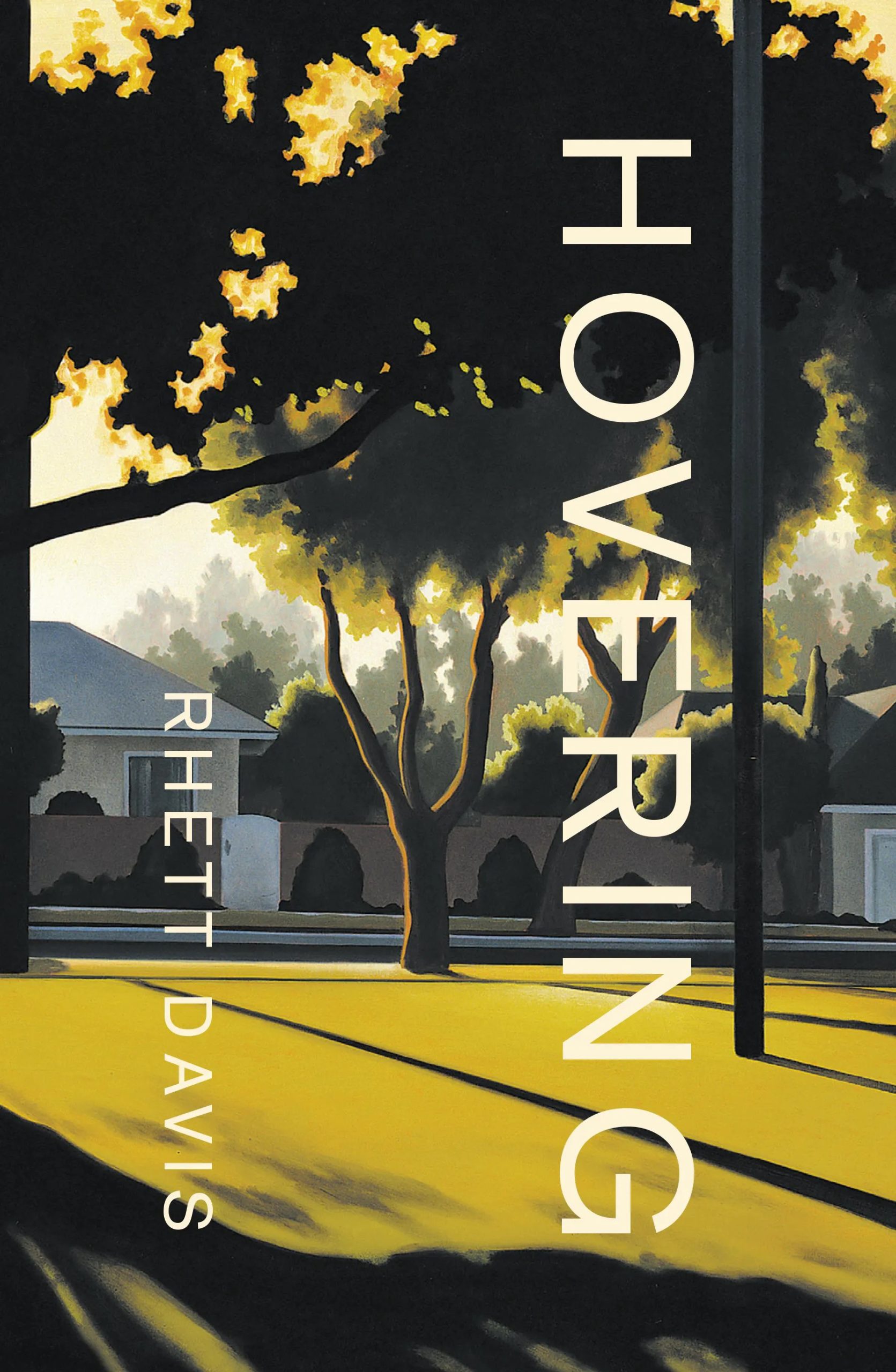
Hovering
Rhett Davis (Hachette Australia, available now)
Hovering is our First Book Club pick for April—Stay tuned for features on our website and podcast throughout the month!
Hovering is set in the near-but-unspecified future in the fictional Southern Australian city of Fraser. Alice Wren, returned out of the blue after leaving for Europe in her twenties, finds her home in a state of flux. The town is going through ‘geographical manipulations’ with streets and houses disappearing and moving somewhere different overnight.
The device of the rearranging city captures multiple Australian anxieties, namely living at the precipice of total climate crisis and the bullish instability of urban sprawl. Alice’s sister Lydia, thinking about their mother’s once-manicured, now overgrown garden, sees it as a ‘losing battle’: ‘Disorder always overcame order … The earth would always shift.’ A space that had been lovingly maintained by the previous generation is impossible to keep liveable for the next.
This is such an original novel, and Davis’s writing is exhilarating, surprising but never heavy-handed.
Land is central to Alice’s tenuous relationship to home. Before returning to Fraser, Alice was a member of a controversial guerrilla art group, producing works under a pseudonym. Her most celebrated and incendiary works were focused on the everyday violence of living on Indigenous land as a coloniser. But an inability to transcend the shame and guilt in any meaningful way is central to how the work is perceived. While the online furore towards Lydia’s work is written with an element of satire, one of these articles reflects that Alice’s work shows how ‘Fraser is a beast that grows and expands of its own volition and that may be remarkable, but it does so stupidly, poorly and with deep insecurities.’ This sentiment of ugly cultural insecurity amid a backdrop of rapid environmental upheaval comes straight from real-life Australia, and indeed any stolen land.
In this state, the future feels untenable, especially for the young—as seen via Lydia’s sixteen-year-old son George, who finds it impossible to imagine his future, even when it is set as a school assignment. Meanwhile, Lydia, who has never moved away, or indeed left the family home, escapes the pressures of the changing world around her (building to disaster-scale throughout the book) via a video-game addiction where she plays at being a botanist, connecting to nature via a simulation.
This is such an original novel, and Davis’s writing is exhilarating, surprising but never heavy-handed. Hovering poses questions of settler colonialism, the invasiveness of technology and the bizarre human tendency to adopt a ‘business as usual’ mindset as the world falls apart. By framing these themes with such an unusual plot, Hovering is one of the most exciting books of this year.
— Ellen Cregan