Enjoy discounts across our wide range of courses with award-winning writers.

Kevin Wilson on Strange Loops, Outsider Art and Worst-Case Scenarios

Alan Vaarwerk

Culture

Conversation with the bestselling author of Now Is Not the Time to Panic

The author Kevin Wilson sitting in a white leather chair. He has short dark hair and is wearing a dark blue denim shirt with rolled up sleeves.
Kevin Wilson. Image: © Leigh Anne Couch

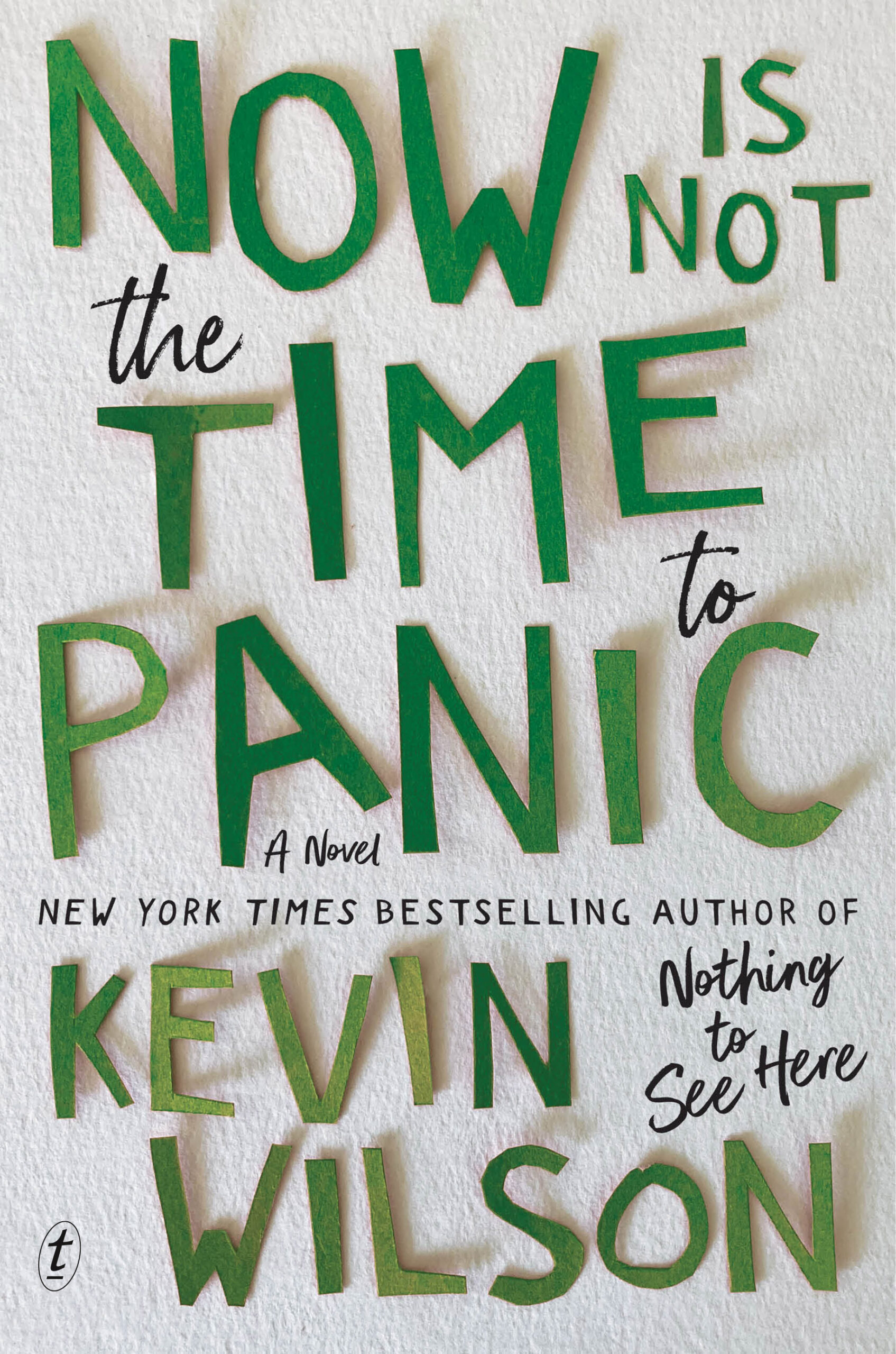
Kevin Wilson is the author of acclaimed novels such as The Family Fang and Nothing to See Here, and the short fiction collection Tunneling to the Center of the Earth. Wilson’s fourth novel, Now Is Not the Time to Panic (Text Publishing), follows sixteen-year-old aspiring writer Frankie Budge who, along with the talented but troubled Zeke, spend a bored summer photocopying and pasting an anonymous and enigmatic phrase all over their small Tennessee town. It’s a work of art that forges a unique bond between the two lonely misfits, but its cult following also spirals out of control as rumours about the poster’s origins and potentially sinister message spread into a full-blown panic. Twenty years on, Frankie still carries the secret of that fateful summer, the mantra echoing privately echoing in her mind, until she receives a call that threatens to unravel everything.

Alan Vaarwerk spoke to Kevin Wilson over Zoom from his home in Tennessee.

This interview has been edited and condensed for clarity.

The novel revolves around a very specific phrase. Can you talk a little bit about where this phrase comes from and how it made its way into the novel?

The novel really is focused on these two teenagers who create this phrase: ‘The edge is a shantytown filled with gold seekers. We are fugitives, and the law is skinny with hunger for us.’ It animates their lives, it’s the thing that gives meaning, even though it doesn’t necessarily mean anything. But that line itself actually comes from my own life. In the summer of 97, I was just finishing my first year of college, so I was probably 19, I think. I was living in an apartment with my cousin and my cousin’s best friend, this guy Eric, who was just about to leave for LA to do acting and writing and all that. And Eric was just incredibly charismatic, he had gone to film school, he had all these cool cameras and editing equipment. Over the summer we just made movies, he would show me movies, he gave me books to read, and I just was really enthralled by him. We became good friends.

And I had this job that summer, at this medical centre—this was the early stages of the internet, and I was putting this policy and procedures manual, hand typing it in HTML, this 700-page document. And it was very boring, and no one ever checked on me. So I just started making stuff up and putting it in the document, and I just figured no one would ever see it. I asked Eric to give me some stuff to put in there, and he gave me a version of that line. From that moment on, I’ve said that line in my head an infinite number of times. It’s just like a repeating phrase that’s calming to me. I put it in my first novel, The Family Fang, like, just a brief little aside. And a lot of times I’m like, if I can just get it out of my head, if I put it on paper, it’ll get rid of it—sometimes that works, but it didn’t this time. It didn’t get rid of it. So I wrote this book to try to get that phrase out of my brain a little bit, and out into the world to see what would happen.

This is a brief moment where this thing I’ve worried in my head for so long will finally reach a receiver.

The final autobiographical detail is that as I was finishing the book, my friend Eric died unexpectedly, super unexpectedly. And I think I’d always thought that this book might bring us back stronger into each other’s orbit, you know? He knew I was writing it, and so when he died, I was like, well, what do I do with this? What’s this work for? And I was like: oh, it’s what it’s always been—it’s a fictional story that you’re writing, get to the end of this and see what happens. We’ll see—the phrase is in the book, it’s out in the world, and we’ll just see what happens in my brain. I still say it, though. It’s still very calming.

Do you think your relationship to the phrase is going to change now that it’s in so many other people’s heads as well?

I hope so. I don’t think it’s insidious in any way on my part. It’s not like The Ring where I’m like, I’ve got to pass this curse on to someone. It’s actually just a really pleasing, strange little line that echoes nicely in my head. I think this is all art, right? All art is made from someone’s personal obsession or personal interest. And you take it and you worry it into existence. But when you release it, when it touches open air, you can’t control what happens. So who knows? But for me, in some ways, just to know that someone else somewhere will read this book, and read that line, and it will echo in their head for a brief moment—I don’t think it will last for 30 years in their head, but that’s pleasing to me, because so much of art is about connection. So this is a brief moment where this thing I’ve worried in my head for so long will finally reach a receiver.

That’s not dissimilar to the way Frankie thinks about the phrase in the book, wanting to get it out in the world and just see what happens—and when she gets it out into the world, things go horribly wrong. I wonder whether that was something you were thinking about, in terms of what might happen once it was out of your head and in the world.

I think a lot of my books are like worst case scenarios, so that I can be like, well, it’s not as bad in real life for me. And then if this is the worst case scenario, and you can survive it still, that’s reassuring to me too. When I wrote my first novel, The Family Fang, it’s about terrible parents—and we’d just had a kid and I was like, I don’t know if I’m going to be a good parent, so, well, let’s write the worst parents that could exist. I tend to do that, where I push the narrative to the extreme, just to see, and then to realise, oh, there’s still, room here for empathy or weirdness or expansion. And that’s always freeing, when you think the worst can happen and you realise you can survive it. But yeah, I mean, it’s a book about a line that goes out into the world and creates a lot of pandemonium and panic. But luckily, this book is coming out in 2022 and not 1996. I feel like so much has gone viral thanks to the internet, that this is not as unique as it would have been in that time period.

Yeah, it’s like a pre-internet version of virality. Which also relates to the medium Frankie and Zeke use to get this message out, which is a photocopied poster that they stick up all over town in secret, like a kind of street art which, when it doesn’t have that context, takes on a life of its own in people’s minds.

Yeah, I’m interested in street art, and I grew up after the Wild Style documentary, and Basquiat and all that stuff. But I come more from skating, so Shepard Fairey and Obey, Barry McGee and all that stuff. I really dug all of that, I thought it was really cool. That kind of street art feels different than graffiti to me, because graffiti is a tag that claims ownership, whereas Andre the Giant, Obey, is a decontextualised—it almost seems insidious in a way that you can’t quite pinpoint. I was also always really interested in the Toynbee tiles, these little tiles that have these strange phrases about planet Earth and a rocket ship, and they would be posted onto the street on the sidewalk.

It’s a strange phrase that gets mutated, and it turns up all over the world, and no one knows if it’s one person or lots of people. To my mind, that was more akin to what I was thinking of—a kind of outsider art where we can’t understand the intention of the artist. And it may just be that there is no intention that we can really understand, but it grows and takes on this mythos, because we don’t necessarily have a narrative to explain it. I love that stuff—that’s my wheelhouse.

It reminds me a lot of someone like Jenny Holzer, who would place these decontextualised, ambiguous phrases all over the city—you give a nod in the novel to other street artists like Jean-Michel Basquiat and Keith Haring, as well, though Frankie doesn’t necessarily identify with those artists.

Yeah, I think that’s one of the things—like Frankie says, she didn’t know about Xerox art or Andy Warhol or even really much about street art. They were just making these things and then second-hand figuring out all these things that would explain it. I love anything where degradation is built into it, that it’s meant to be painted over, or that it’s meant to fade away or break apart, and then what’s left is people’s memory of it. And people’s memories are unreliable.

For me, it was a policy and procedures manual for a medical centre. I hid it in that and I’d check it over the years, and eventually they put up a better version of it. The internet had become more complex, so it became outdated, and it disappeared, and it’s gone. I can never go back and see it. But for this story, I was trying to figure out what would linger, and I was like, oh, street art—that makes sense to me that these kids, especially because they have such limited means in this little rural place, like, what’s the easiest thing? Well, paper, right? Paper that you can just post up and forget about. I was super obsessed as a teenager with zines, these hidden artefacts that were made and you may never see it again, or only two or three people would have it. And I was like, oh, yeah, this will be like a zine that gets posted that no one can figure out.

It seems like for Frankie and Zeke, the idea of people bringing their own narrative to it is enthralling, but there’s also something scary about it as well. How did those characters grow to become the people we meet in the book? Did they arrive to you fully formed?

Frankie did, for sure. I knew Frankie was going to be slightly angry, because her world had been changed against her will. She was stuck in this place, but her dad had gotten to leave. That all made sense to me, and that she would rebel—or not rebel, but like, try to make a space for herself by making stuff, by writing. So I knew that this was going to be a transformative summer where this thing gets made.

I love anything where degradation is built into it, that it’s meant to fade away or break apart, and then what’s left is people’s memory of it. And people’s memories are unreliable.

Zeke at first appeared to me only as a temporary person, he shows up and he is not going to stay—and that transitory nature was important to me, but he wasn’t shaped in the same way. A lot of it was just playing him off Frankie, and that’s how I could figure out who he was—like, okay, he’s an artist in a different way, but they have this kindred sense of themselves, but he has a little bit more of an expansive understanding of the world, and that was helpful. And then little by little, it became very clear to me that you can each take part in making something, but how you respond to it or how you feel about it doesn’t have to be the same. And that was when the story opened up. I was like, oh, Zeke will be super terrified because he has a little more at stake. He has a plan to be exemplary. He has more money, he has more opportunity, and so he’ll be a little more afraid about this ruining him. Whereas Frankie is like, I want that, I want to be ruined—because maybe then I’ll actually get somewhere.

So much of it is just—I know they’re not real, I’m not weird like that, I don’t cry when I finish the book because I’ve lost the characters. But you live with them long enough that you start to get depth and nuance that you didn’t originally understand.

Something that I think pops up both in this book and in The Family Fang is the tension between making art that is just for you, or just for its own sake, versus having art that is out in the world. How do you approach that tension in your writing, particularly now you have a few books under your belt? Has that changed over your career?

I think now I’m maybe instinctually thinking about an audience. When I was first writing, it would have been insane to be like, okay, let me imagine what my reader needs from me. It was just me writing for myself and hoping maybe that it would resonate later. Now though, I think I do have some sense of, how do I keep a reader engaged as they open the text? How do I keep them connected? Even though I may have these singular obsessions, how do I make those feel slightly more universal, or what do I tie them to? So I do think about that. But still, I mean the reason that I still write is just the pleasure of generating, like making it. Because I know that eventually, no one will want to read my books, or they’ll get so bad that people won’t want to publish them. And that’s fine with me, because no matter what happens, no one can take away the pleasure I got from making it.

I think one of the hardest things about teaching is, I have students and there’s this idea of like, this is my one thing that I made that I’m really proud of. And you want to tell them, you’ll write more—if you love it, you’ll make more. And you will outpace this thing that you’ve made, and you can still feel that connection, the echo of that first time that you felt the joy of creation. But if you do it right, you will outpace it and leave it so far behind that it will really only exist in the nostalgia for the moment of what it gave you, not necessarily the work itself. But, you know, they’re 20. It’s hard to be like, you have a whole life ahead of you. They want the pleasure that they got from making it, they want to try to extend that for as long as possible. A lot of times, the way you extend it is you keep making new stuff, and then each time, your skills get a little better, so you get a little closer to it.

So, yeah, I think for me, it’s more about teaching them to love the pleasure of finally figuring something out and making progress, as opposed to, like, this thing that you made is now the totem that you will carry for the rest of your life. I don’t think that’s necessarily healthy. Like, for Frankie, I think she carries that totem around, this paper, but part of it is just the deep desire for nostalgia, to live in that moment again, to experience it.

It’s interesting to think about that in relation to your short fiction collection Tunneling to the Center of the Earth, which was rereleased last year—I think you wrote a lot of those stories when you were in college. What was that like, revisiting the writer that you were at that point in your life?

Yeah, definitely. Some of those stories were workshopped in college, and I definitely went through multiple drafts. But yeah, when I look back, I can remember in some ways the specificity of being in college and writing them, not because I wanted them to be in a book—I was writing them because I wanted somebody to be so enamoured with the story that they would make out with me, you know what I mean? Like, my aims were so much more specific. And so I was writing in some ways to try to make myself known, not to a readership or an audience, but to the 15 people in that workshop. I think I’ve gotten better at not writing just to make the people in my orbit want to make out with me—I feel like I’ve found some artistic aims beyond that. But when I read those stories, part of it is just—it’s not desperation, it’s more an expansiveness of, like, what can I do here, to make these obsessions known to the larger world? And there’s a lot of searching and magic and weirdness in those stories, because I’m just trying to figure it out.

There’s this summer writing conference for teenagers here where I live, and every year the professor who runs it teaches that book. And it is so absolutely insane every summer to have students who are 17 ask me about this story that I wrote when I was 19, and try to even explain it in any way, shape or form. They’re like, well, what were you doing here? I have no idea! I don’t know, I had no clue what I was doing. I was completely motivated by intense desire. But, yeah, they’re fun, and there’s definitely stories I wish I had done a better job of, there’s some that are clunky and not so great. But, you know, I made them with my own two hands, and it’s nice to be reminded of them at times.

Some of the ideas in those early stories have found their way into some of your later work—and you mentioned how The Family Fang contained the phrase from Now Is Not The Time to Panic, but it also included essentially a short synopsis for Nothing to See Here, nearly ten years years before that book was published. As you were saying before in relation to the phrase in the novel, is it a case of ideas or topics staying in your head, and not feeling like you’re done with them?

I get pleasure in looping. It’s just the way my brain works. Everything functions on a loop—like, nothing has ever quite passed, I know it’s coming back around. I just think that’s an artistic process for me—I think I’m done, and then it circles back around and I find some new way that I might want to play around with it. I keep putting in the name Hobart—which is a town in Australia, right? I just like that name, I love the sound of it. And so each time I’m like, oh, this will be fun to put it in a story, to slightly vary who that person is and hear the resonance of it. Yeah, I think I’ll do this for the rest of my life.

Everything functions on a loop—I think I’m done, and then it circles back around and I find some new way that I might want to play around with it.

I think a lot of writers have their obsessions, mine are just like super specific—like feral children, spontaneous human combustion, the name Hobart, like art and what is it, all that stuff. I don’t know that I’ll ever get rid of it, I think it will just bend and mutate and twist as I go. I think a lot of that stuff, I put it in those stories, in my first novel, because I didn’t know that I’d ever write anything else. So I was like, oh, I’ve got to get this in there. And then I was like, oh shit, I gotta do this for the rest of my life—I need that back, I gotta take another crack at it!

And as you build a body of work and build a career, do you see your newer works as being in conversation with your older ones?

I think they are. Pretty much every book I’ve written, at least part of it takes place in a town called Coalfield. There is a real Coalfield, Tennessee, but it’s not the Coalfield, Tennessee, that I’ve made up. It’s a town that mutates and changes with every book. But I get a little bit of the charge of the sound of that same place. So yeah, I think they’re all of a piece in some ways. I think they’re connected, and a lot of times, like, The Family Fang in so many ways is about like, what is art and what’s the purpose of it, and what’s the meaning of it and the value of it, in really broad terms. And this book is right back in that thing. I think of myself so much as a domestic writer—I’m just really interested in how a home is made, how you live in that home. And in almost all of my books, characters just really don’t ever want to go anywhere. In Nothing to See Here they can’t even leave the estate, and in Now is Not the Time to Panic, they’re stuck there for the summer. I just try to make my characters never leave. I find myself doing that again and again. Let’s lock these people into a specific place, give them a few weird things to deal with, and then I’ll get some variation out of it.

One of the ways Frankie deals with her stuck-ness is by writing, both the phrase on the poster and other stories. I was struck by the way she describes how she writes: ‘This little voice, this tiny, insistent voice, was not God and it wasn’t some muse and it wasn’t anyone in the world except for me. This voice was my voice and no one else’s.’ I’m wondering if that also reflects your own approach to writing.

I talk a lot to my students about all these rules for craft—like, here’s how perspective works, here’s how setting works, this is how you construct a sentence. And you teach that stuff, but at the heart of it, what you eventually start to tell them is so much of this is just instinctual. You just did it because it felt right, and then you build up the reasons later and then you start to learn about yourself. But so much of what you do in the beginning is instinctual and then that becomes your style.

I don’t care about a muse or inspiration, that’s not interesting to me. I don’t care about something outside of myself. I just have a weirdness inside of me, and if I can just slow it down enough, I might be able to transcribe it and figure it out and put it on paper. But again, it’s instinct. And then you tie that instinct to craft, you know, and then that’s when you can really like, make it do stuff that you couldn’t otherwise. But yeah, initially it’s a voice that you know is not outside of you, but you also know it’s not entirely yours. And that’s kinda fun.

I don’t care about a muse or inspiration, I don’t care about something outside of myself. I just have a weirdness inside of me, and if I can just slow it down enough, I might be able to transcribe it.

What are the books that you gravitate to, or that you would encourage people who are interested in your work to seek out?

So I think the major throwback for me, and the person that really influences me is Carson McCullers, the Southern writer, and she has this novel called The Member of the Wedding. It’s about this young girl, whose name is Frankie, and her brother is coming back to town for a wedding, and she assumes that he’s going to take her away with his new wife to Alaska, and it takes place over a green, hazy summer. It’s just this very brief little novel, and it’s a small town that feels isolated. I love that book, it’s one of my favourite novels. I was thinking a lot about McCullers when I wrote this book, with the name Frankie, and a small town and a single summer. So that book really influenced me. But now the writers that I gravitate towards are George Saunders, who’s magical, weird, but still connected to reality.

Another one that has really shaped me a lot is Jennifer Egan, who wrote A Visit from the Goon Squad, which is this nonlinear, slightly experimental book about time and memory, and how do we reconcile the past and technology. So she’s huge for me. And she’s interested in art, too, a lot of her characters are artists in some form. And then Ann Patchett, who writes a lot about found families or people who find themselves, for some reason, connected for a brief period of time, and how you form a family to survive. So those were huge.

And then I do want to mention one book—it didn’t influence this book at all, but I just literally finished teaching it and I’ve read it a couple of times. But it’s an Australian writer, Elizabeth Tan, it’s called Rubik.

I love Rubik! It’s such a good book.

I just think it’s just such a singularly brilliant book. And so much of it is like, can you control the art that you make, right? The falling girl, like, that image, and it gets taken up by Seed. I just finished teaching it, and my students, like, some of them were like, ‘I do not have a fucking clue what this book is about, it is a riddle,’ and then others were like, ‘this is the greatest thing I’ve ever read’, they were just like, I love everything about it. It’s just a beautiful book. I think a lot of what I’m interested in is, like, how do we reconcile the person that we are with the person that we were, you know? How do we keep people alive in our memory? How do we connect ourselves to the past? What are the little cultural units that exist even after we’re gone? I loved it.

I always wondered how that would read outside Australia, because there’s so many little things that are specific to Australia, or to Perth.

Yeah, Perth was certainly unknown to me. There are times where I’m like, I don’t know if this is a fictional world or it’s Australia and I just don’t know about it. But the confusion is fine because it’s all about, like, what is real and what’s not and what is dreams. So I just assume everything about Australia might not be real.

*

Now Is Not the Time to Panic is available from tomorrow at your local independent bookseller.
Latest

Have Gun Will Shoot

Vivienne Cleven

Shed a Tear for the Norman Mailers

Rebecca Starford

How to Love the World

Ilka Tampke