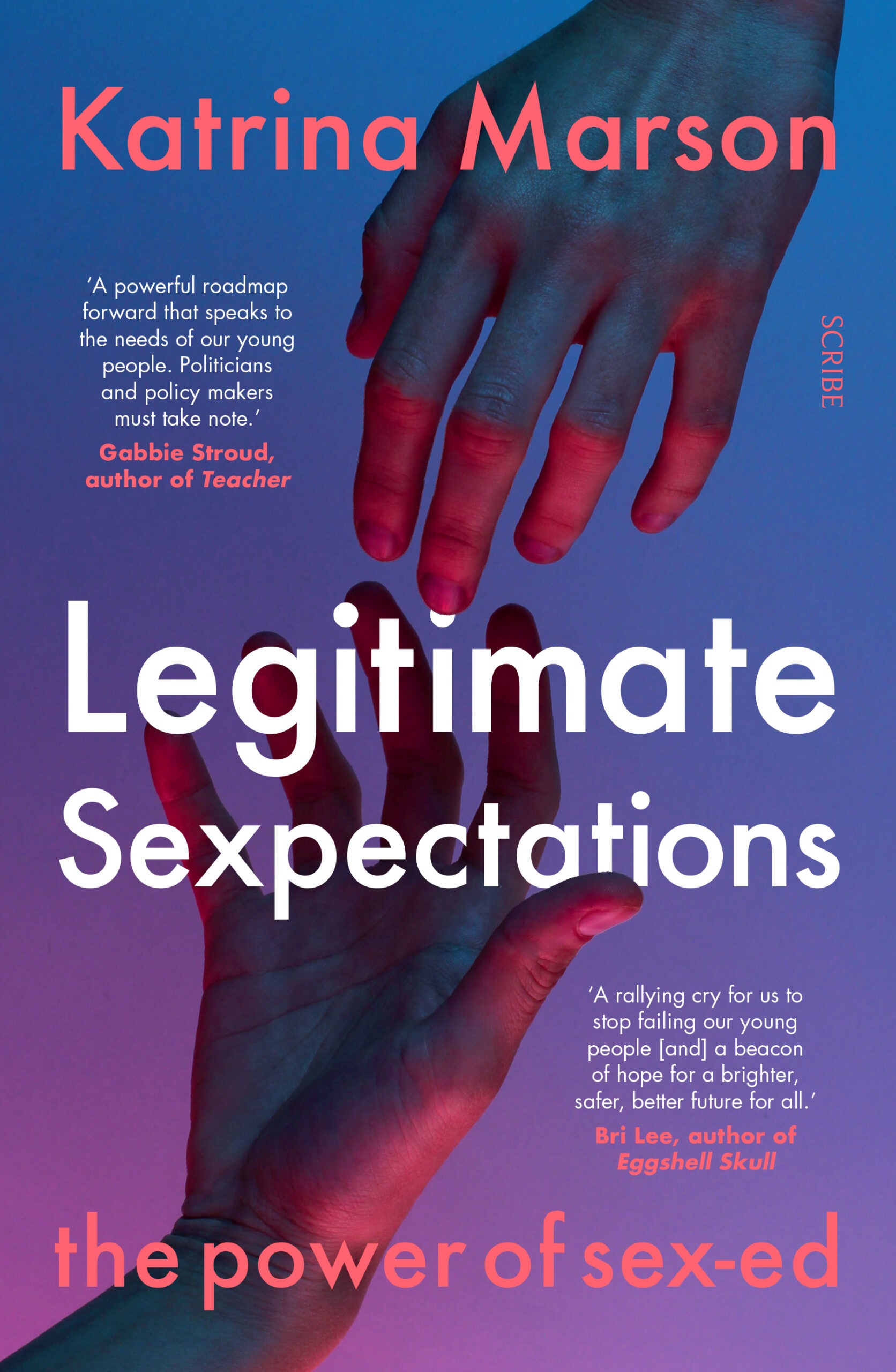
Each month we celebrate an Australian debut release of fiction or non-fiction in the Kill Your Darlings First Book Club. For September that debut is Legitimate Sexpectations by Katrina Marson (Scribe)—a book that blends extensive research and fictionalised scenarios to explore the limits of the criminal justice system and the fault lines in our society when it comes to sex, sexuality, and relationships. Ellen Cregan spoke to Katrina in an Instagram Live conversation earlier this month.
Editor’s note: This interview contains generalised discussion of sexual violence and negative sexual experiences.

For the people who haven’t had a chance to read the book yet, can you give a brief summary of Legitimate Sexpectations?
It’s an exploration of the protective power of comprehensive relationships and sexuality education (RSE), to safeguard sexual wellbeing and protect against sexual violence. And it looks at all different aspects of sex ed—so the implementation of it, the fact that we need to start young, the way that we need to talk about body parts and puberty, queer issues, those sorts of things from quite a young age—and the benefits of that for young people. And it does that from a dual perspective that I have: one as a sexual offences prosecutor, where I see the end of the spectrum where the damage is already done when it comes to sexual violence; and my research perspective of looking at sex ed as that protective power. And it weaves the two of those together through fictionalised vignettes—none of which are based on any individual case that I’ve worked on, they are entirely a product of my imagination, but obviously draw on my experience in dealing with sexual violence and in the sex ed space as well, hearing a lot of stories about what people have experienced, my own experience. So I guess the compelling thing about those vignettes in one sense is how universal they feel—and the sad thing about that, I guess, is the consistency of some of the things that drive sexual violence or negative sexual experiences more broadly. So the vignettes are used to explore some of these issues and how they actually play out moment by moment. And then I use those to talk about sex ed, and how they might have gone a bit differently if the characters had had better sex ed, or been better equipped to confront those situations they found themselves in.
So you’ve researched in this area quite a lot—Can you tell me about how your research came to be published in the form of this book?
My research in the space of sex ed started ten years ago or more, when I was at university and I did an Honours thesis comparing the ability of the criminal justice system to prevent sexual violence with primary prevention measures like education. And it was a very academic piece, it was looking at the literature, the research, and it came down very much in favour of preventative measures, rather than the reactive criminal justice system. And then I graduated and went into practice as a criminal lawyer, and I came back to the subject in 2019 on my Churchill Fellowship, which was a much more in-depth and practical research opportunity, because I went to all these places where they implement sex ed better and more consistently than we do here. And I got to learn about what it was that made it possible for these communities to do that, and what we don’t do here that means that we can’t guarantee young Australians that they’ll access comprehensive RSE. So the Churchill Fellowship really informs the research in the book, the people I spoke to, the things they told me—and of course, I draw in other research and subsequent conversations I’ve had with people here in Australia about the Australian experience, too.
It’s been an interesting experience weaving the fictional voice and the non fictional, more research-based voice. But that was, to my mind, what makes the book a bit more interesting. Because it’s not just me presenting my research like the way I did in my Churchill Fellowship report, which is really policy language—I don’t think it’s dry, but it doesn’t have that emotional connection that the book obviously tries to form with the reader.
You open most of the chapters with those vignettes, so as the reader turns the page, that’s how they start. And then you do come back to them a few times in the chapter to illustrate points. Why was it important to you that that was the opening of most of the chapters?
I think it gives the book a rhythm, and an energy to it in terms of keeping the interest. But it was really important to me to tell stories—because we can talk about ideas like consent in very legalistic and abstract terms, but until you start to see how that plays out in real life, in such a wide range of experiences and all the different nuances and all the different forces that bear down on people in these situations, I don’t think we can fully appreciate all the different factors that people bring with them to these sexual encounters. And we certainly can’t appreciate how all of us, as members of the broader community, contribute to these things. So the storytelling is really important—I think it’s the backbone of the book, because that allows us to interrogate some of these things and see how they played out for individuals in these moments. And because they’re fictional as well, it also meant that I could make the points I wanted to make by manipulating the characters and their histories.
‘It was really important to me to tell stories…to bring the readers along in that journey, rather than me just telling people what to think.’
So I could write into their histories what sex ed they did or didn’t have, or the kinds of sex ed they’d experienced, or their own interactions with the adults in their lives, whether that’s their parents, their teachers—there’s one character who has an interaction with a neighbour. So I could write that into it to illustrate the point about all of those aspects of sex ed that I needed to cover, but also particularly the way we all contribute to the attitudes and drivers of sexual violence and negative sexual experiences.
And we can see what leads the characters to saying yes when they really mean no—all the different factors, a lot of them are cultural, and then those experiences and you can see that so in depth with those vignettes and like it happens all throughout.
Yeah. And I think the other thing is I really wanted to connect with the readers. It’s very didactic if I just present my research and say, ‘this is what I learned and this is what we should do’. I think situating it in stories that people can relate to—so many people have said they see their own experiences, my experiences are in practically all of them in some way or another—that was really important to me, to bring the readers along in that journey, rather than me just telling people what to think.