Enjoy discounts across our wide range of courses with award-winning writers.

Culture

Son of Sin, Sadvertising, AustralianaThe Novel Project

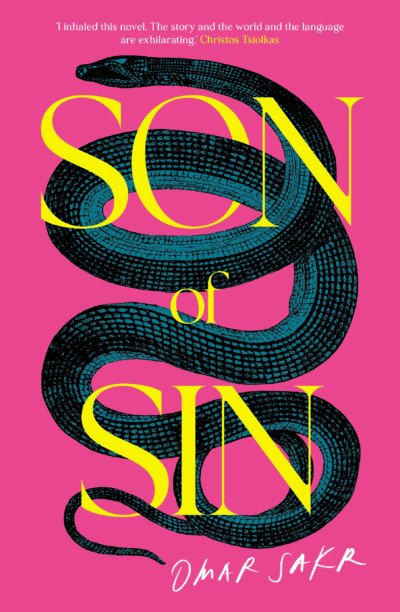
Son of Sin
Omar Sakr (Affirm Press, available now)

Son of Sin is our First Book Club pick for March—Stay tuned for features on our website and podcast throughout the month!

Son of Sin, the debut novel by award-winning poet Omar Sakr, is the coming-of-age story of Jamal Smith, a young queer Arab man raised in a tight-knit but disadvantaged community in Sydney’s west. Jamal is the child of a mother who struggles with addiction and an absent father, but is constantly surrounded by members of his extended family.

This novel features a large cast of characters, and at times it can be difficult to keep track of the cousins, aunts, uncles and assorted others. However, as a person from a large family, this sense of endless relatives rings true. Sakr alludes to the idea that the neighbourhoods filled with various relations are more meaningful than just having family nearby—at one point Jamal wonders, ‘if a map of Lebanon’s villages before the war would match where families had ended up in Sydney, if they had unconsciously replicated a way of being that no longer existed.’ Here, and throughout the book, Sakr reflects on the fact that humans are creatures of habit, in the way they build communities, and in the moral standards they uphold for those communities. In Son of Sin toxic masculinity and homophobia are upheld by people because they feel like it’s what’s expected of them. Jamal is a study in what can become of a person who has been alienated from a tight-knit community for illogical reasons.

Sakr captures the complexities and darkness of a queer youth in which acceptance is hard-won, if present at all.

There is a lot of ugliness in this novel, and Sakr painstakingly depicts the strange tension of adolescent homophobia. Early in the novel, Jamal and his friends find pornography belonging to one boy’s father. They watch the video ‘intently, carefully spaced out around … wherever they could contort themselves into seeing the screen, all of them jerking off and yelling, Don’t look bro, don’t look bro, don’t be gay!’ Jamal finds himself mesmerised by both the woman and the man, ‘unable to look away from the screen, unable to touch himself’ in what is both a revelation and a realisation that his queerness is a secret he may never be able to reveal.

This queer coming-of-age story brings a contemporary reframing of the themes and ideas seen in the works of authors like Christos Tsiolkas, and anyone who is a fan of Tsiolkas should make room on their TBR pile for Son of Sin. But what characterises this novel perhaps more than its plot or its themes is Sakr’s beautiful prose. Each sentence is infused with poetry, and not to the detriment of the book as a longer work. With this novel, Sakr captures the complexities and darkness of a queer youth in which acceptance is hard-won, if present at all.

— Ellen Cregan
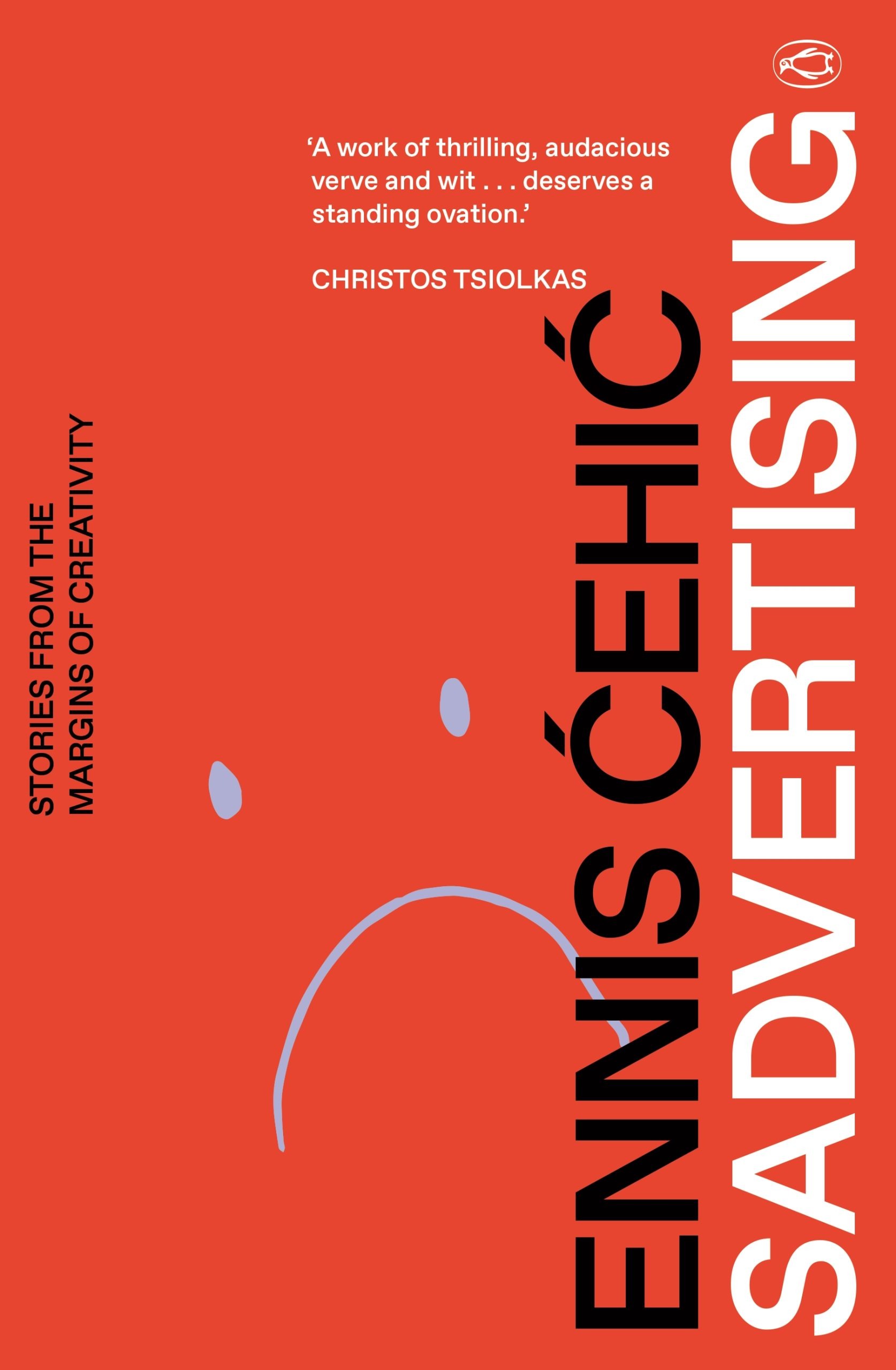
Sadvertising
Ennis Ćehić (Penguin Random House Australia, available now)

In Ennis Ćehić’s debut short story collection, advertising agents have the souls of artists. Account managers and copywriters are compromised poets who spend fifty well-remunerated hours a week ‘on other people’s dreams.’ In one story, an art director with ambitions of being a painter reflects on all the art she’d failed to make. She resolves to ‘free herself from the burden of work’ and finally commits to her true calling. Art is restorative—not only for her but her countrymen too. Like the author, the character is a Bosnian migrant and we learn that her future magnum opus will ‘wash away the pain the people of Bosnia and Herzegovina still feel from the war they experienced in the 1990s.’

Ćehić never dismisses advertising as merely an obstruction to creativity. Art is art, whether it’s commissioned by Mitsubishi or Medici. Within the confines of lurid commerciality, there’s hope for transcendence. Many of Ćehić’s office workers are thus visited by gods, immortals and anthropomorphised metaphysical concepts. Many fall short of enlightenment too, such as one executive who ‘does his best thinking by walking’ and returns half-insane from a three-year-long wander, having glimpsed the secrets of outer planes.

Cehic never dismisses advertising as merely an obstruction to creativity … Within the confines of lurid commerciality, there’s hope for transcendence.

The characters in Sadvertising are sketches. They tend to be young, cosmopolitan sophisticates. They have expensive tastes in fashion. They’re fluent in internet lingo. They mix alcohol with anti-depressants and they vape and they’re kinder to their home assistants than their romantic partners. Ćehić establishes each character in shorthand, in a rigorously maintained comic-serious voice, before sending them spiralling into an existential crisis or a soft sci-fi/fabulist/horror scenario. Vonnegut, Ballard and, notably, Barthelme—who makes a cameo as Mr A / Ambrose—are his stylistic predecessors. The stories are flash- or micro-fictions, truncated at their climax so they feel like movie pitches. The concision and the flattening of character have the effect of putting each vignette’s ‘concept’ or punchline at the forefront.

The 60s and 70s postmodernists are a strong influence on Sadvertising but the book doesn’t re-tread the same exhausting paths. Metafiction, when it’s deployed, is a self-conscious gesture at memoir. (The advertiser sells you an ideal version of yourself and the memoirist may be selling you an ideal version of theirs.) Ćehić—the character—pulls no punches: ‘I don’t think it bothers you that everybody mines their autobiographies today…What bothers you is mining yours and finding nothing.’ Ćehić is coy with autobiographical detail and hesitant to dwell on trauma: ‘Now, war is certainly sweet to those who haven’t experienced it’—speaking here again about the Bosnian War—‘but for the purpose of our story, it isn’t relevant.’ In the final story, the ‘author’ quarrels with his own third-person avatar: ‘I was losing control of my own story’, the narrator confesses. Moments like this surprise us in Sadvertising’s most effective stories: when melancholy, humour and earnestness are tied together by literary play.

— Bryant Apolonio

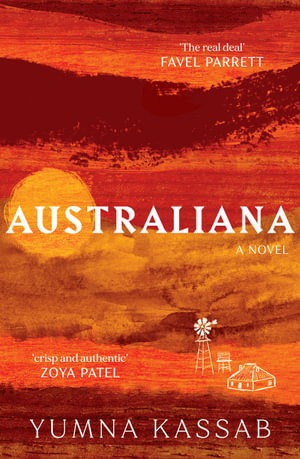
Australiana
Yumna Kassab (Ultimo Press, available now)

Loss, belonging, pain and hope are mapped out on the backdrop of rural communities in Yumna Kassab’s novel, Australiana. In a series of interconnected vignettes, we see different stages of life, from the mishaps of adolescence to the quietness experienced in late adulthood, and all the chaos in between.

The book is made up of five parts, with chapters that read like short stories and can span a few pages or just one paragraph. Often an element from a previous story—a character, object or event—will be examined from a completely different perspective in the next. For example, one chapter presents a police officer’s internal thoughts as he views the body of his friend who died by suicide and wonders ‘how darkness gets into a person’s mind, how it can torment a heart.’ This is followed by another story that reveals the point of view of the friend in his final moments—taking in a memory from childhood. Then in another chapter, the reader is given the perspective of the dead man’s mother. Kassab’s experimentation with vantage point paves the way for a nuanced understanding of human behaviour.

Kassab’s experimentation with vantage point paves the way for a nuanced understanding of human behaviour.

The isolation of rural Australia is shown to be amplified by the effects of a changing climate where ‘once upon a time, clouds that dark would have brought rain. Now they did no more than spit on the land.’ With powerful imagery to evoke the land, the farming lifestyle and the sky—and an experimental structure that connects these themes—Kassab links the environment to the book’s wider insights on connection and disconnection. Kassab pushes us to empathise with the characters and the factors that influence them to make the decisions that they make, such as why a wife would shoot her husband in the head. Kassab also adds to the theme of alienation by showcasing the absence of time in her writing style as the structure is non-linear, jumping around the present, past and future.

Belonging features strongly in later parts of the novel as Kassab highlights the connection the characters share with the world around them and what their sense of ‘home’ means. Kassab continually displays the generational link rural communities have to farming, showing that to it isn’t just work but a pivotal part of a sense of identity. There are uniquely ‘Australian values’ on display, such as a sense of ‘mateship’ and optimism for a better tomorrow. However, underpinning all of this is a keen eye that looks closely at inequalities. By interrogating the narratives of the country that underpin the mythologies of colonial Australia, Kassab shows that there is space to be more equitable and inclusive. Lacing together the lives of different families and showing how the landscape influences their behaviour in the face of an uncertain future, Kassab has created a deeply empathic and poetic book.

— Abira Kannan

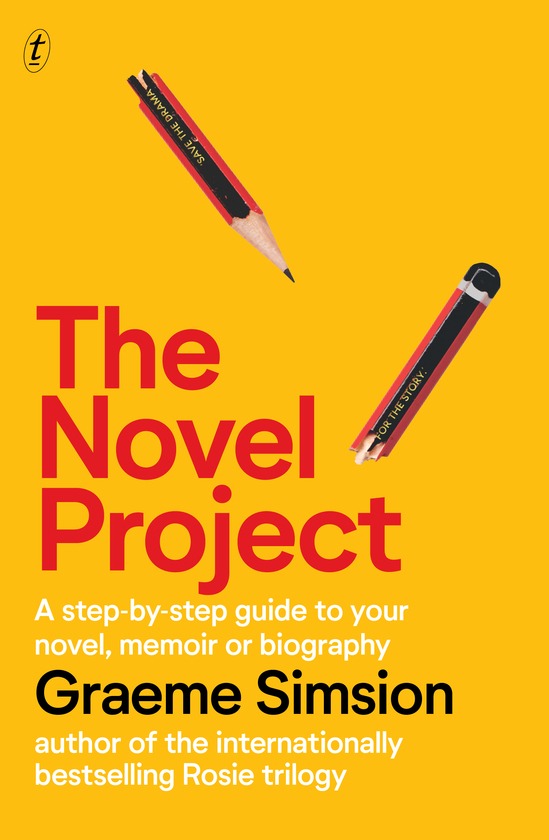
The Novel Project
Graeme Simsion (Text Publishing, available now)

Melbourne writer Graeme Simsion gained international success with the 2013 novel The Rosie Project, as well as its sequels and several other books. In his latest, The Novel Project, he enters a genre almost more crowded than fiction—the ‘how to write’ genre.

Stephen King’s memoir On Writing is one of the most famous, but these books vary. They might put forward exercises and craft tools (Kate Grenville’s The Writing Book), provide information about writing while navigating the industry (Courtney Maum’s Before and After the Book Deal), or examine creativity (Charlotte Wood’s The Luminous Solution). Ottessa Moshfegh once claimed she drafted the Booker Prize shortlisted Eileen as a joke while following Alan Watt’s The 90-Day Novel, so the path is clear.

The Novel Project has much in common with books about screenwriting, which is no accident—Simsion originally developed The Rosie Project as a screenplay, and he refers to some of these texts (including Syd Field’s Save the Cat) in his own. Where this book differs, as the ‘Project’ of the title suggests, is in its focus on breaking down the process of writing a novel into a kind of project management task, from building creativity into your life, to actually writing the book, the drafting and redrafting process, and the experience of dealing with rejection and success.

Simsion offers a convincing argument for his process of ‘plotting’ over ‘pantsing’, including his suspicion that a lot of what the pantsing approach involves, ‘consciously or otherwise’, is a lot like planning. This isn’t to say that Simsion ignores the more elusive ‘process’: he recommends ways of getting ideas to flow through walks, and emphasises the need to create space for conscious and subconscious generative periods. His tone is encouraging, and he shares fragments from early stages of his own development process, which demonstrate how much these ideas can grow and change over time for any writer. However, while caveats are regularly added for those attempting more experimental forms, the guidance offered here would be most useful for those seeking to write a book with traditional structure (or something close to it).

Simsion offers a convincing argument for his process of ‘plotting’ over ‘pantsing’, including his suspicion that a lot of what the pantsing approach involves, ‘consciously or otherwise’, is a lot like planning.

The examples used in the book refer most heavily to the third book in the Rosie series, The Rosie Result. While Simsion recommends having read this to follow some of the specifics, the examples are also clear in context and often come with references to other material. However, as The Rosie Result explores autism and neurodiversity, these subjects also feature here in the context of plot beats (a practice with ethical considerations that are touched on in this book, but not as a focus), as well as in discussions of representation and community consultation. While the DIY novel genre may be bustling with titles, this book also points to a gap in the market: more works on craft from a wider diversity of authors.

The success of books about writing usually depends on what the reader/writer needs. This book would best serve those who might already feel comfortable with the creative elements of writing—generating ideas, crafting sentences—but who are looking for direction on structure, or on time management when approaching a longer project. Possibly the neatest thing The Novel Project achieves, by the end, is making writing a novel seem—if not easy, or fast—achievable.

— Scott Limbrick

Latest

Shed a Tear for the Norman Mailers

Rebecca Starford

How to Love the World

Ilka Tampke

Writing in the Age of AI