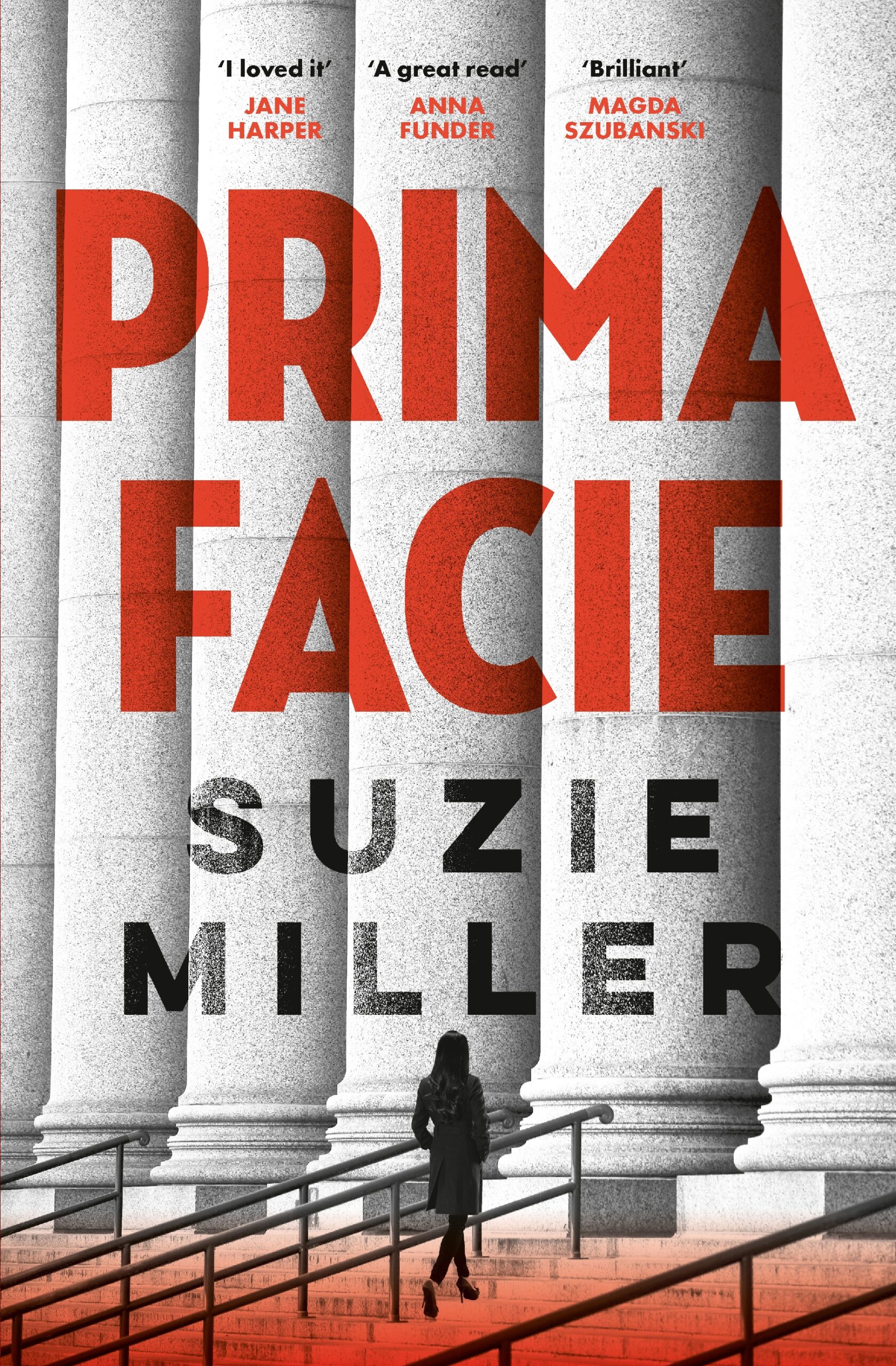
Prima Facie
Suzie Miller (PanMacmillan Australia, available now)
Prima Facie is our Debut Spotlight for November! Read an interview with first-time author Suzie Miller here, plus watch an exclusive reading on our Instagram!
The one-woman, award-winning play Prima Facie was a blistering indictment of how the legal system continues to fail victims of sexual assault. Playwright Suzy Miller’s novel preserves that theme, of course—but her story loses some of its sharpness in the translation to prose. Its supplementary material, which is primarily added backstory about her childhood, and her brother’s flirtations with criminality, isn’t a detraction, though it does feel like a distraction from the marrow of Miller’s tale.
Prima Facie the novel is at its best when closely channelling the original source material.
Boiled down to its essence, Prima Facie is about a young criminal defence barrister named Tessa Ensler who has defied all the odds—foremostly her working-class background—to earn a reputation as one the pre-eminent defenders of men accused of rape and sexual assault. For Tessa, morality never enters the equation. The mechanics of the law are reasonable when you’re a vital cog in the machine:
[M]y job is to tell the best version of my client’s story, and the prosecutor tells the best version of the police story, and the jury decides which story they think is more likely. That’s it. Simple.
Tessa’s perception of the law mutates when she is raped by a colleague, and she decides to press charges despite indomitable odds:
I have to believe that the system of law works for both true victims and for those wrongly accused. I have to know that if we take a crime to court, that if all that has been done has been correctly, by the book, then the law will find the truth. That justice will be served.
The second half of Prima Facie explicates Tessa’s ordeal, from her reporting the rape to a taciturn male police officer, so indoctrinated in the bureaucracy of law enforcement that he seems to view Tessa’s trauma as an exercise in box-ticking, to the trial itself, and the emotional turmoil involved in this judicial process. Miller’s delineation of these events is riveting and heart-rending as Tessa’s professional and personal worlds are thrown upside down. A glimmer of the play’s blazing polemic slips out towards the end during Tessa’s impassioned, biting monologue, but by this point, it feels deserved, and for the reader it is a much-needed tonic.
Ultimately, Prima Facie the novel is at its best when closely channelling the original source material. In both of its forms, the story unravels with a remarkable combination of empathy and pitilessness. The play benefits from economy, the honing of its most brazen observations, and the rawness of its message. In this expanded format, that content remains, though it is overshadowed by a surplus of background detail.
—Simon McDonald