Perhaps Australian literature has always had impostor syndrome. In a 1950 Meanjin essay, AA Phillips coined the term ‘cultural cringe’ to describe the country’s ongoing sense of literary inadequacy stemming from ‘an inability to escape needless comparisons’ to that ‘intimidating mass of Anglo-Saxon culture’. Since local writers and artists could never hope to compete with England’s ‘great tradition’, they felt like frauds. And if you feel like a fraud, why not, you know, just be a fraud?
Australia thus has a long tradition of literary hoaxes, practical jokes and fabricated identities. In some cases, the motivations behind such impersonations remain ambiguous. Why did Helen Darville pretend to have Ukrainian heritage and assume the name Helen Demidenko while promoting her Vogel-winning and Miles Franklin-winning novel, The Hand that Signed the Paper? Were Mudrooroo’s claims of Aboriginality a genuine confusion about his ancestry or something else altogether?
But most Australian literary hoaxes have been much more than shameless grifts. Gwen Harwood’s fictional poet Walter Lehmann had a certain poetic style—his poems were intentionally bad—and thus he was both a fraud and a fraud detector: Harwood wrote the Lehmann poems to test the judgment of literary editors. Two poems were eventually published by Donald Horne in the Bulletin in 1961, but no one realised that both poems were acrostics (one read ‘SO LONG BULLETIN’, the other ‘FUCK ALL EDITORS’). Cassandra Atherton noted in the Journal of Australian Studies that a local paper ran the headline ‘Tas Housewife in Hoax of the Year’, which only further annoyed Harwood, who already felt that misogyny had negatively impacted how people read her poetry. The earlier, better-known Ern Malley hoax was also an attempt to satirise a group of Australian modernists that its creators, Harold Stewart and James McAuley, thought were second-rate, but ironically Ern has become far more famous than the tricksters or their targets.
If you feel like a fraud, why not, you know, just be a fraud?
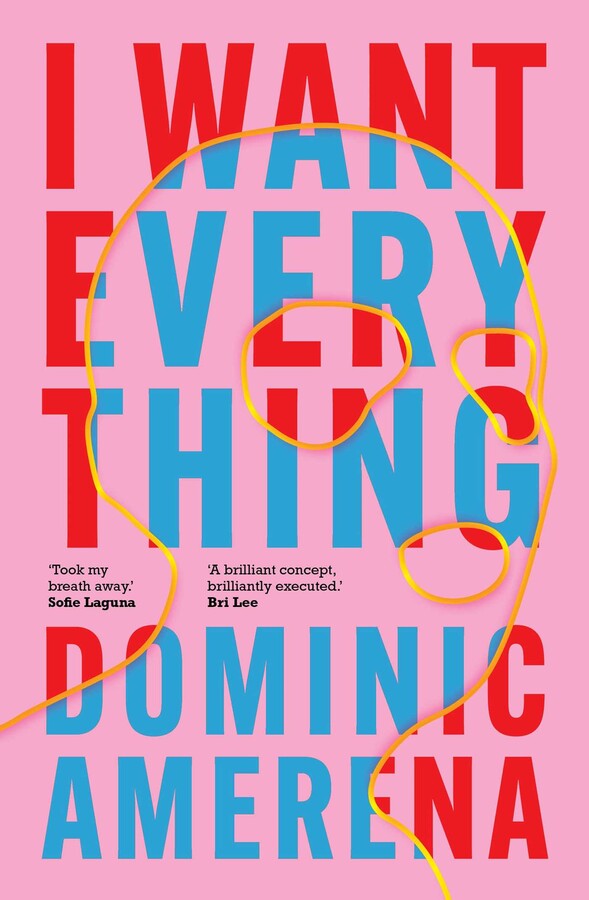
Perhaps taking their cue from our most famous (fictional) poet, a run of books over the last twenty-five years—Peter Carey’s My Life as a Fake, David Musgrave’s Glissando, John A Scott’s N and Ryan O’Neill’s Their Brilliant Careers, among others—have imagined alternative Australian literary histories with a thriving avant-garde that never existed (and even now persists only on the fringes of an increasingly marginal literary culture). Dominic Amerena’s I Want Everything adds to this tradition when its unnamed protagonist—an aspiring young writer—accidentally happens upon Brenda Shales, a reclusive author who published two experimental feminist novels four decades ago and then disappeared even as her work attracted a cult following.
This is very much a novel about Australian traditions of dubious authorship. The phrase ‘mistaken identity’ appears in the fourth sentence of the first page, and Shales’ last name—aside from recalling John Shade in Nabokov’s Pale Fire—is also a word that derives from the same root as ‘to shell’, suggesting the peeling away of false layers. Our protagonist is drawn to Shales as a way of securing literary fame, and he happily seizes upon an assumption about his own identity in pursuit of this goal.
The title I Want Everything is also an ironic allusion to Nanni Balestrini’s 1971 Marxist factory novel, We Want Everything, which was translated from the Italian a decade ago by Melbourne academic Matt Holden. In one passage, the similarly nameless protagonist of We Want Everything states: ‘I want everything, everything that’s owed to me. Nothing more and nothing less, because you don’t mess with me.’ Whereas that novel’s financially desperate protagonist struggles to earn a living by sacrificing his body to industry, I Want Everything’s lead has found other ways to make money from his anatomy, but this is due to his elitist aversion to holding a full-time job rather than desperate material circumstances. However, Amerena transports the urgency of Balestrini’s novel into the generic conventions of contemporary literary autofiction by utilising relentless first-person narration.
Links between the author and the novel will be easy for many readers to make. For example, the protagonist lives with his partner, the ‘Melbourne-famous’ essayist, Ruth. Amerena is married to the essayist Ellena Savage, whose writing has often engaged with similar themes to those of this fictional counterpart. And while Solzhenitsyn suffered in the gulag, Amerena’s characters suffer in an environment even more soul-destroying: Melbourne literary dinner parties.
This is very much a novel about Australian traditions of dubious authorship.
Along with its interests in invented avant-gardists, I Want Everything recalls a series of recent contemporary novels—starting with Rachel Cusk’s Outline trilogy and followed by works such as Pola Oloixarac’s Mona and Sam Riviere’s Dead Souls—that have skewered contemporary literary culture in its bourgeois, institutionalised form. We meet Linh, a former experimental playwright turned expedient arts administrator, and their partner Simon, whose only virtue is just how pathetic he is, a parasite ‘feeding on [Linh’s] cultural capital’. Simon is ‘even more of a failed novelist’ than our protagonist, and for this reason, the narrator tells us, ‘I loved spending time with Simon, because he made me feel good about myself, as both a boyfriend and a writer.’
But it is unclear how talented our narrator really is. While Ruth praises him by saying his ‘sentences are clean enough to eat off’, there are signs that he is not quite a practitioner of ruthlessly sculpted minimalism. He writes, ‘Ruth was cut from Brenda’s cloth, fierce and fearless, with a mind like a steel trap and prose style to match.’ The run of clichés next to the invocation of a steely prose style underscores the joke, but other peccadillos are more ambiguous. Amerena has a propensity for inventive similes but also loves to gloss them for the reader: ‘No, the deception […] already felt more comfortable, a pair of new boots broken in’; ‘Things felt unbalanced between us, like one leg was longer than the other’; ‘I felt a bit used and sweaty like a bench press […] used without a towel’. All three are inventive and funny, but we are also frustratingly told how to interpret them.
I Want Everything takes great pleasure in creating its imaginary avant-garde novels, and its engagements with feminist Australian culture in the 1970s (which arguably defined the literary aesthetics of that decade) are genuine. You can imagine Shales’ work fitting in alongside Helen Garner’s and Helen Hodgman’s novels. But I Want Everything is also a deeply ironic book that loves to undercut itself at every turn. Both of Shales’ novels seem to recall the work of male experimental authors not exactly known for their feminist bona fides. Anchoress, about a woman isolated in a cell, seems to recall the monastic fantasies of Gerald Murnane, and The Widowers, a series of seemingly contextless laments by angry, lonely men, seems inspired by David Foster Wallace’s Brief Interviews with Hideous Men. Are these imaginative reappropriations of masculinist works, implicit criticisms of Wallace and Murnane, or does Amerena simply delight in the incongruity of these pairings? The novel tends to multiply rather than resolve these ambiguities.
I Want Everything takes great pleasure in creating its imaginary avant-garde novels.