Journalists claim to be objective, but that’s a myth. Looking back over my career as a foreign correspondent, I’m rethinking my role in an industry that perpetuates harmful and blinkered narratives about those so often excluded from the newsroom.
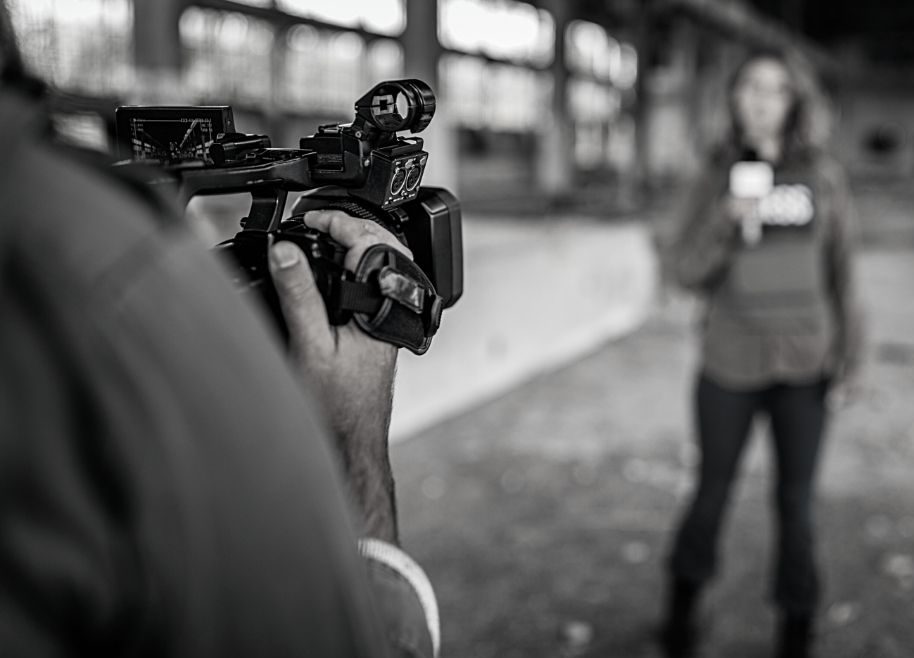


‘Being a spectator of calamities taking place in another country is a quintessential modern experience, the cumulative offering by more than a century and a half’s worth of those professional, specialised tourists known as journalists.’
——Susan Sontag, Regarding the Pain of Others
In the aftermath of the Nepal earthquake in 2015, I wrote in my capacity as a journalist—I’m conscious not to use extractive terminology such as ‘reported on’—about the lack of psychologists and psychiatrists the country had to deal with the surge in mental health problems following the disaster. The piece, written for a development website, focused on how foreign NGOs could address the mental toll of the disaster and how the country as a whole could develop a better mental health care system.
I don’t know if other journalists revisit their old stories; I’m now of the belief that we should interrogate our work frequently. But one morning last year, as I sipped coffee on my balcony, I re-read what I had written five years earlier. I was compelled to review this piece because I had been corresponding with a dear friend who had experienced a lengthy transition out of journalism after she confronted the profound racism and inherent violence embedded in the field.
I don’t know if other journalists revisit their old stories; I’m now of the belief that we should interrogate our work frequently.
As I re-read my work I cringed. The piece—and the quotes I chose to narrate it—implied that Nepal did not yet have all the healing structures that exist in the West and thus needed Western specialists and medicine to be brought into the country. I completely ignored the existing local and traditional healing structures, including methods that have existed for centuries, far longer than modern drugs for anxiety or depression, or job descriptions such as ‘psychologist’ and ‘psychiatrist’. Aside from the fact I was writing for a European-based development site (I hadn’t considered at the time that Nepalis do actually read articles written on Nepal), the hard truth is that I had written about Nepal as a place of lack. I was narrating the country as if it hadn’t caught up to the West yet, as if the West is the centre of the world, the universe.
Why do we do this? Why do so many Western correspondents describe Afghanistan as archaic, or describe India as preternatural? Why is that Mexicans are depicted as drug traffickers, criminals and rapists who are desperate to migrate to the US, as if no other identity exists in the country? Thinking about my own place in this structure, I have had to confront and interrogate my beliefs and start dismantling them from within. For me, it has—and continues to be—a deeply personal process that I liken to the process of deconditioning. It involves a lot of reading, listening and writing. I don’t see that there’s an end point to this process, but the beautiful thing is that for every belief that is confronted and broken down there is an awakening, a realisation, that makes space for the truth.
A lot of the narratives that we read in Western media today by foreign correspondents are constructed long before a journalist ever arrives.
In journalism, too often imperialistic and hierarchal worldviews dictate what stories are told—and how. Patronising white saviour narratives, development stories that posit that all countries should hope to end up like the West and narratives that other their subjects all stem from this superiority complex. Journalists claim to be objective, but objectivity is a myth. This lack of self-awareness only enables misinformation, marginalisation and violence. One of the last journalistic pieces I wrote was a piece from Afghanistan. It had nothing to do with the Taliban, yet my editor insisted that I add a few lines in. I wondered, is a story from Afghanistan really a story if it doesn’t mention the war and the Taliban? I fought back—which was, at the time, rare for me, as freelancers are conditioned to not push back too heavily for fear of not being hired again—and the piece was published without such reference.
A lot of the narratives that we read in Western media today by foreign correspondents are constructed long before a journalist ever arrives. Even the best-intentioned of us will come with predetermined questions and predetermined outcomes. I am absolutely guilty of this. But I’ve come to understand that by approaching a story this way we miss the real story, we miss what is going on right in front of us. The deep nuances and intricacies of the places and subjects we narrate are lost. If we work to dismantle our preconceived notions, prioritising local perspectives and ideas over what we believe to be true, then our questions and thus our stories will inevitably change.
In journalism, too often imperialistic and hierarchal worldviews dictate what stories are told—and how.
Journalists need to shift the centre of our stories to the very place that we are writing from and to the people we are writing about. Parachute journalism should be shunned in favour of slower reportage. Foreign journalists should collaborate with local journalists and give them due credit. After all, they know more than we ever could. Journalism prizes often lionise the blow-in with the byline while the local journalists who made the story possible are ignored, or worse yet, like we have recently witnessed in Myanmar, put in danger.
Integral to all this, I believe, is changing the language we work in. In her essay collection, Encyclopedia of Trouble and Spaciousness, Rebecca Solnit details how the mass media, in the face of disaster, misrepresents reality in ways that often abet and justify a second wave of disaster.
Following the 2010 Haitian earthquake, the Los Angeles Times ran a photo series with captions that repeatedly used the word ‘looting’. One such caption read, ‘A Haitian police officer ties up a suspected looter who was carrying a bag of evaporated milk’.
Solnit asks: Is the man with the powdered milk really a criminal? For all we know, he could have been taking that milk to starving babies trapped in rubble. What would you do if your city was ruined by disaster and what cash you had was now long gone and your child is on the brink of starvation?
Solnit argues for the banishment of the word ‘looting’ and to replace it with ‘emergency requisitioning’: ‘Someone who could be you, someone in [these] kind of desperate circumstances … takes necessary supplies to sustain human life in the absence of any alternative.’ It’s a small yet profound example of the power of language.
If we prioritise local perspectives and ideas over what we believe to be true, then our questions and thus our stories will inevitably change.
These issues are not just limited to coverage of foreign affairs. Growing up as a white person in Australia—a country that is to a certain degree still hung up on the dystopic idea of a White Australia—it would be nearly impossible not internalise some of the deep-rooted beliefs that underpin our racist and colonial society. After all, we don’t need to look far to see how media provokes and promotes racism, nor do we need to look far to see that systems of policing and corrections continue to disproportionately harm Aboriginal and Torres Strait Islander peoples.
By resisting exclusionary frameworks of journalistic practice, I’m opening myself up to new ways of writing that I hope are truer and more expansive, and mitigate harm. Earlier this year my book Renewal: Five Paths to a Fairer Australia was published by Text Publishing. In it, I was able to interrogate, in the face of the COVID-19 pandemic, the principles and values that underpin our society and offer new ways forward. One of the greatest joys of writing such a book was that I no longer needed to promulgate the myth of objectivity. I was able to argue for what I believe in: a post-capitalist, post-neoliberal deliberative democratic society; a universal basic income; tough action on climate change; and justice and treaty for First Nations people in this country.
By resisting exclusionary frameworks of journalistic practice, I’m opening myself up to new ways of writing that I hope are truer and more expansive.
However, individual writers like me opting out of journalism into other forms of writing isn’t enough, and nor is it the answer. The industry, as a whole, needs an upheaval so that it is fairer and more representative. Before I left Australia a decade ago, I spent a few years in the newsrooms of the Sydney Morning Herald, Nine and Ten. It would be a stretch to say that I could count on one hand the number of people who were non-white and not from a private school in such newsrooms. It was something that I was acutely aware of at the time because it made me question whether I actually deserved such jobs or whether I was ‘chosen’ because my education and postcode, the direct result of my immense privilege. I doubt much has changed in the decade since. As Osman Faruqi asked in Meanjin in 2016, ‘Why do our news journalists so rarely reflect the population they are reporting on?’
While newsrooms may be slow to change, there are journalists who are already defying the status quo inside and outside the realm of mainstream media—telling stories from and about their own communities. Amy McQuire is one such phenomenal journalist: A Darumbal/South Sea Islander writer, McQuire reports across multiple platforms, from a regular Substack newsletter to publications as big as the New York Times. Her work on the COVID-19 pandemic has been a standout. It is reporting like this, as well as community-first outlets like Liminal magazine and IndigenousX, that powerfully challenges racist preconceived narratives, offering important insights and news developments that can be lost in hegemonic mainstream media.
I still believe in the power of journalism as a tool for good. Words and images are power. What could make journalism more just is if the industry structures stopped imposing a particular way of being on the world, so we are no longer producing, reading and regurgitating narratives that are formulaic and lack imagination at best, and deceptive and destructive at worst. As Solnit concludes in her essay, ‘In Haiti, Words Can Kill’, ‘we live and die by words and ideas, and it matters desperately that we get them right.’
Renewal is available now from your local independent bookseller.