I quit my smartphone and became attuned to a ‘wood-wide web’ under threat.



After driving across the country in an old bus, my partner and I found a room in someone’s North Balwyn investment property. The valley grassy forest that once thrived in this area had been reduced to a remnant known as Koonung Creek Reserve. To its south, the streets are lined with the deep-rooted leafy green of post-war suburbia. From there, we could hear the constant groan and growl of the Eastern Freeway at the northern edge. In the chaos of relocation, the nature trails became my lifelines.
When we arrived, peak mushroom season had come to an end. The fungal fruiting bodies had disappeared, but I didn’t yet know to miss them. When long stems with bulbous caps began growing in every patch of unpaved earth, basking in the crisp sunshine of Melbourne’s May, my attention was drawn to the life that’s always been there, beneath my feet.
Mycelium is the long, branching root-like structure of fungi. Its tiny threads seek nutrients needed for the fungal reproductive organ—the mushroom—to penetrate the surface of the soil and release its spores. They also wrap around and bore into the roots of trees, which feed carbon to the fungus in the form of sugar produced by photosynthesis. In return, the mycelium not only provides trees and other plants with nitrogen, phosphorus and other essential minerals, but its network structure also enables trees to transfer water, nutrients and electrochemical messages to kin and cousins alike. This relationship, known as the mycorrhizal network, or the ‘wood-wide web’, is the foundation of a diverse and healthy ecosystem. Flora and fungi work together in mutually beneficial ways, following the same unspoken mantra for five hundred million years: If you thrive, then I thrive. But Homo sapiens is struggling to get the message. I, too, had been distracted.
The fungal fruiting bodies had disappeared, but I didn’t yet know to miss them.
I’m sure the more recent models are even more addictive, but I couldn’t stop picking up my barely functioning second-hand iPhone 7. Long after the social apps and all their superfluous accounts had been permanently deleted, one of the default apps (which can’t be removed from Apple devices) began to emerge as the main drain on my time and attention. When the Health app informed me that I had been walking a lot more lately, I felt good about myself—like I had some sense of agency and control. I religiously took my iPhone on every walk at Koonung Creek, ravenously consuming information in podcast form via noise-cancelling headphones and tapping nonsense into the Notes app while the Health app quietly counted my steps in the background. I began to collect and analyse this data, making sure I kept my average daily steps above ten thousand, always adjusting my priorities to make the weekly and monthly average higher than the last. The app had facilitated a dependence on data that severed my mind from my body and left me disconnected from the ground beneath my feet. My mental health walk had become a mental illness walk.
The global tide of neoliberal capital has put smartphones in our hands, primed us for economic efficiency and disconnected us from our place in the ecosystem. Ever-increasing convenience and endless consumer choice are underpinned by narratives of freedom, but according to the philosopher Byung Chul Han, the smartphone is a tool of domination. This view is echoed by Canadian tech critic Paris Marx, who describes technology as ‘a political tool developed and deployed by particular forces in society to serve their interests’. One of these interests, according to Marx, is to make it increasingly difficult to challenge the oppressive power of capital in the future.
Apple’s first official iPhone ad from 2007 is a compilation of movie scenes of people answering the phone. The ad moves forward through cinematic time in a linear, inevitable march of progress until the sleek-for-its-time original iPhone appears alone in the middle of the black screen. Look closely and you’ll see that Johnny Appleseed is calling from beyond the grave—you better pick up! He’s calling to let you know that his life’s work as a proliferator of apple trees throughout the American frontier is now being continued in some meaningful, metaphoric way by the kind and generous folks in Silicon Valley. The final image is Apple’s logo, a ripe symbol of knowledge and immortality, temptation and the fall of humanity.

Jump forward sixteen years—through a myriad of global crises—and all Apple has to say about the iPhone 15 is WOW. What’s disturbing about this recent iPhone ad is that it captures the POV of a smartphone-addicted society: the screen is always in view, information is in constant flow and the jingle (if you can call it that) repeats the most depressingly appropriate lyrics in the history of advertising: drop it down now pick it up.
The global tide of neoliberal capital has put smartphones in our hands, primed us for economic efficiency and disconnected us from our place in the ecosystem.
My smartphone languished in painful obsolescence for at least a year—still draining my time and attention, still disconnecting me from the ground beneath my feet—before I switched it off and shoved it in a drawer. That day, I bought the cheapest and most boring option available. It makes calls, sends T9 texts and wakes me up in the morning. Nothing else.
In response to The Social Network—the 2010 film about Mark Zuckerberg creating Facebook in his musty college dorm room—Zadie Smith wrote an essay titled ‘Generation Why?’ She expresses a concern that her ‘idea of personhood might be nostalgic, irrational, incorrect’. As I was freshly free from my failing iPhone 7 when I read Smith’s treatise, I was particularly sensitive to the relationship between technological ‘progress’ and the changing concept of personhood. What’s lost in the tech-enabled auto-exploitation of the 21st century is what Han calls ‘constructive negativity’. It’s the boredom, stillness, inconvenience—the friction that slows the mind to a creative pace, enabling the body to be felt and emotions to be processed. The same tension also requires us to connect with our local communities and physical environments.
For two months, I walked along the trails at Koonung Creek without producing a data trail. For two months, I walked in that place and listened to its message. For two months, I felt the presence of my body and responded to its needs. For two months, my thoughts slowed to a discernible pace, and an unhindered creative practice began to find its form. I became fascinated by fungi. Making up twenty-five percent of the earth’s biomass, they are fundamental to life as we know it. Without the mycorrhizal fungi, there would be no plants on land; without fungal decomposers, there would be no space for new life. Even pathogenic fungi—demonised and misunderstood—create the hollows in trees that many birds, bugs and microbats depend on.
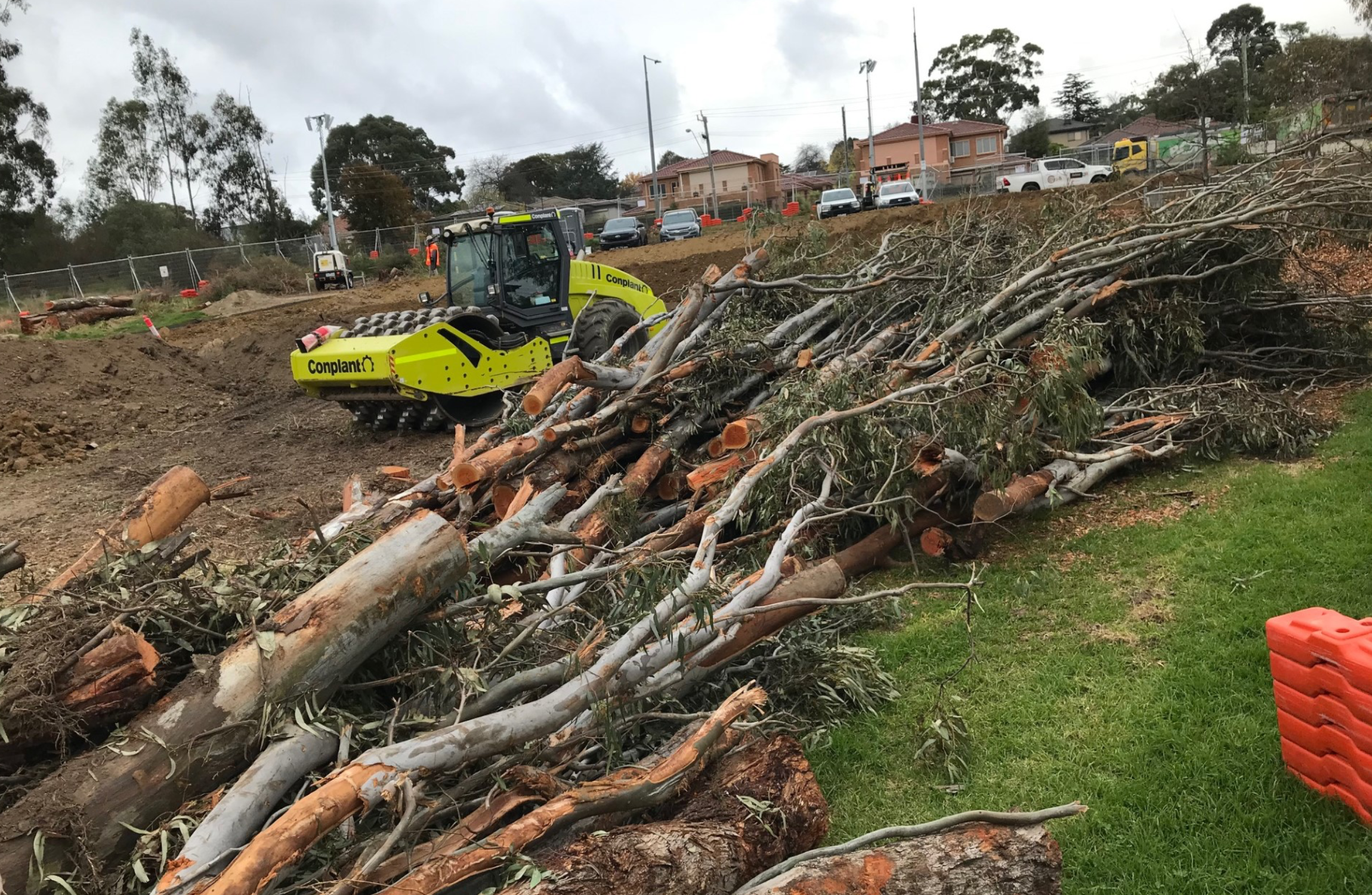
Then one day, I arrived at Koonung Creek Reserve to find a site of sadness, anger and loss. Something horrible was happening at that vital remnant of ancient wetland where forgotten fungal networks support diverse and fragile life.
‘I’m very excited to be part of this project,’ said a man in management attire as I watched machines snap healthy trees with violent efficiency. ‘It’s going to make life so much easier for so many people.’ The government contractor was destroying public green space to make way for the North East Link Project (NELP). Corporations have been automatically granted legal personhood since the 19th century, so perhaps he wasn’t talking about actual human beings. ‘We’re planting three trees for each one we remove, so the park will be even better than before!’
Despite the greenwashing efforts of Major Road Projects Victoria, biodiversity loss (and its far-reaching health and climate change impacts) can’t be reversed by simply ‘replanting’ trees. Not even 30,000 of them. Tellingly, the 2019 Minister’s Report detailing an assessment of the environmental impact is completely void of the following words: Mycelium, Mycorrhizal, Fungi. I emailed the Complaints and Compliance team with this alarming oversight and was provided with two detailed technical reports. They served only to corroborate my concern that the fungal networks being impacted by freeway expansion have been entirely overlooked.
For two months, I walked along the trails at Koonung Creek without producing a data trail.
Disturbances to native landscapes can seriously disrupt the connections plants make with fungi and other microbes in the soil. ‘Depletion […] can in turn limit how well native vegetation can recover from those disturbances,’ according to CSIRO senior research scientist Dr Ben Gooden. Despite years of pushback from local councils and residents, the mega-freeway project has been permitted by the courts to proceed without properly accounting for the loss it is inflicting on this ecosystem. In August 2023, North-East Metro Greens MP Aiv Puglielli asked Environment Minister Ingrid Stitt two questions: ‘Will your department report on the impacts of the loss of biodiversity along this toll road? What assurance can you give that the fragile ecosystem of the Koonung Creek will be protected?’
The minister deflected these questions and said the details could be provided by the Transport Infrastructure minister. I contacted Mr Puglielli, asking whether Stitt had followed through on her commitment to solicit the requested information. His senior advisor replied, saying that no further information had been received, inviting me to draft a more specific question regarding the mycorrhizal network. My question was asked in parliament the following week, but the destruction of my local wetland had significantly and irreparably progressed by the time I received the minister’s reply three weeks later. The response covered the project’s media talking points but failed to provide a meaningful answer.
The North East Link Project is boring a tunnel deep beneath the base of the Yarra River. Most of Koonung Creek Reserve has been sectioned off from the public with temporary fencing covered in signs warning of danger and security guards. Other signs are less overtly threatening, but somehow more sinister: We’re reimagining Koonung Creek Reserve. This place will be a construction site until 2028, when the most expansive (and expensive) stretch of freeway carved into unceded Wurundjeri land is open for business.
‘All life is interconnected,’ writes Peter McCoy in Radical Mycology, ‘this is the primary lesson that fungi teach […] every act carries an immeasurable chain of effects’. While habitat loss from urbanisation, road building and wetland draining, and forest clearing for agriculture and mining put fungi at risk of extinction on both local and worldwide scales, governments and corporations persistently downplay the ecological cost of putting more earth under asphalt. In fact, the kingdom of fungi is not explicitly mentioned in the Environmental Protection and Biodiversity Conservation Act 1999—Australia’s federal environmental legislation. Given the vital roles these diverse and fascinating lifeforms play in maintaining the delicate balance of terrestrial life, forcing those in power to take fungi seriously is an urgent matter of existential personhood.
Thirteen months after arriving in North Balwyn, my partner and I uprooted again and moved into an apartment on one of the most built-up and busy roads in Richmond. Viewing life through the mycelial lens, I’ve resisted the greater haste of my new surroundings, and the friction I’ve encountered through living without a smartphone has helped to safeguard my pace. With some slowness reclaimed, local human (and non-human) connections have begun to form.
On my first no-smartphone anniversary, I read ‘Black Swamp Ohio, Spring 1838’. This first part of Tracy Chevalier’s novel At the Edge of the Orchard is the story of a family’s disintegration as they desperately struggle against the marshland and oak forest to grow apple trees, as required by frontier law. Johnny Appleseed’s presence in this narrative brought that first iPhone ad into my mind as I read, reinforcing my understanding that settler-colonial life is at odds with the more-than-human places it absorbs—from its harsh wagon-stuck-in-the-mud origins to the tech-enabled hyper-convenience of the mega-freeway present.