Human creativity sets itself apart from AI slop in this playful comic-essay hybrid on artmaking—a runner-up of the KYD Creative Non-Fiction Prize 2025.


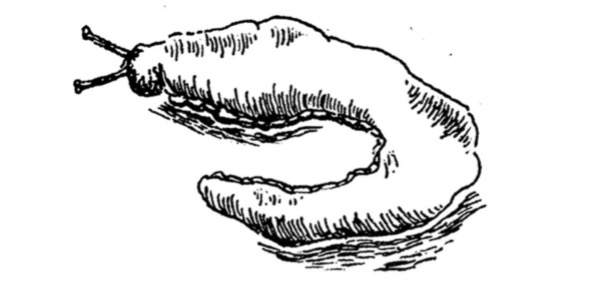
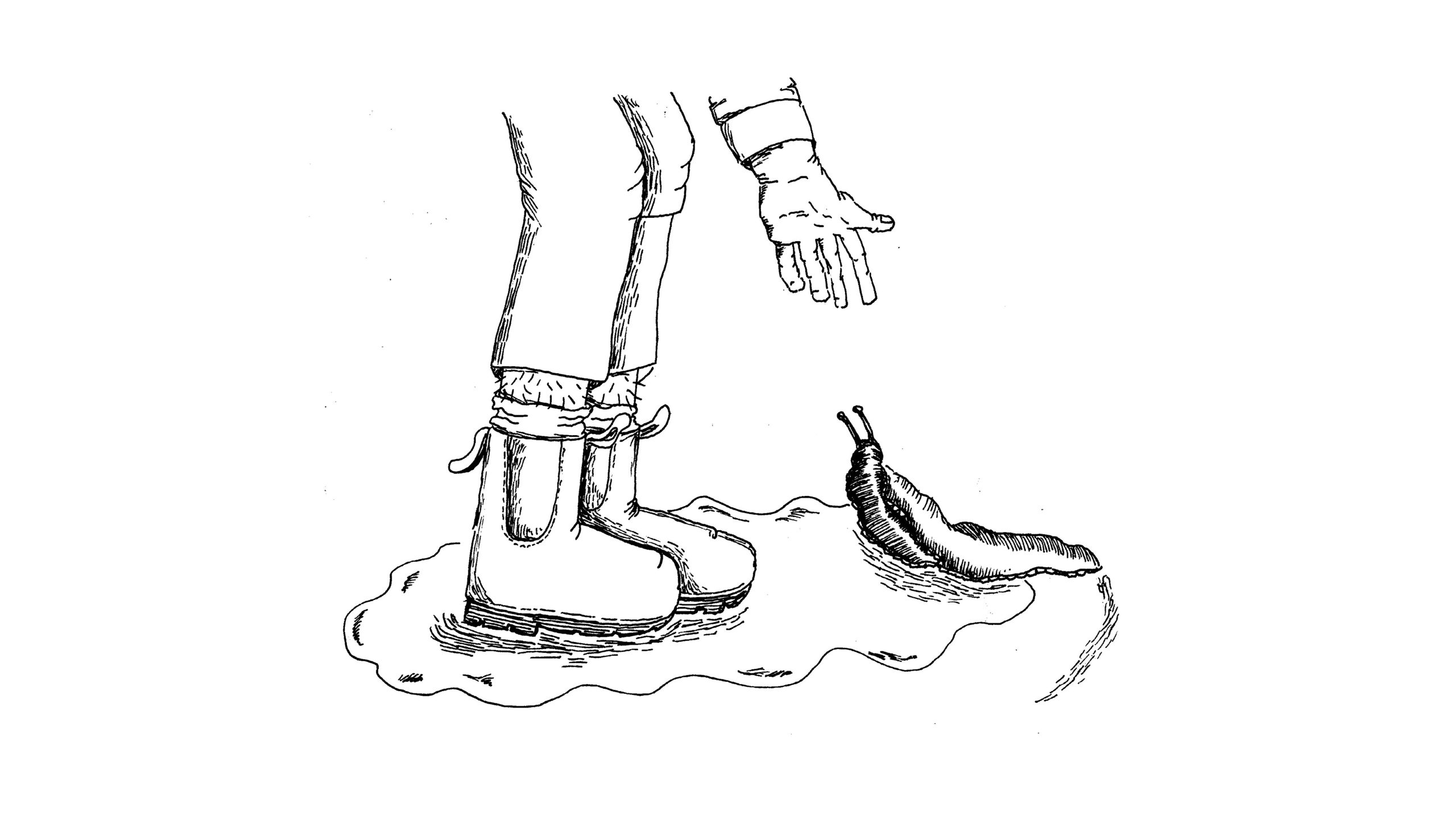
Ikeep thinking about slugs. Oozing and sticky, they are inciters of full-bodied disgust as they squish between our toes, weaving silver trails in and around the garden path. I’ve been imagining myself as one, a slug on the carpet of my lounge room, trying to make my way through. And then also imagining myself as I am now, human, standing by the slug’s side, broom in hand, gently shepherding it across the floor to where it is trying to get to. There is something very gentle and caring in the figure who is helping this creature on their path, and the phrase ‘be kind to yourself’ now means to me: Be kind to your inner slug who is doing their best to carve their way forward and could really do with a gentle nudge in the right direction.
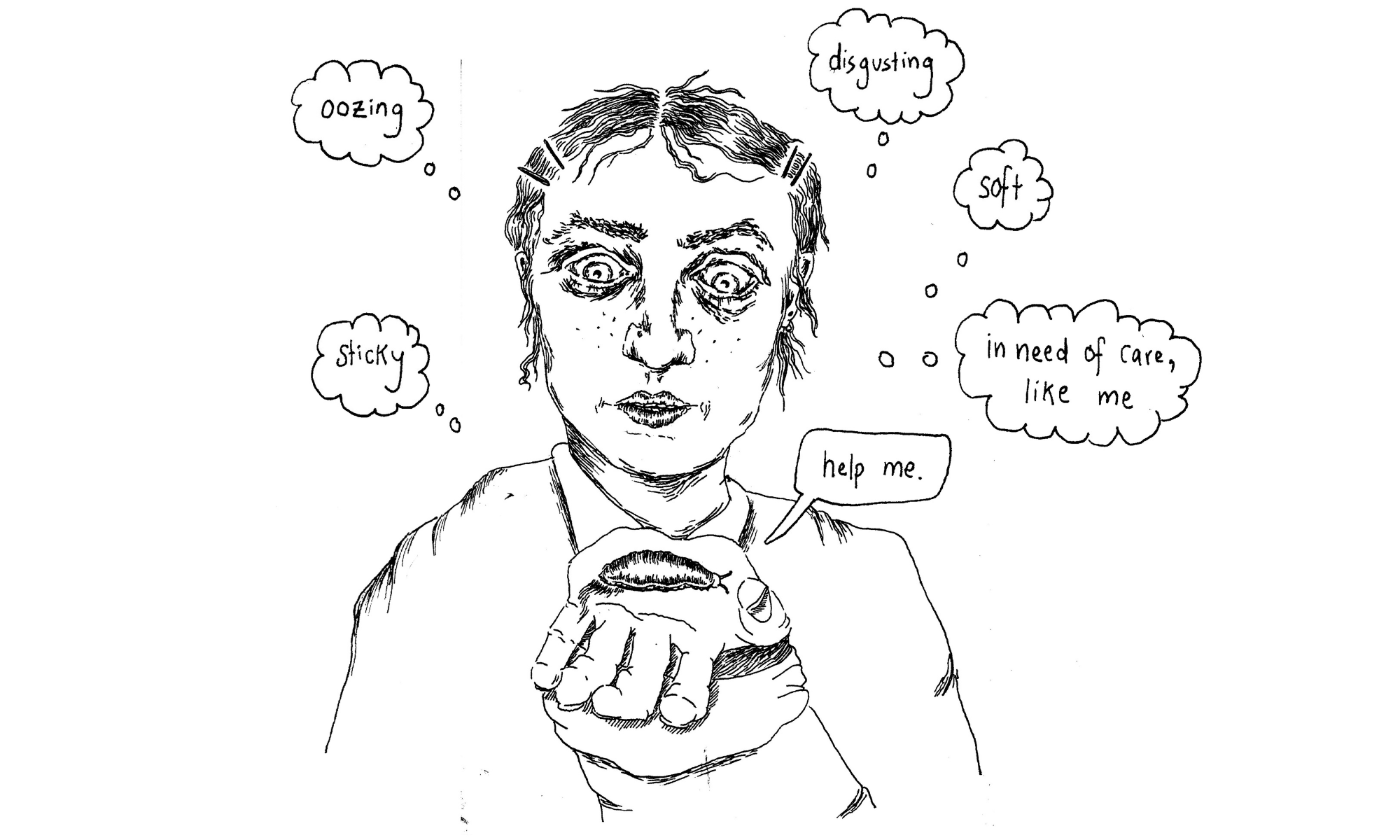
Despite this orientation towards care, imagining myself as a slug feels repulsive. Slugs have fleshy bodies; they weep mucus. But there is something in them that speaks to me. My work has repeatedly returned to the body. Primarily, this involves rendering myself in the most abject form possible: I want to see body hair, eye bags, tiny lines of fat. I want to be disgusting, but I want to control the limits of this disgust, and the direction it takes, through the lines I draw.
Slugs have fleshy bodies; they weep mucus. But there is something in them that speaks to me.
Slugs, too, have yucky bodies. And slugs, like me, are soft. They are in need of care if they are to stay safe as they slime their way across a footpath. And slugs are sticky; mine keeps picking up new things from the carpet to be interested in, which cling to the tacky underbelly of its slug body. How might I think about this stickiness? Perhaps with Sara Ahmed’s concept of ‘sticky affect’.
In The Promise of Happiness (2010), Ahmed talks about how objects become sticky as good and bad feelings accumulate around them. She notes how objects ‘become saturated […] as sites of personal and social tension’. These feelings can be shared and reacted to as the object (which can be as everyday as a table or as contested as a national flag) comes into contact with other things or beings. In this process, the objects shift, taking on new meaning. Thus, Ahmed explains, happy objects can become unhappy over time. However, what was once associated with an object ‘persists as an impression,’ Ahmed writes, ‘available as memory’. In this conception, artefacts become capable of producing change and holding histories that can be passed and shared among others. Like the slug, oozing, Ahmed’s objects leave a trail in the world.
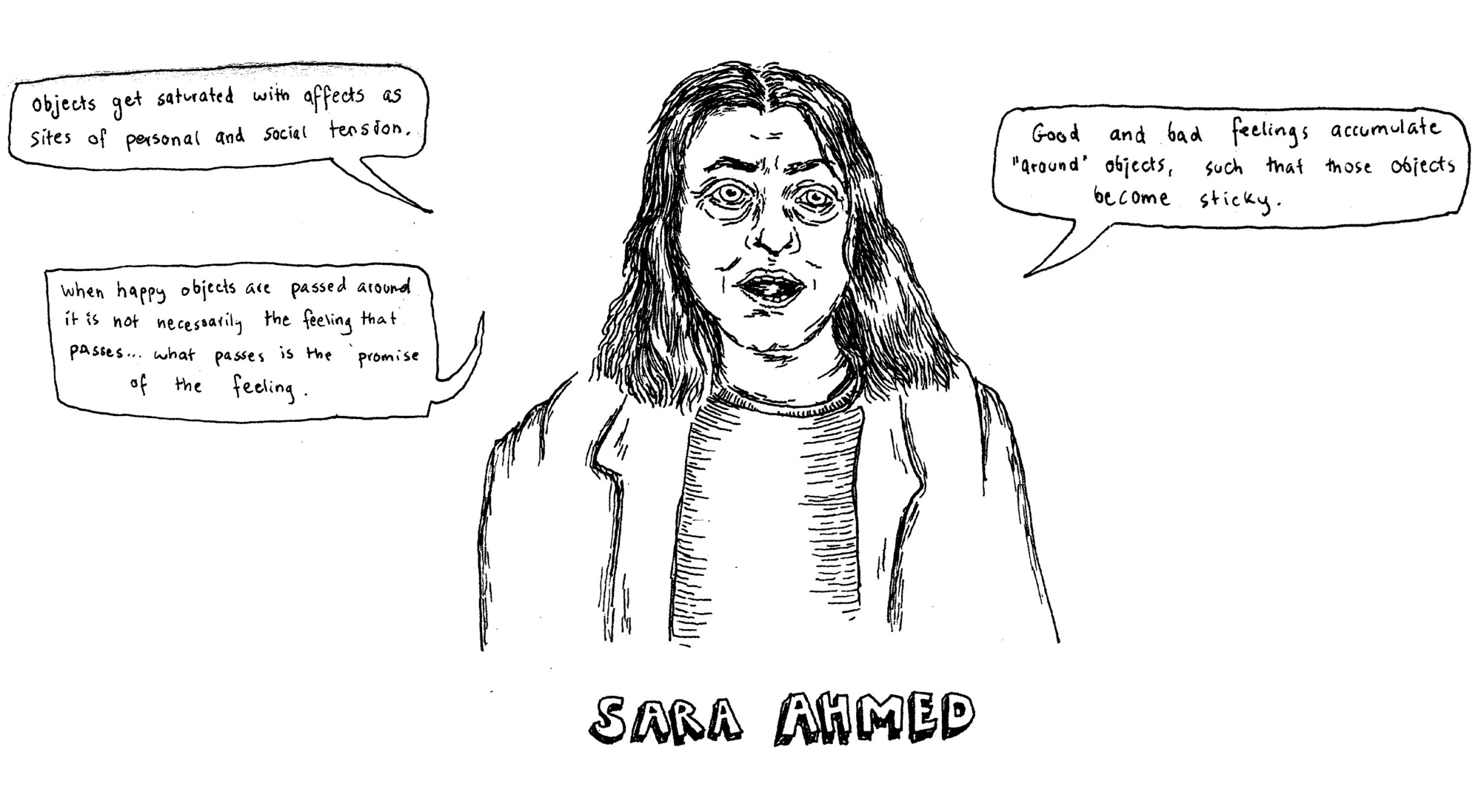
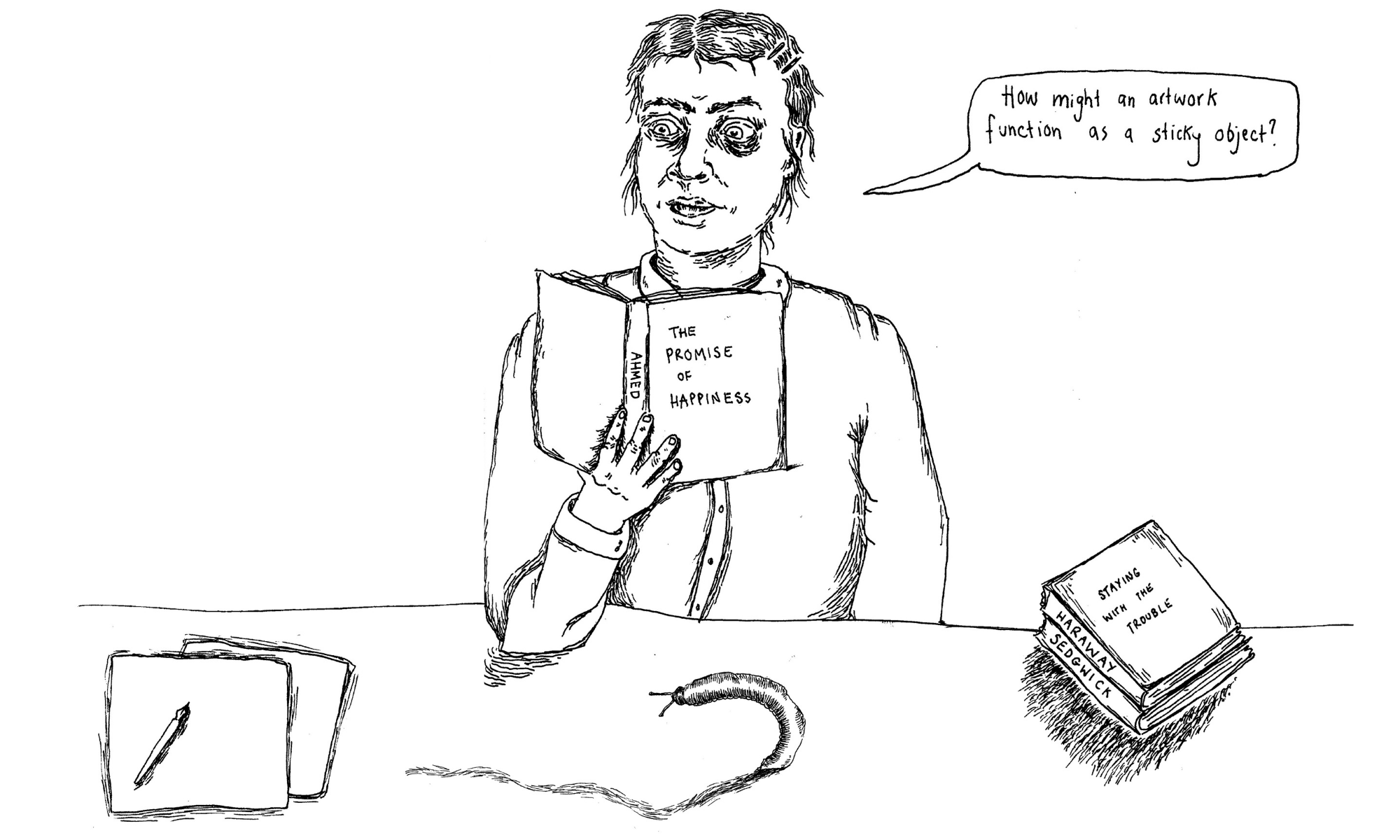
To me, this raises the question: How might an artwork function as a sticky object? Artworks are objects of a kind, whether a sculpture or a scrap of paper, and are circulated too, whether in galleries, among friends, in the pages of comic books. Artworks are also associated with feeling, or as Ahmed articulates, ‘the promise of the feeling’, allowing them to move from the artist to the viewer via the medium of their work. Ahmed writes that these impressions are not simply shared; rather, the artist might express something about their emotions, their experiences, their body as it interacts with the page, clay, paint. The viewer likewise brings their body, their experiences, their emotions to the work. Together in this mix, something occurs that I don’t yet have the words for.
Take, as an example, the most recent artwork that has moved me: an eight-page, risograph-printed, hand-stapled comic. It was passed to me in a room of strangers while we listened to the artist talk in front of us. The comic was illustrated with childlike simplicity, the marks of what I imagined to be a 6B pencil showing through the soft edges of the drawings. The story, however, was disturbing: an account of childhood abuse. The contrasts between the discomfort created by the narrative, the kiddy images used to tell it and the luminosity of the artist in front of us were entrancing. The comic created a ripple as it moved throughout the crowd; there were gasps and small sighs and whispered conversations as we each encountered it. Had the book become sticky? Holding it in my hands, did I feel the emotions of each person who had turned the pages before me? What about the emotions of the artist, etched into the paper through the mark of their pens on an original? Even through the distortion of the print, with its ink smudged, the emotional presence of everyone in that room felt palpable to me as I turned the comic’s pages. A sense of reverence had been created around the book, the artist and the crowd’s faces as we turned between them.
Become a KYD Member
Unlock writing and publishing resources, discounts on writing courses and editorial services, plus exclusive workshops and events.
The stickiness of art objects extends to works encountered in the gallery space, too. Walking through the Met in New York the week before I held that comic in my hands, I was feeling angry and disaffected; the gallery had failed to give me the emotional experience I was yearning for. Turning a corner in search of a Rembrandt self-portrait, I found myself in a room of recent acquisitions: Chicano lino prints, woodblocks and etchings. Face-to-face with the linocut Soledad (1948) by Leopoldo Méndez, I burst into ferocious tears. It was, and I don’t have any more eloquent way to express this, so beautiful.
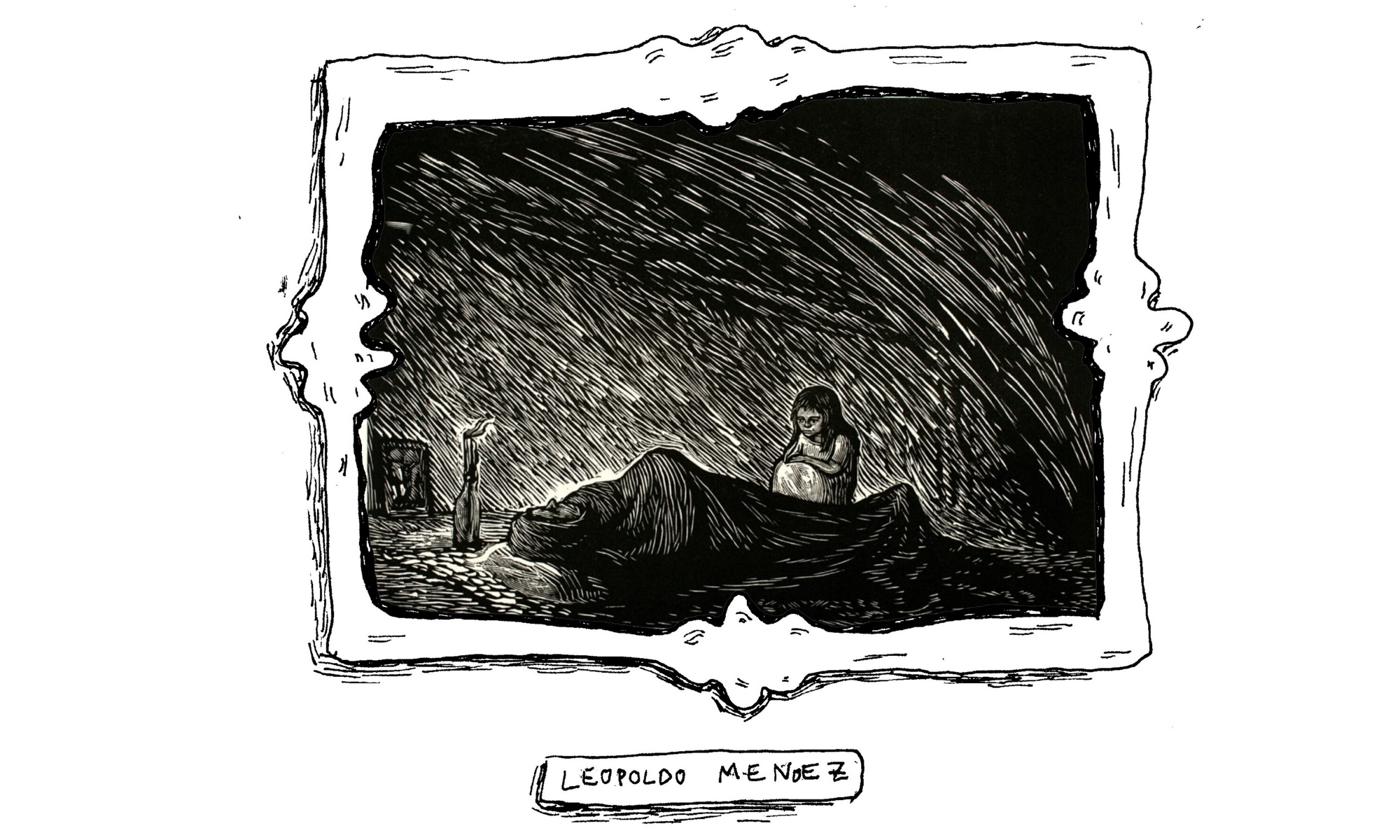
The print depicts a person lying shrouded and cadaver-like on the floor, while a small child sits hunched by their feet. The child watches with eyes wide, their expression solemn, hands clasped protectively around their legs. The scene is lit by a single candle, with its glow depicted in repeated gestural cuts upon the walls and ceiling of the room that contains them. Again, like with the risograph comic book, the artist is somewhat at a remove from the work. Méndez carved a lino block, and that block was then inked and printed upon the paper, leaving only an impression of the artist’s hand upon the page. But still I felt it in each jagged mark; so strongly, in fact, that I cried on the gallery floor. Not the discreet cries of a person moved by the beauty of a print either; this was ugly crying, my body reacting intensely and almost obscenely in response to the artwork. Was this sticky affect in action? Emotion passed from artist to block to paper, and then shared back to me? The feelings I sensed accumulated around Soledad were pain, sadness, hopeful watching; each carving a little gouge that etched a feeling into me.
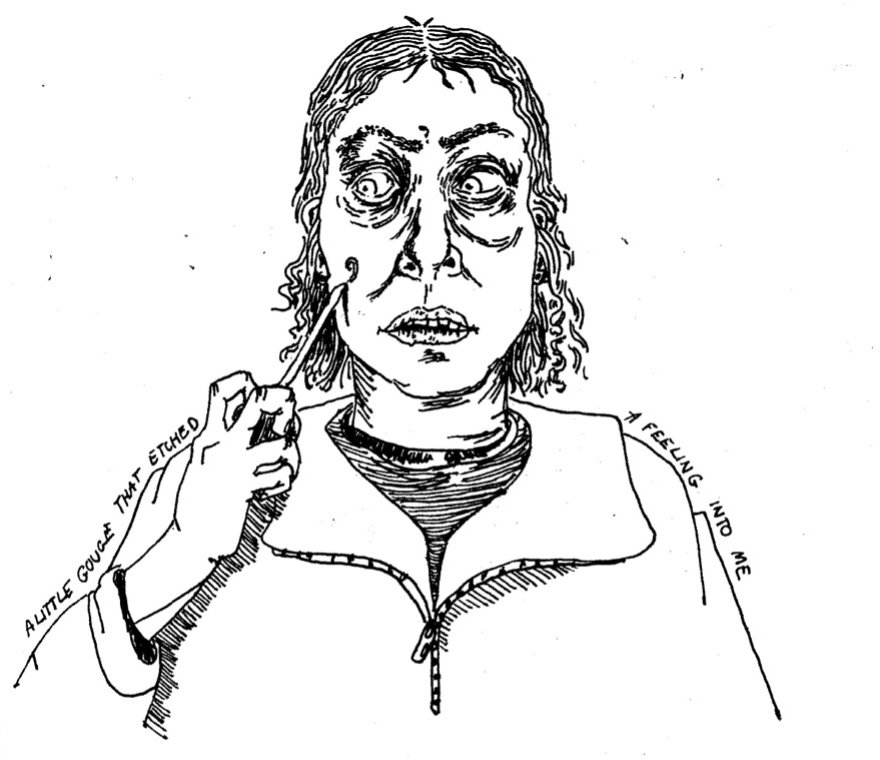
What to do with what we pick up from the artworks we encounter? Ahmed suggests we transmute: ‘We are moved by things. In being moved, we make things.’ The relationship between people, objects, affect and art might then be cyclical and repeating: I am moved by an object; through being moved, I create; in the act of creation, I can move someone else or even move me again in turn. I experienced this viscerally after holding that risograph comic book.
What to do with what we pick up from the artworks we encounter? Ahmed suggests we transmute.
I picked up my pen and tried to draw my way around the feeling the zine had given me. Being in this case, a little sparkly, a tentative desire that I might connect with others through the pictures we make. The resultant drawing is small, only half a face and a scattering of stars, but the feeling it evokes in me is strong. If I am to be a slug, then in this moment I am a hopeful one and any stickiness I encounter is generative.
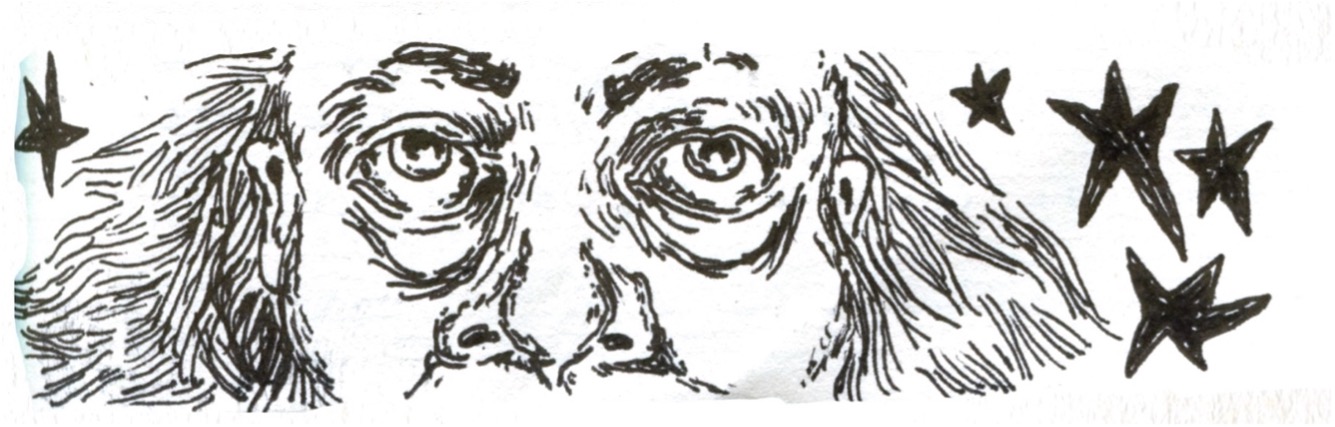
Slugs are easy to track. They leave trails of silver slime in their wake. For Ahmed, emotions too leave marks, or what she terms ‘impressions’ upon the things and beings they encounter. I like to think that the impression left upon an object by its maker might be similar to Walter Benjamin’s concept of the aura, as outlined in his essay ‘The Work of Art in the Age of Its Technological Reproducibility’ (1935). He writes:
What, then, is the aura? A strange tissue of space and time: the unique apparition of a distance, however near it may be. To follow with the eye—while resting on a summer afternoon—a mountain range on the horizon or a branch that casts its shadow on the beholder is to breathe the aura of those mountains, of that branch.
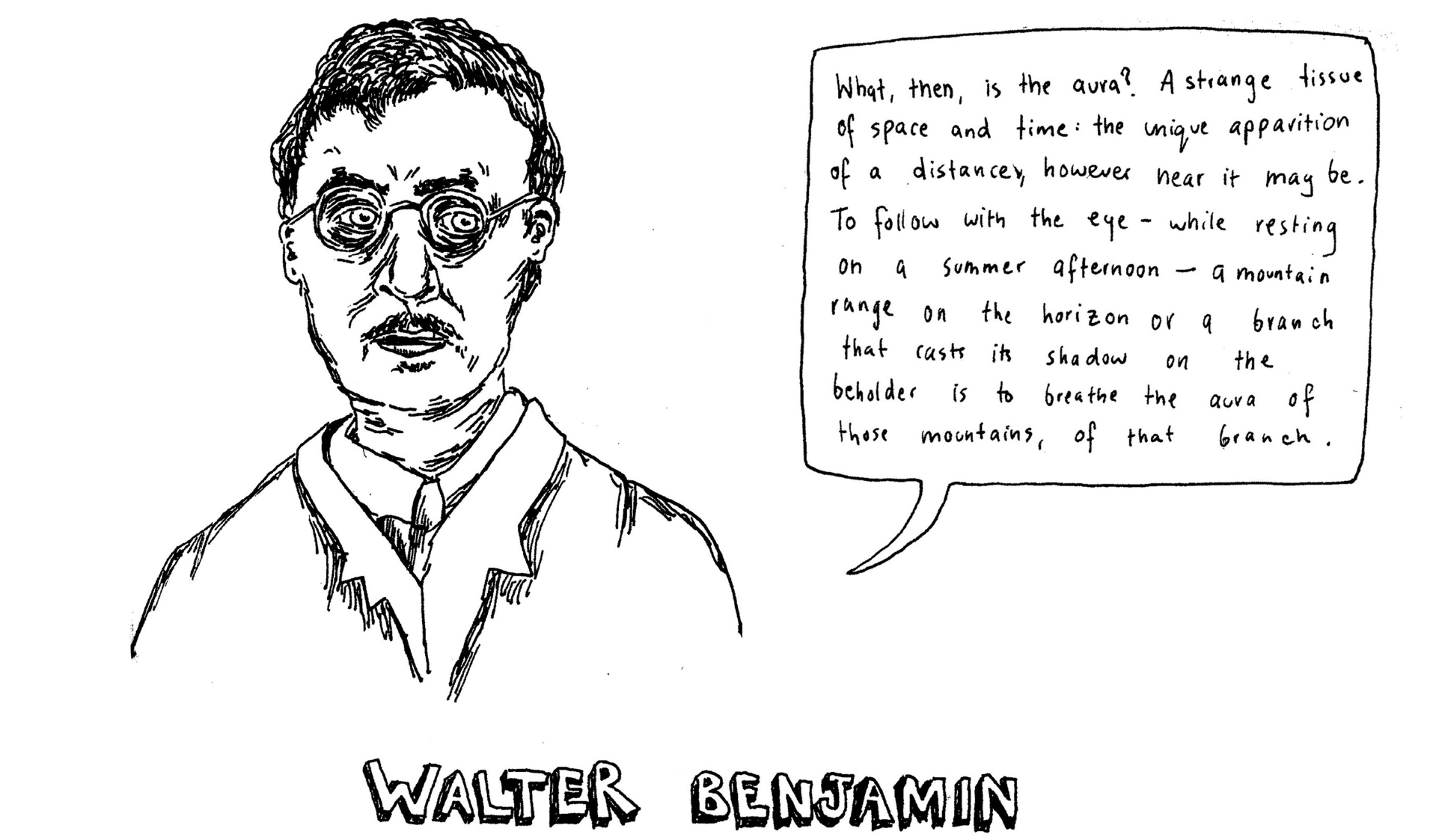
Following Benjamin, an aura then is connected to the eye that sees, and to the present, lived reality of the scene it is beholding. Furthermore, we need to be in direct proximity to what the philosopher terms the ‘here and now’ of an artwork if we are to feel its ‘uniqueness’. Benjamin writes that the aura is in ‘decay’ due to the reproduction or facsimile of artworks by, at the time of his writing, new technologies such as ‘illustrated magazines and newsreels’. Technology has advanced aggressively further since then, and we now have drawing tablets, Apple Pencils, Procreate and, of course, generative AI.
I personally understand—or perhaps feel—the aura to be the presence of the artist’s hands. When I am able to see the wobble of a line, or traces of a hand as it holds a paintbrush, I am thrust into that here and now. The fact that the work was physically touched, manipulated, pressed upon by the hand of the person who made it is what allows me to gain access to the emotional resonance of the work. The shadow my eye beholds is not cast upon a mountainside; it’s the shadow of a hand cast upon a page. If an artwork is to become sticky, and if memories persist as impressions upon it, perhaps the aura provides a way to investigate where these impressions might reside. And taking into account my own conception of the aura, perhaps they accumulate around the mark of the artist’s hand and the eyes that follow these marks.
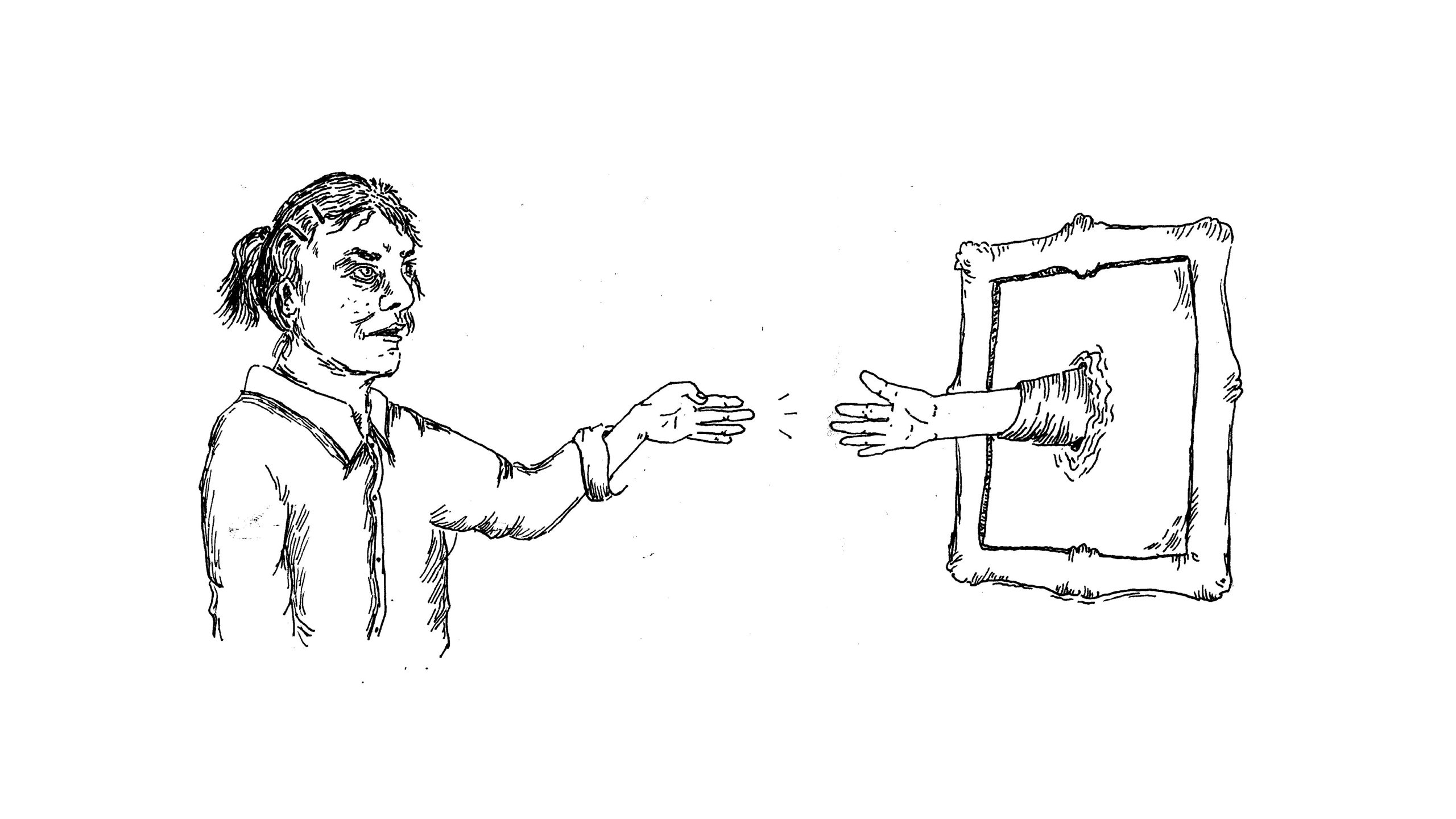
That works are repeated, reproduced, fed into machines and returned to us far from the here and now of their creation is to be expected. Perhaps it is partially because the goal posts are shifting so rapidly that I measure the auratic power of an artwork by how present the artist’s hand is, rather than whether it is a physical work vs a reproduction. Are the lines drawn digitally, by an Apple Pencil? Or are they drawn by no one, the faceless collation AI that spits images out at us? I can feel what I perceive to be an aura in works that are reproduced, such as in the riso prints or linocuts I discussed earlier, or even in digitally printed works, such as comic books and graphic novels, as long as I can feel the hand of the artist, the presence of their body, in the marks they make.
When I am able to see the wobble of a line, or traces of a hand as it holds a paintbrush, I am thrust into that here and now.
Perhaps this is sad—to live in a society so removed from touch, from the sharing of physical artifacts—that I am clutching at the last auratic straws available to me, but I am going to argue here for an expansive definition of the aura. In my understanding, it is felt in the interaction between the body of the artist who made the work and the body of the viewer who beholds it, and this can be transmitted via print, via copy, as long as the mark of the artist is rendered visible. In this conception, a comic printed in a large publishing house, or a linocut made in someone’s kitchen, or an oil painting on a gallery wall, might each equally possess an aura.
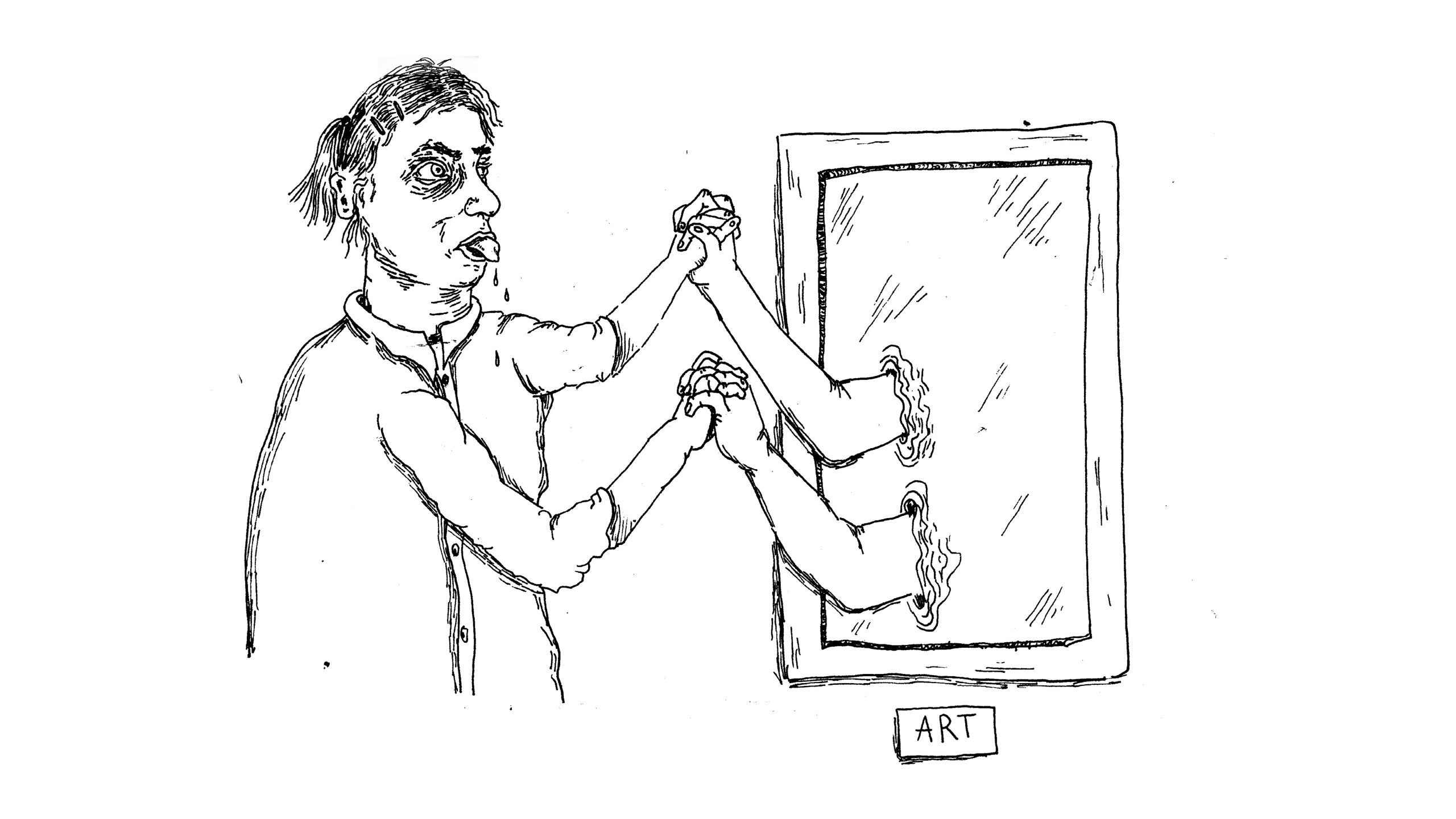
The contrast between the bodily affects that arise when looking at art and the words often used to describe the experience is stark. My experiences are defined most often by crying, gagging, retching: an overflow of bodily excretions that express my inner awe and are far removed from concepts such as ‘beauty’. These are not metaphors; I spent years photographing myself pretending to throw up in galleries in an attempt to express the intensity of this feeling, and the bile that would often come to my throat when faced with a painting I loved.
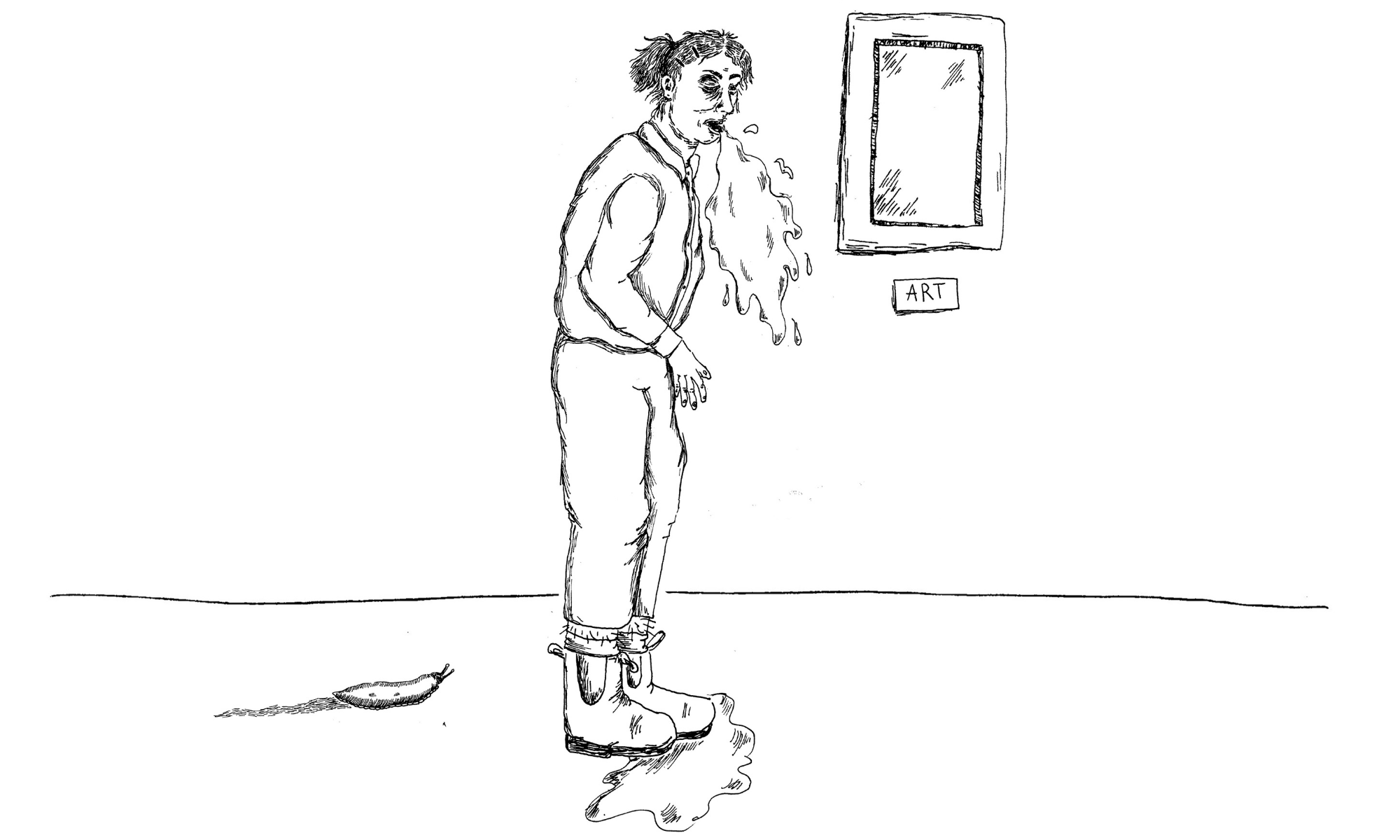
Somehow, and I’m not sure of the words yet to explain this, but somehow when looking at a work of art, or making one, my body is on the line. And isn’t this a little bit slug-like? To be so disgustingly of one’s body? I think my alignment with slugs stems here from the revulsion they inspire. There is something about the lowly, repellent slug that reminds me of myself as I haemorrhage feeling, an overflow of affect, on the gallery floor. What happens when I am rendered so abject by objects so beautiful? What feelings might I open myself up to when in this place of vulnerability?
Roland Barthes provides a framework for how this embodied slug-like feeling might facilitate deeper connections between myself and artworks. In Camera Lucida (1982), Barthes makes an argument for the reciprocal liveliness that passes from an artwork to the person who engages with it. Speaking of a photograph that particularly moves him, Barthes writes, ‘it animates me, and I animate it’. For Barthes, the punctum is the key. Derived from the Latin word to wound or to prick, it is that ‘element which rises from the scene, shoots out of it like an arrow, and pierces’. The punctum serves as Barthes’s entry point into the image: it draws him in, engages him and encourages him to animate the photograph as the punctum is now animating him.
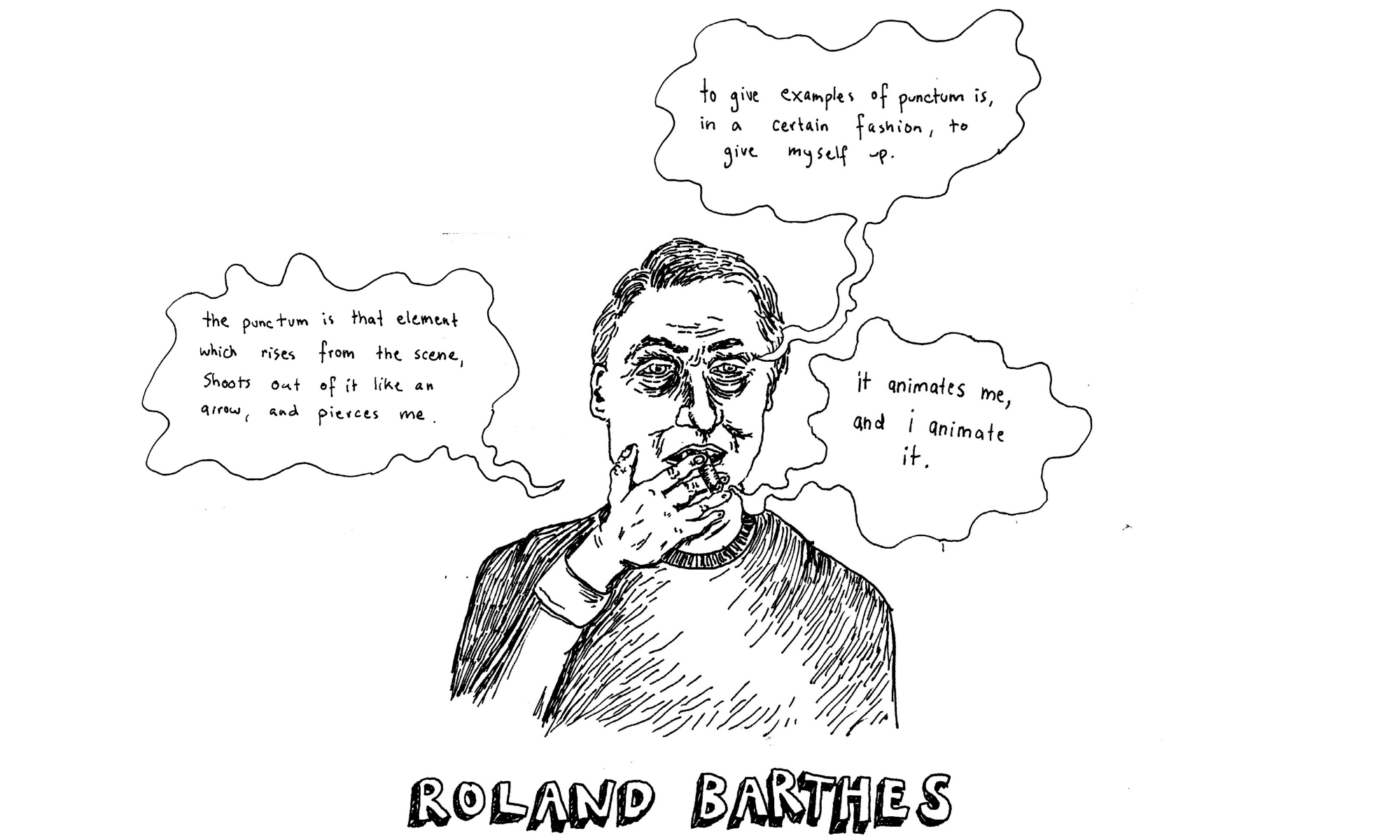
I am going to term this mutual animation, which might act as a precondition for stickiness to occur. For Barthes, the source of this animation is always personal. ‘To give examples of punctum,’ he writes, ‘is, in a certain fashion, to give myself up’. It is not intended by the artist; it is an ‘accident’. Might the punctum pass affect between maker, artwork and viewer? Or perhaps the punctum is the prick through which we allow the affect in? Either way, I’d argue, stickiness is acquired.

A desire for connection and reciprocity post-creation is not something I have seen reflected back at me from capital-A Art institutions, namely my art history degree or the fancy gallery where I now work. I have always had the same complaint of art historians: they so often focus on the facts, the details, the amount of money something costs, the exact type of pigment used. It’s as if they are trying to legitimise themselves. This isn’t about emotion! their writing screams. They forget affect in their search for academic validity. I want to read a book about standing in front of a Rembrandt self-portrait feeling like you are in direct engagement with his hands, his body and mind, connected through the folds of paint that make up the artist’s baggy eye skin and the fingers that put it there. I feel like I’ve fucked Rembrandt is a sentence I have said out loud in front of a 1660s Van Rijn self-portrait more times than I can count. Where is the explanation for affect so strong you feel like you have copulated via canvas on a public gallery floor? Where is the discussion of that stickiness? (Sorry, couldn’t help myself.)
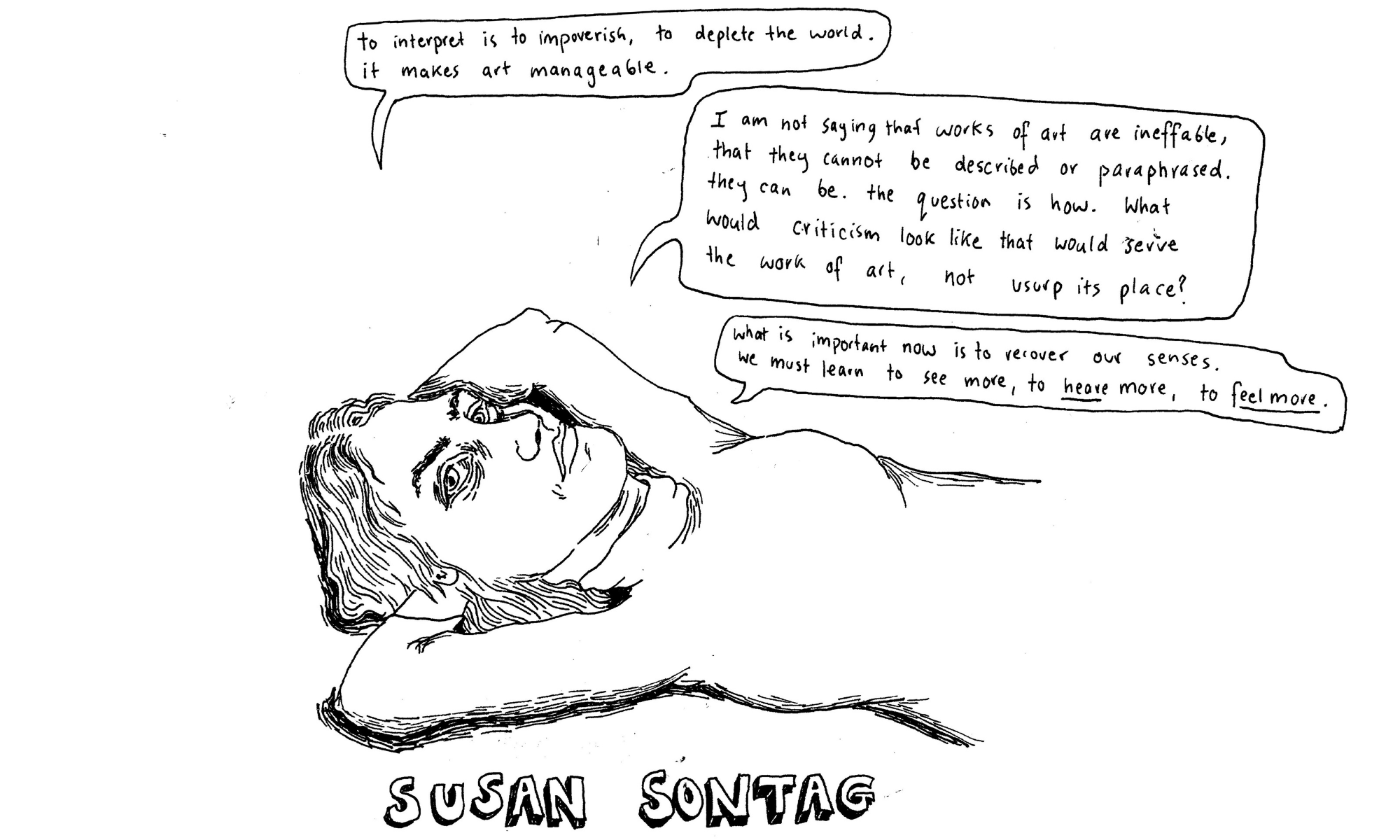
In Against Interpretation (1966), Susan Sontag argues for an erotics rather than a hermeneutics of art. Maybe she too has felt a little strange when surrounded by the portraits of Dutch Old Masters? According to Sontag, it is widely assumed that ‘a work of art is its content,’ or rather, ‘that a work of art by definition says something’. Criticism therefore primarily involves explaining, interpreting and decoding the work in question; what it says and what it means. For Sontag, this is a mistake: ‘to interpret is to impoverish, to deplete the world’. It ‘makes art manageable,’ she writes. Instead, Sontag encourages a form of criticism that serves the work itself. As she explains:
I am not saying that works of art are ineffable, that they cannot be described or paraphrased. They can be. The question is how. What would criticism look like that would serve the work of art, not usurp its place?
This is a compelling question to take up. How can I describe and understand what is happening when I engage with a work of art without trying to interpret it? Sontag explains that we can achieve this by way of feeling. She writes, ‘What is important now is to recover our senses. We must learn to see more, to hear more, to feel more.’
She calls for a vocabulary to facilitate this process, namely ‘a descriptive, rather than a prescriptive, vocabulary—for forms’. I understand this to mean that we need to find new ways and new words to describe artworks and our relationships to them. What might my vocabulary of feeling be? Mutual animation, sticky artworks, punctum, aura, slug theory; here are the terms that help me to think my way through these ideas.
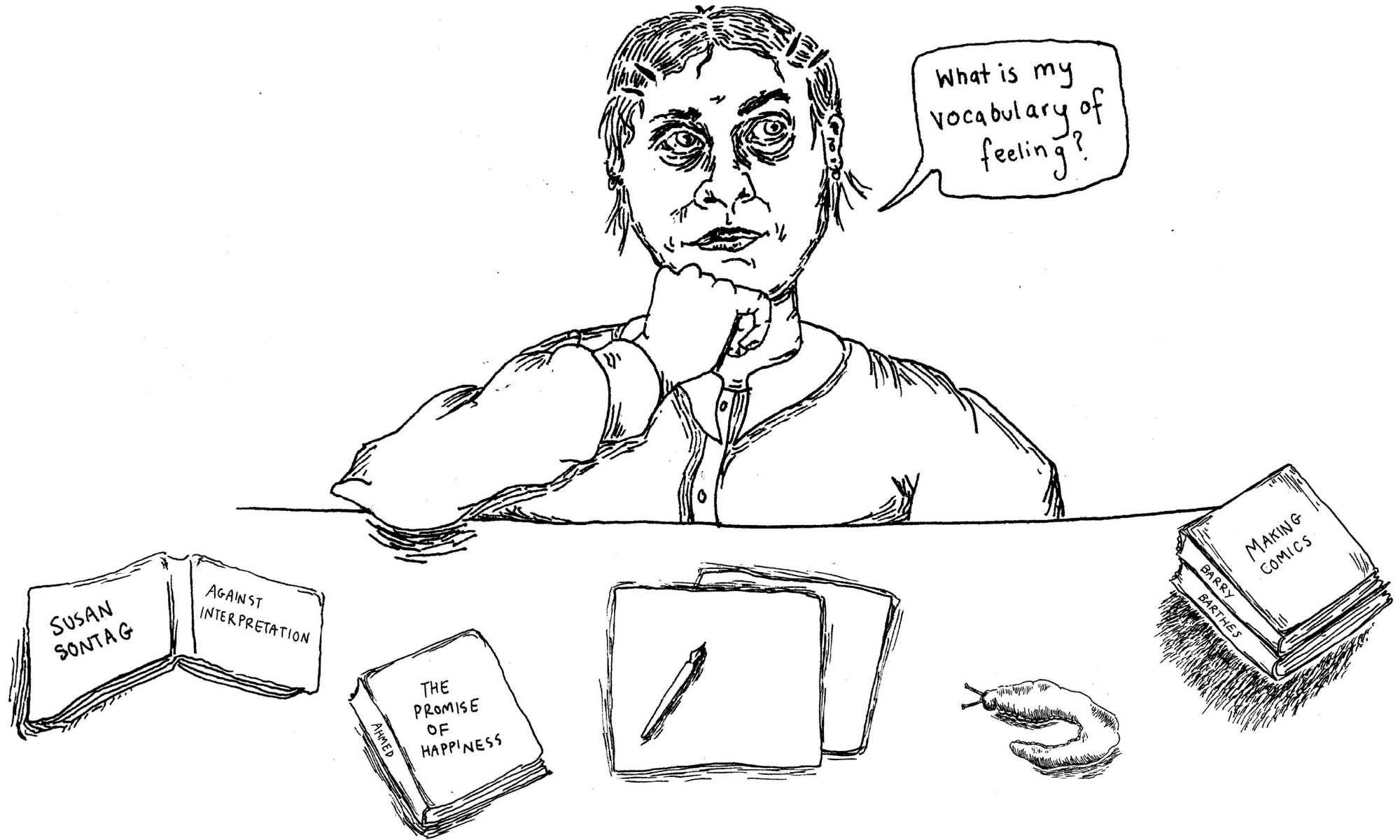
But I need more than new terms; I need a new methodology to think my way around the slug. If, when I look at art, my body is on the line, and if the slug is a symbol of this embodied engagement with another’s work, then I need to prioritise a way of academic thinking that sees the body as central. These ideas imply that drawing is doing something; they take drawing seriously. Rather than privileging language, I have been foregrounding the capacity for drawing to be as expressive and constructive as words. Constructive in the sense that as language impacts the way we think and therefore the way we feel, drawing, likewise, can be a method of thinking. Not merely an expression of thought, but a way of thinking: it creates thought. By this I mean that drawing can not only express how we think about ourselves and our relation to the world but has the capacity to create new thoughts and relationships. I wonder, therefore, how I might deepen this practice. I am thinking here about the way lines connect, and the ability to draw over, to redraw, to draw into and over old drawings. Drawing is not linear in the way that a sentence might be conceived as being. In drawing, lines connect and reconnect and move in many varied directions. Maybe I would think differently if I were a tonal charcoal artist? In this paragraph, I am thinking in ink.
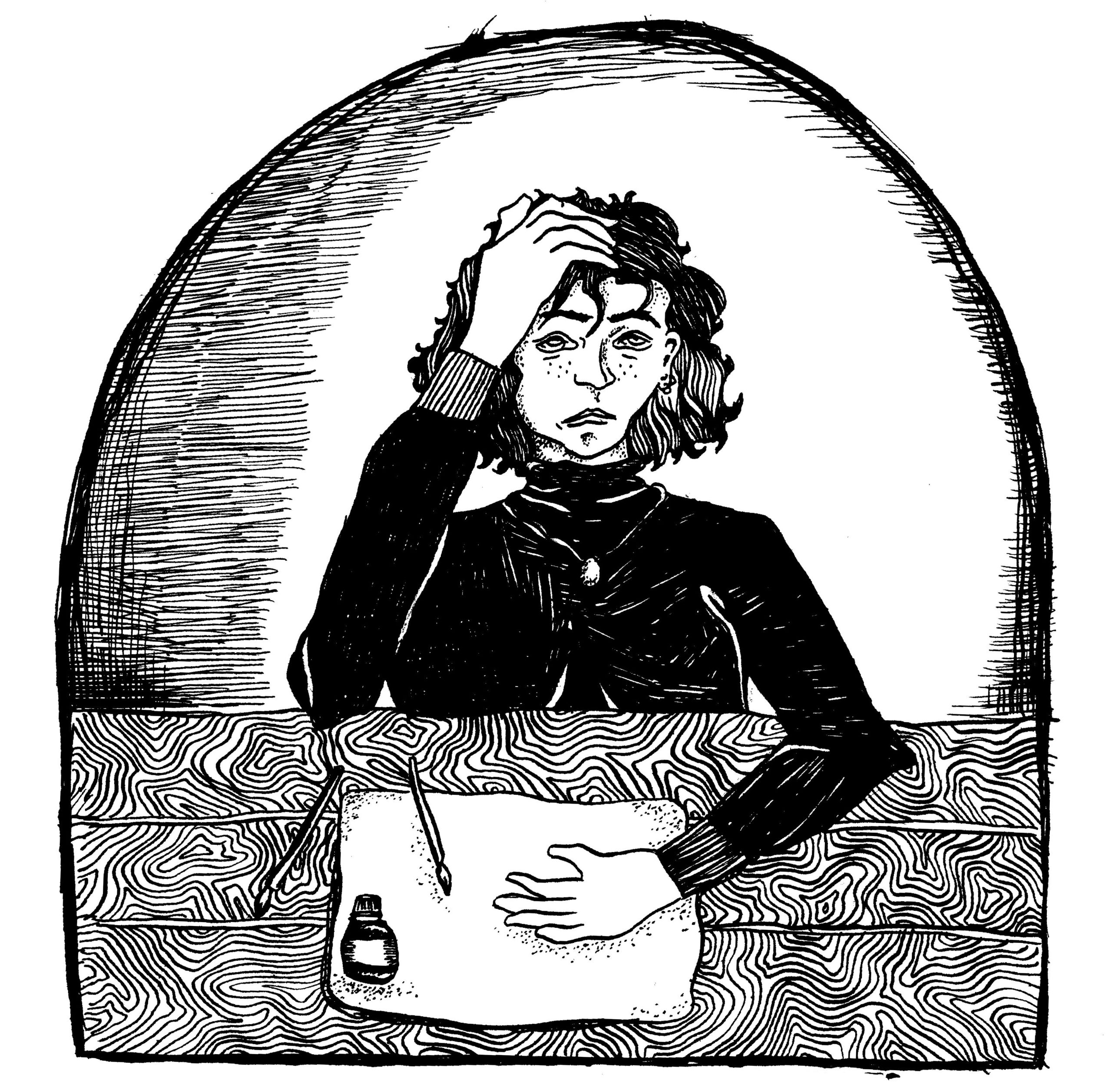
Back to the sticky slowly girl, to the trail of silver issuing from my soft underbelly: at the beginning of this essay I was thinking about sticky affect, about how things are stuck together, about how our feelings get stuck too. But I’m also interested in how feelings can unstick, how they can be shared and passed around, how they can morph. And how drawing might be a way to facilitate this. Making, drawing, sticking, piercing; the body that encounters the artwork, the hand that holds the pen. They are connected, but I’m not entirely sure yet what to do with these connections.
I haven’t progressed that far. I’m still stuck, slug-like, on the living room rug. I’m also hovering nearby, offering gentle encouragement. I haven’t come to any conclusions but instead a set of ideas around which I might orient myself. I am a slug, I am slow, I am sticky, I am stuck; I am hoping, for once, that the ideas will stick.