Don’t miss out—Our EOFY sale is ending soon! Browse discounts on all writing courses. 

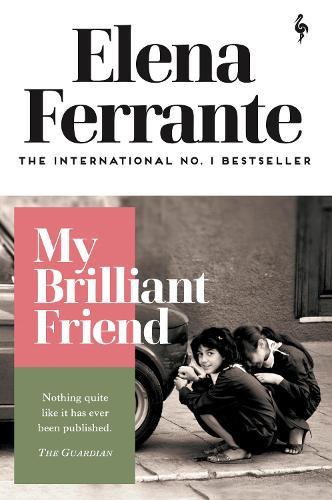
My Brilliant Friend and I

May Ngo

Culture

Reading Ferrante’s novel for the first time, I was amazed at how much a story set in 1950s Naples echoed my own migrant upbringing in 1980s western Sydney. 

two young girls wearing dark coloured school dresses running along a dilapidated street in an Italian village.
A scene from the TV adaptation of My Brilliant Friend. Image: HBO

The first time I read My Brilliant Friend, I was in Cambodia and living in a room in a neighbourhood predominately for factory workers; the blue roofs of the nearby factories could be seen from our street. I remember the heat, the humidity. The whirring of the fan in my room. Next door to me were a trio of nuns from The Little Sisters of Jesus, my reason for moving there in the first place.

The Sisters were part of an order that was predicated, on the one hand, a contemplative life of prayer, and on the other, an engagement with the world. The nuns undertake jobs in factories all over the world as well as other types of low paid manual work, both in solidarity and as a form of witnessing. I had taken a room next to theirs, ostensibly to do my postdoctoral fieldwork research on them and on the possibility of a politics of presence within the context of rapid industrialisation in Cambodia.

On a whim, I downloaded My Brilliant Friend on my iPad and began to read it in my downtime. I had avoided what had been termed as ‘Ferrante fever’ for as long as I could—I usually avoid books recommended by white women that praise ‘female friendship,’ and so was certain that Ferrante’s book would hold nothing for me. Still, I started it. And found that I could not stop.

I was stunned. How could this book, set in 1950s Naples, remind me so much of my own childhood, growing up in a migrant family in the outer western suburbs of Sydney in the 80s?

How did Ferrante’s descriptions of Naples, and of the people who lived in that neighbourhood, ring so true for me, despite coming from a world and a time away?

Our world was like that, full of words that killed: croup, tetanus, typhus, gas, war, lathe, rubble, work, bombard, bomb, tuberculosis, infection.

We lived in a world in which children and adults were often wounded, blood flowed from the wounds, they festered, and sometimes people died.

From its opening pages, the prose (wonderfully translated by Ann Goldstein) evokes vivid but at the same time very precise images of a neighbourhood dominated by poverty, the Camorrists (mafia) and violence. It also evokes the anger that permeates; attacks are countered by further retaliatory attacks; violence is perpetuated by women as well as by men, indeed it is women who ‘were more severely infected than the men,’ because although they ‘appeared to be silent, acquiescent, when they were angry flew into a rage that had no end.’

How did Ferrante’s descriptions of Naples, and of the people who lived in that neighbourhood, ring so true for me, despite coming from a world and a time away?

Violence is suffered not only from outsiders but also from within the family. Lila Cerullo, the titular ‘brilliant friend’ of narrator Elena Greco, is continually physically assaulted by her brother when she refuses to bend to his will over the shoes they are designing, ‘Every time Lila and I met I saw a new bruise,’ and her father throws her out of a window when she demands to be allowed to continue going to school. But Elena recounts this violence not as a sensationalised anomaly, rather it is a component of everyday life in the neighbourhood—the only thing they have always known.

As narrator, Elena gives a brilliant description of what it feels like to live in that neighbourhood:

I felt squeezed in that vise along with the mass of everyday things and people, and I had a bad taste in my mouth, a permanent sense of nausea that exhausted me, as if everything, thus compacted, and always tighter, were grinding me up…

The book is full of these striking descriptions that are at once specific, but also general, dispersed, as if trying to pin down something as intangible as the air around you. Elena’s narration walks a tight-rope between being both diffused and anchored in material reality. This style of writing reflects the themes of the novel: at once a concern with the material world and with the affective experiences that are inextricably tied to it.

This might account for why My Brilliant Friend and the other three books in the Neapolitan Quartet has resonated for so many different people—the experience of feeling stifled by our environments, especially while growing up, is perhaps universal at one point or other in our lives. The suffocation, the narrowing of possibilities, the feeling of compression that Elena feels inside her neighbourhood—it’s something I can certainly relate to.

For a period of time when I was around seven or eight years old, my family moved to a suburb of Liverpool in outer south-western Sydney that was predominately white and working class. Previous to that, and afterwards, we lived in predominately migrant working class areas nearby. We moved to Liverpool precisely at that time because we had been offered a heavily subsidised council house. It was a four-bedroom fibro for our family of six, the fibro painted a garish colour that in my memory lives on as a kind of pastel green. My Dad later told me that we had also been offered a council house in Glebe but that it was smaller so he didn’t take it. Glebe! How my destiny would have been so different if I had grown up in that inner-city hipster suburb.

We were only one of a handful of Asian families in the area, and most people there, like my family, lived in subsidised government housing. In school, I was the teacher’s pet. The only other Asian in my class became my best friend. I remember some of my classmates, all white and working class—Gary, a troubled boy who used to staple his fingers; Chris, who used to pick the wings off a fly; and Michael, who lived on the same street as me, whom the teacher said was so talented, but wasn’t it a shame his parents didn’t care much about his education.

We didn’t stay long in Liverpool. When I was around twelve or thirteen, my family built their own house in neighbouring Fairfield, one of those kit homes, and effectively climbed the social mobility ladder out of the area. My migrant parents were ambitious—we were never going to stay in that council house.

The suffocation, the narrowing of possibilities, the feeling of compression that Elena feels inside her neighbourhood—it’s something I can certainly relate to.

In Ferrante’s book Frantumaglia: A Writer’s Journey, she states that: ‘If we look carefully, we are the destabilising collisions that we suffer or cause, and the story of those collisions is our true story.’ My migrant family’s time in a predominately white working-class suburb was sometimes a story of collisions. But that was only part of the story. Out of the fragments of that collision was a common experience between us, because in their everyday economic struggles these white working-class Australians also experienced a form of rootlessness similar to my family. My time there reminds me how much more I have in common with the white working class than the cosmopolitan circles I am more likely to move in now, people who might live in inner city enclaves like Glebe.

*

What I’m really reminded of when I read My Brilliant Friend, especially in the descriptions of the neighbourhood, is philosopher Simone Weil’s conception of ‘force.’ In her essay The Illiad: the poem of Force, Weil analyses the Homeric war poem:

The true hero, the true subject, the center of the Iliad is force, force that is manipulated by men, force that subdues men, and force that makes human flesh shrink…Force is what makes whoever is subjected to it a thing.

People can only employ and manipulate force, it doesn’t belong to them, even if in their delusions of power they believe it does. The use of force also deforms those who wield it as much as those oppressed by it.

Force is at the centre of the Iliad, a tale about a war; but for Weil, force is also at the centre of the world—indeed it is what rules the world. In My Brilliant Friend, force expresses itself in a range of economic, political and social ways in the neighbourhood that are largely gendered and misogynistic. And those who get hit by force, pass it onto others, in ‘a chain of wrongs that generated wrongs,’ with women and children often at the end of that chain:

Blows were given and received. Men returned home embittered by their losses, by alcohol, by debts, by deadlines, by beatings, and at the first inopportune word they beat their families…

Despite intentions, will and even desire, people’s actions are often influenced by forces external to themselves. In the novel, the local Camorrist and loan shark Don Achille is that force overshadowing the neighbourhood. Feared and despised, he bends residents to his will; Lila calls him the ‘ogre of fairy tales.’ But even he becomes subjected to force, when the tables turn and he is assassinated in his own home. No power is absolute in a person—it simply changes hands.

Weil wrote: ‘To define force—it is that that turns anybody who is subjected to it into a thing.’ The people in Elena’s neighbourhood struggle not to be turned into a thing: by the mafia, by poverty, by misogyny. To do so, they often turn on each other.

And in the middle of it all stands Lila.

*

Is there anyone else in literature quite like Lila? Elena’s best friend since they were young girls, the bond between them is at once competitive and complicit. Lila doesn’t respond in the same way as the others to the operation of force in her neighbourhood. If anything, she is acutely aware of the underdog and those who suffer injustice. When a neighbourhood woman, Melina Cappuccio, the mother of one of their friends, becomes mentally unstable after the death of her husband and then develops an obsession with another male neighbour, only Lila sides with her against the rest of the neighbourhood. It is extraordinary to see a child go against social opinion, itself a form of force. When one of their friends calls Melina a whore, ‘without rancor, but because she was repeating the phrase that her mother used at home,’ Lila immediately slaps her so hard that she knocks her down.

The people in Elena’s neighbourhood struggle not to be turned into a thing: by the mafia, by poverty, by misogyny. To do so, they often turn on each other.

Lila is also a child prodigy—actually more than that, in that she manages to be a prodigy despite her surroundings. At six years old, she has taught herself to read and write, and continually does well in all her subjects at school. But her brilliance is not confined to her intellectual or academic capacities: On rereading the novel, I realise how much interest she displays in others, particularly those looked down upon by everyone else, like Melina. She is curious about the wider world—Fascists, monarchists, the mafia—in a way Elena is not. Her brilliance is being who she is, in spite of neglect, despite being judged for it: ‘Lila was too much for anyone.’

*

Lila has a special devotion to her family, even after their devastating refusal to let her continue going to school. When her parents announce that she must instead help her mother at home or work in her father’s shoe shop, we can imagine that she feels her life and future narrow crushingly down; ‘she seemed dazed, like the victim of sunstroke.’ But all Elena can see is that afterwards Lila ‘became even more unreasonable and mean.’

This is a key point—we view Lila from Elena’s first-person perspective, and on a second reading it was quite painful to realise how dismissive and blind to Lila’s pain this perspective is. But even more than that, rereading the novel makes it clear how jealous Elena is of Lila’s brilliance—and worst of all, how much she feeds off it.

Something convinced me, then, that if I kept up with her, at her pace, my mother’s limp, which had entered into my brain and wouldn’t come out, would stop threatening me. I decided that I had to model myself on that girl, never let her out of my sight, even if she got annoyed and chased me away.

Elena recognises early on that Lila is ‘dazzling’, but only to her: ‘To our classmates Lila was only terrible.’ (It is only as Lila grows older that her innate energy proves attractive to others, particularly men). When Lila is no longer allowed to return to school, Elena’s main concern is not having Lila there to bolster her. Without Lila’s presence and personality to drive her, ‘it seemed to me that every promise had fled from the textbooks, all energy.’

Elena is both resentful and admiring of Lila, wanting to be better than her, ‘I looked forward to a school where she would never enter, where, in her absence, I would be the best student;’ while at the same time having a need for her, ‘…without Lila I would never feel the pleasure of belonging to that exclusive group of the best.’

She copies Lila’s writing style and in one instance, even outrightly plagiarises Lila’s ideas for a paper for school. Writing is an important recurring motif in My Brilliant Friend; it is where Elena is most parasitic in her friendship with Lila and it proves pivotal for Elena’s future. By eating Lila’s words, Elena becomes the brilliant one not only in the eyes of the teacher, but for the whole neighbourhood. It is ultimately what enables her to leave—through her education, Elena escapes her neighbourhood by becoming a writer and academic.

Elena’s character is portrayed as self-absorbed, often seeking recognition and praise. Unlike Lila, she is not interested in what is happening around her (what we might term ‘politics’) both in her neighbourhood or in the country. She looks down on her mother, who has a lame leg and a ‘misshapen figure,’ and who speaks with ‘a dialect bent into an ungrammatical Italian.’ While merciless towards her mother, she is lovingly tolerant of her father, a city porter who knows how to talk to important people. An illustrative moment of Elena’s character is when Donato Sarratore, the father of her crush Nino, reads fascist material to her:

At times he read aloud to me some passage from an article, words and sentiments that would have made Pasquale extremely angry and certainly Professor Galiani, too. But I was silent, I didn’t feel like arguing with such a kind and courteous person, and spoiling the great esteem he had for me.

The use of Elena as (unreliable) narrator is genius. Elena is continually preoccupied with social acceptance and engaged in people pleasing—which aids her social mobility—and by proxy, so are we. Elena becomes known not only as the brilliant one, but also as the good one between the two friends. We are complicit in her judgements of Lila, which are also expressed by rest of the neighbourhood. When we become aware of this, as I did in my second reading of the book, the realisation is even more powerful—how easy it is to slip into being seduced by the force of social opinion.

*

It is true, this is a novel about female friendship. But Ferrante explores friendship, and by extension, all human relations, as a form of eating. Alec Irwin writes about Simone Weil’s contention that a kind of cannibalism exists in all human relationships:

The driving force in our love relations is not disinterested valuation of the other’s beauty, nor moral commitment to her welfare. The force in love is the rage of our own hunger to use the other as a means to fill (or at least conceal) our psychological voids, and to enhance our power. The overflowing, giddy energy we experience during the brief flourishing of a new romance is the empirical demonstration that in love we metabolize the other being. ‘We love as cannibals,’ Weil writes. ‘Beloved beings… provide us with comfort, energy, a stimulant. They have the same effect on us as a good meal after an exhausting day of work. We love them, then, as food. It’s an anthropophagic love.’

It may seem like a paradox that Elena both cares about Lila and is parasitic towards her, but Irwin’s point is that Weil believes this is what we all do—that it is ‘the very structure and substance’ of human relationships. We can only see things from our own self-interest, we rarely see the other independently of what we want from them. This is even more true when people are struggling to survive. The mafia, the loan sharks, the smugglers—they are all parasites on Lila and Elena’s poverty-stricken neighbourhood.

Ferrante explores friendship, and by extension, all human relations, as a form of eating…a kind of cannibalism that exists in all human relationships.

It is only Lila who withstands the weight of that force in the neighbourhood without eating others. Even as the neighbourhood bends under it, she attempts to rely on her wits to hold things together for her family. She hatches a plan with Elena to write a bestselling novel like Little Women that will make her family rich; when that dream falls through because she is not allowed to go to school, she attempts to create a shoe design for her father’s shoe shop. When the local gangster Marcello Solara tries to marry her by seducing her family with his money, she marries the equally wealthy grocer Stefano to escape him. This turns out to be disastrous, yet it is a recurring theme that continues on in her adult life: at each step she struggles to manoeuvre a way through forces and obstructions that hinder her.

But withstanding force comes at the cost of what Lila describes to Elena as feeling as if she had ‘dissolving margins,’ where ‘the outlines of people and things suddenly dissolved, disappeared.’ At one point, when Lila is under sustained pressure from her family to marry the mafioso Marcello Solara, a copper pot explodes suddenly. Force becomes a physical manifestation.

‘It’s this sort of thing,’ Lila concluded, ‘that frightens me. More than Marcello, more than anyone. And I feel that I have to find a solution, otherwise, everything, one thing after another, will break, everything, everything.’

Lila—despite her brilliance—is as vulnerable to force, as vulnerable to breaking open, as the copper pot.

*

It is difficult not to see Lila and Elena as representing two very different trajectories and approaches to life.

Elena, co-opting, avoiding confrontation, people pleasing. Wanting to make it in the world; even at the cost of erasing parts of herself. It is the easier path after all, and more a guarantee of survival.

I want to be Lila, but I know that I have become Elena.

After all, here I am in Cambodia, my academic research taking me back to the ‘motherland’, but also raising vexing questions on what it means to do research on the ‘other’ who is also a part of you. Have I joined the ranks of white researchers who do their research on poor brown people? How many times did I not speak up against problematic white academics, in order to just get by? There also remains an abiding sense of alienation and ambivalence for me in attempting to navigate an industry like academia that is so overwhelmingly middle class. Whatever the case, I have undoubtedly been successful in my social mobility.

I want to be Lila, but I know that I have become Elena.

Most of us will be Elenas. Very few of us are Lilas. Or maybe that is too harsh. Maybe we are at all times, a combination of Lila and Elena, navigating through the various forces that impels our lives.

*

In The Story of a New Name, the book following My Brilliant Friend, sixteen-year-old Lila is married to Stefano, the wealthy neighbourhood grocer, as a way to escape the attentions of the Solara brothers and to help her family out of poverty. The marriage is abusive and she flees her home with her son, becoming a worker in a sausage factory.

Here I am in Cambodia, also living with factory workers. Perhaps unconsciously, it is an attempt to walk a little the path of Lila—a path back to what actually matters. Not the playing with words that has become my livelihood, which in the end doesn’t really do anything for anyone—but back to something real. Back to people who possess that energy that Lila has—this unfailing desire, despite everything, despite so much, to continue to live.

That is perhaps what Lila is: A desire for life that persists, despite the weight of force.

What I’m saying is that maybe there was a Lila in my neighbourhood in Liverpool that I never noticed, only seeing them as difficult. Whose parents and environment didn’t have the economic and social capacity to nurture someone like her.

And maybe there are Lilas in this factory worker neighbourhood here in Cambodia. This neighbourhood, like Lila and Elena’s, that has also had to live under force. Here, force looks like the consequences of colonialism, genocide, war, poverty, land grabs, political corruption, and the parasitic behaviour of government and foreign investors. In the factories it is union busting, harsh working conditions, low pay and our terrible greed over here in the West for cheap goods, and quickly. Here too, starkly, force is real.

So maybe it was fitting to read My Brilliant Friend while I was in Cambodia, while I was doing research on the Little Sisters of Jesus. Fitting that I happened to be with those who emphasise a solidarity with workers, who prioritised presence as a form of witnessing. Maybe the character of Lila in My Brilliant Friend is a reminder to pay attention to the people around us who often go unnoticed or misrecognised; but who nonetheless are there, brilliant, persisting.

Latest

My God, It’s Full of Stars

Jennifer Down

Goodbye to the Body

Jack Vening

Who Can Afford to Be a Writer in Australia These Days?

Nina Culley