Priests have long been an adaptable entry point into narrative struggles between good and evil. As audiences grow more secular and sceptical of the church, filmmakers are increasingly leaning into the inherent conflicts and contradictions of the calling.


Editor’s note: Contains spoilers for Midnight Mass
We open on a balmy West Virginian night. A boy named John is telling his sister a story when he spots a figure, standing at the edge of their property: A man in preacher’s clothes, haloed by lamplight. ‘Leaning, leaning…’ he sings, in a sonorous, butter-smooth voice, ‘Leaning on everlasting arms…’
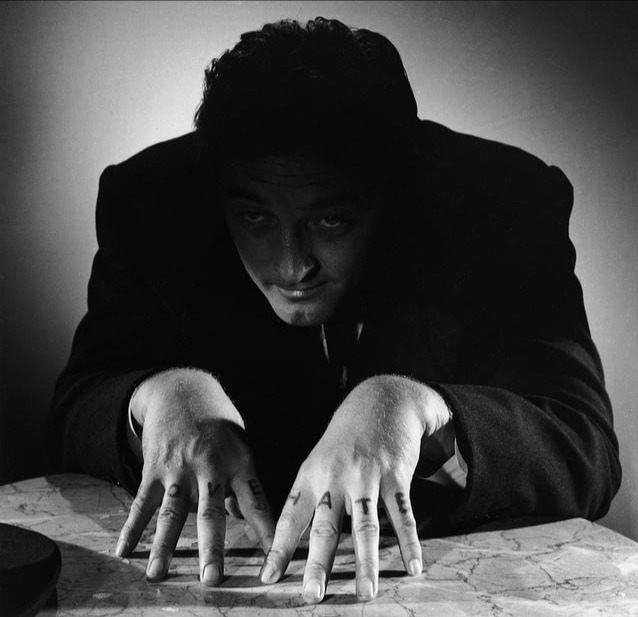
The preacher is Reverend Harry Powell (Robert Mitchum), a serial killer, and the spine-chilling villain of Charles Laughton’s 1955 horror classic The Night of The Hunter—critically panned at the time, and the only film the English actor ever made.
I first came across Powell as a religious teen, obsessed with the Disney cartoon Gravity Falls. In the episode ‘Sock Opera,’ the protagonist Dipper is possessed by the demon Bill Cipher, who immediately dons Powell’s iconic outfit and convinces everyone in Dipper’s life that nothing is amiss. He sets out to murder Dipper’s sister Mabel to acquire a magical artefact—all while Dipper’s spirit watches on, helpless. Though the episode is full of bombastic physical comedy, the image of ‘Bipper’—draped in that coal cloak, lips stretched in glee—disturbed me.
At my church, the pastor would regularly remind that us that all men, himself included, were afflicted with sin. But God’s love could move through all of us and, as the Church’s representative, it had already done its work on my pastor, saved him so fully. But during sermons, I began to wonder if something dark festered beneath his smooth words (which dictated what I could wear, who I could love, how I should behave). I imagined his eyes flashing yellow—if only for a moment.
The priest in horror is a fraught and incoherent figure, particularly in a genre which deals in explorations of evil, otherness and victimisation.
In a children’s show like Gravity Falls, the image of a demon wearing preacher’s clothes (and the skin of beloved, trusted character) horrifies because it violates child logic. It plays into tropes of the horror genre, which deal in transgression: audiences are unnerved when organising principles are upended, creating a sensation of abject powerlessness. Christianity’s religious dominance means that ecclesiastical imagery is ever-present in horror, often representing the fight for order in the face of unknowable, chaotic Other. Naturally, its clergymen are equally ubiquitous: priests represent a curious intersection between humanity and a higher plane. Defined by discipline, isolation from wider society and a remove from earthly attachments, they are more than just people—they are brokers between the common people and God.
However, a closer examination of the priest in horror show that they are a fraught and incoherent figure, particularly in a genre which deals in explorations of evil, otherness and victimisation. As churches of all denominations grapple with centuries-long allegations of abuse, most recently in the case of megachurch Hillsong, on-screen men of the cloth reflect the troubled space they occupy in our wider imaginations.
*
When Laughton’s masterpiece was first conceived, censorship and rating boards requested that the filmmakers ‘remove any impression that Preacher was an ordained, legitimate reverend.’ Joseph I. Breen, the head of Production Code Administration, went as far to say that it would be ‘necessary to change [Preacher’s] vocation entirely, to get away from any flavor of religious hypocrisy on his part.’ The script was eventually amended to emphasise that Harry Powell was an aberration, distinct from the normative good of Protestantism.
However, when I finally sought out the film for myself, I was entranced by the ways in which Powell drew his power from religious tenets. He is not, in fact, possessed by a demonic force. He’s simply a man after stashed treasure, the location of which is only known by little John and Pearl. Powell’s simple goal is accompanied by an insidious kind of evil: over the course of the film, he marries the children’s mother Willa and earns the trust of the small community with his repertoire of biblical allusions. Mitchum, best known for playing noir antiheroes, oozes a commanding charm that leeches off the shame of the townspeople; after he admonishes Willa’s sexual desires, she whispers: ‘Help me, Lord, to get clean…so I can be what Harry wants me to be.’
The Night of the Hunter‘s menace doesn’t reside in any of Powell’s singular acts of depravity, but in the slow, ritualised way his violence infects every frame.
Influenced by German Expressionism, Laughton frames Powell in irregular swathes of black. The rigid lines of his dark coat jar against the florals and airy cloth worn by the Depression-era townsfolk. Also cast in violent shadow is the young protagonist, John: he is enclosed by murky doorways, windows, and the narrow confines of an escape skiff. No matter who he tells about the preacher’s sinister motives, he is disbelieved, his presence rendered immaterial.
And despite Powell’s seemingly preternatural ability to hunt down the children no matter where they run, Mitchum never lets the audience forget the man underneath. Tattooed on his left knuckle are the letters H-A-T-E; on his right, the letters L-O-V-E. In a signature speech, he clasps his knuckles together and declares that all of life is the struggle between these two forces (a scene that later inspired Spike Lee).
‘What’s truly startling about his performance is how buffoonish he allows himself to be, in between bouts of menace,’ writes Terrence Rafferty. ‘His Harry Powell is a man whose composure masks the most unruly impulses—imperfectly capped wells of lust and greed and violence that tend to leak in moments of crisis, and not in attractive ways.’
Powell is prone to erratic outbursts that interfere with his plans; he stumbles, hops away wounded, wails like a child. He is both a fairy-tale wolf and uncomfortably human. The menace of the film doesn’t reside in any of Powell’s singular acts of depravity, but in the slow, ritualised way his violence infects every frame. It’s in Willa lying peacefully on her marital bed, feeling she is deserving of death—mirrored by the angelic visual of her flowing golden hair at the bottom of a river. It’s in the way a rabid mob, the very same people who ignored John, later bray for Powell’s hanging. And it’s in the scene when John threatens to tell his mother the truth, and Powell replies sweetly: ‘Well, it doesn’t matter. It’s your word against mine.’
*
As cultural signifiers, clergy have been an adaptable entry point—either as heroes or villains—into works that explore a struggle against evil. Often, they are edifying symbols, providing hope for salvation and a return to understanding. Horror writer Claire Cronin outlines a trend of ‘latent religiosity’ in much of contemporary horror, where sinners and sceptics are ‘compelled, by horror, to repent.’ These types of stories offer closure by elevating virtue, strength of will and family values—a return to order earned by suffering.
As cultural signifiers, clergy have been an adaptable entry point—either as heroes or villains—into works that explore a struggle against evil.
Perhaps the greatest horror example of clergymen triumphing over evil is William Friedkin’s The Exorcist (1973), where Catholic priests free young Regan MacNeil from the grasp of a demon. Cronin states: ‘I’ve heard priests joke that The Exorcist did more to bring people back to the Church than any efforts of the Vatican.’
Curiously, however, the most heroic figure of The Exorcist is a man defined by multiple gaps and ambiguities. Father Damien Karras (Jason Miller) is a trained doctor who is not present for his mother’s illness and eventual death; he is both a Harvard-educated intellectual and a scrappy, often-clueless boxer; he is a priest who continually lacks faith. He searches for absolution for his failures, for the comfort of an essentialist ideology. He defeats the demon not through the power of scripture but by punching its lights out. He takes the creature into his own body and destroys himself, a violent resolution to an internal knot of contradiction.
Frank Burke writes:
Unlike the novel upon which it is based, the film does not privilege mystery only to hypostasize it under the sign of some Transcendental Order (God, the Divine, the Ineffable)—and thus merely defer closure to some higher and more absolute level. Instead, it revels in the slippages and uncertainties, gaps and differences, ruptures and alterities that reside within the materiality of life.
With Western society growing more secular, representations of priests have leant into the enigma and conflict inherent in priesthood, as artists and audiences grapple with the strict binaries of religion and its far-reaching institutional power. Even heroic depictions of priests often show them being consumed by larger forces, revealing an innate spiritual uncertainty. In The Amityville Horror (1979), Catholic faith is used as an easy stand-in for unambiguous good, represented by Father Delaney (Rob Steiger)‘s efforts to bless a haunted house. Dedicated to his mission, he is ultimately powerless in the face of paranormal evil: boils form on his palms, a ghostly force tampers with his voice. Eventually, he is struck blind and lobotomised. In Silver Bullet (1985), a supernatural force is similarly self-annihilating, as Reverend Lowe (Everett McGill) succumbs to the effects of werewolfism. He dreams he is presiding over a mass funeral, the congregation eyeing him with distrust. ‘There’s so much we don’t know…and we feel very small,’ he stutters as the crowd transforms into werewolves and bodies burst from the caskets, the Reverend consumed in snarl of outstretched arms.
Recent years have seen a greater willingness to show clergymen as corrupt and sinister. Action-horror films such as The Order and Priest (2011) both feature shadowy Church bureaucracies, whose totalitarian attitudes create as much harm as the brood of bloodthirsty creatures. Meanwhile, Amityville’s 2005 remake traces the source of ghostly evil to the crimes of a sadistic Reverend, who tortured and murdered Native Americans on the house’s grounds—perhaps speaking to the violence of colonial missions and residential schools.
Today, when a priest walks into frame, the immediate associations are unclear: is this a trusted figure, or do we feel a coil of unease?
These characters reflect the conflicting, looping archetypes of clergymen in horror: they symbolise religious virtue but are vulnerable to human impulse; they are saintly guardians of power, they are dissolute abusers of power; they impose binaries of good and evil, while existing in-between. They encapsulate the notion of faith in an increasingly uncertain world, where uncontrollable forces threaten to consume them, and destabilise clear notions of self.
Today, when a priest walks into frame, the immediate associations are unclear: is this a trusted figure, or do we feel a coil of unease?
*
All these crossroads converge in Monsignor Pruitt (Hamish Linklater), the central character of Mike Flanagan’s 2021 Netflix limited series Midnight Mass. Suffering from dementia and nearing the end of his life, Pruitt stumbles upon a winged creature during a pilgrimage to Jerusalem. It sucks his blood and feeds him its own, rejuvenating his youth and granting him classic vampire traits: immortality, sensitivity to the sun and overwhelming bloodthirst.
Like in Silver Bullet, Pruitt is consumed by a paranormal force, which rewires his body chemistry and impulses. But the audacious irony of the series is that Pruitt believes the vampire is an angel of the Lord, and when he returns to his fading fishing community of Crockett Island (now under the identity of young stand-in priest Father Paul Hill), he brings the monster along with him to ‘save’ everyone else.
Much like in Flanagan’s previous Netflix hit, Haunting of Hill House, his characters speak in long, flowery monologues, often spelling out their competing ideologies. But in the mouths of characters like Pruitt and his zealous acolyte Bev (Samantha Sloyan) this sermonising feels right at home, as the characters devolve into demagoguery, drawing from the Bible to justify to a series of escalating horrors. And Pruitt, unlike Bev, is never characterised as a prejudiced zealot: even as a vampire, Linklater plays him with a boyish, approachable sincerity, his voice sliding from gentle to impassioned whenever he takes the pulpit. He cares deeply about the fate of his island, which is eroding due to the financial devastation of an oil spill, an ageing population and widespread alcoholism.
Though his acts of harm become as expansive as that of Harry Powell’s—resulting in a bacchanalian climax where the townspeople drink poison to become vampires—Pruitt is always operating out of desire for resolution, for love. Where The Exorcist’s Damien Karras resolved his overpowering uncertainty through death, Pruitt self-affirms through the monster. In a key sermon, he proclaims:
Rebirth, resurrection, eternal life. Life that rises again. Even out of blackness, love rises again. Even out of sin. And this island, it will rise again. Even out of disaster, rebirth, restoration, eternal life.
Interestingly, Pruitt is intoxicated by the concept of eternal life on Earth, rather than in Heaven. Even as Pruitt reaches for the Divine, he is obsessed by his own mortality and that of his ageing erstwhile lover. His anxiety is located in the material—in the pain he’s witnessed over years, in lives of those close to him. Pruitt represents the many shadings of horror priests: a menacing wielder of power, the helpless hero and, most of all, a human in search of an origin, of meaning amidst senseless suffering.
*
‘Part of why Midnight Mass resonates with me is because it understands the beauty of faith—not just in a higher power, but within and among ourselves,’ critic Jamie Tram has said. ‘With this faith comes the possibility for forgiveness, and only through forgiveness can past transgressions be transposed into something new.’
Pruitt represents the many shadings of horror priests: a menacing wielder of power, the helpless hero and a human in search of meaning amidst senseless suffering.
The most crystalline images of Midnight Mass occur in the finale, where the remaining townspeople—now all vampires—gather to wait for the sunrise, accepting of their certain death. The Christian characters sing the hymn ‘Nearer, My God, To Thee,’ while Sheriff Hassan and his son Ali, both Muslims, perform their last prayer towards the shoreline sun. Similar religious comfort is found in The Night of the Hunter, as John and Pearl’s downriver escape lead them to the kind, no-nonsense Ms Cooper (Lillian Gish), who assumes the role of their protector. Ms Cooper reads from her Bible nightly but, notably, the passages she chooses offer comfort to vulnerable children in search of safety: Moses safely adopted after his own downriver journey, baby Jesus safely hidden away from King Herod’s army.
As clergymen represent larger anxieties around faith, dominance and vulnerability, these stories don’t dismiss the certainty found in genuine love and generosity. It’s a fragile certainty, one that can never be as indelible as the L-O-V-E inked on Powell’s knuckles, but it exists all the same, in the paradoxical materiality of life.
Midnight Mass is available on Netflix. The Night of the Hunter is available to watch via the Internet Archive.