

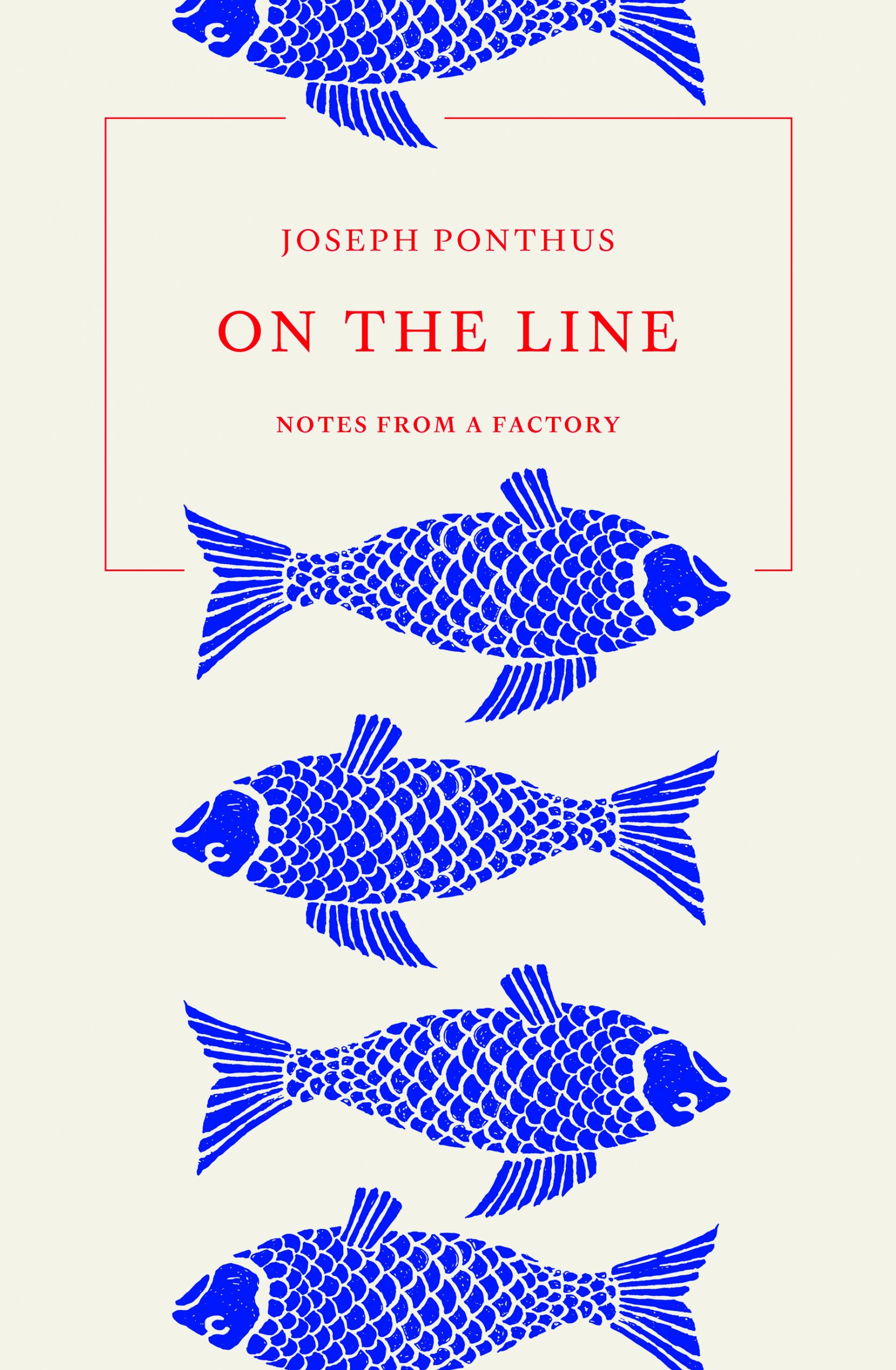
While reading On the Line, I couldn’t help thinking of another French writer who also worked in a factory, although for very different reasons. Simone Weil was a philosopher, teacher, Christian mystic and labour activist. In the 1930s she worked in various car factories in France for a year to better understand the working conditions of factory labourers; she believed only a direct experience could allow her to know what solutions would improve their lives. France in the ’30s was undergoing rapid industrialisation and correspondingly, tumultuous labour unrest culminated in the French general strike of 1933 protesting unemployment and wage cuts.
Weil’s factory diaries from this period are a meticulous documentation of her experiences—not only of the work that she did, the suffering she witnessed and indeed experienced herself, but also her suggestions for improving the situation for workers. Like Ponthus, she felt her time in the factory changed her permanently: ‘I still know how to feel joy, but there is a certain lightness of heart that seems to me now, forever impossible.’
It is striking that Weil’s writings, almost ninety years later—particularly her recommendations for factory work—still ring as true and necessary. Weil argued that better pay alone would not ensure better working conditions; instead, a complete reorganisation of the factory was required. Work that is regulated by the clock puts workers at the mercy of managers’ changing demands and production targets, and means work is often done piecemeal, one worker doing only one part of a whole and not even getting the satisfaction of seeing its completion.
Work that is regulated by the clock means it is often done piecemeal, one worker doing only one part of a whole and not even getting the satisfaction of seeing its completion.
Instead, Weil argued that factory work should follow similar rhythms and cycles to that of a peasant farmer, where they are able to plan and have autonomy over their tasks, and be actively involved in the whole production process. Physical and monotonous labour could never be completely eradicated, Weil contended, but by placing the worker and their dignity at the centre of the production process, factory work—working together in a collective effort to create something—could be satisfying and meaningful.
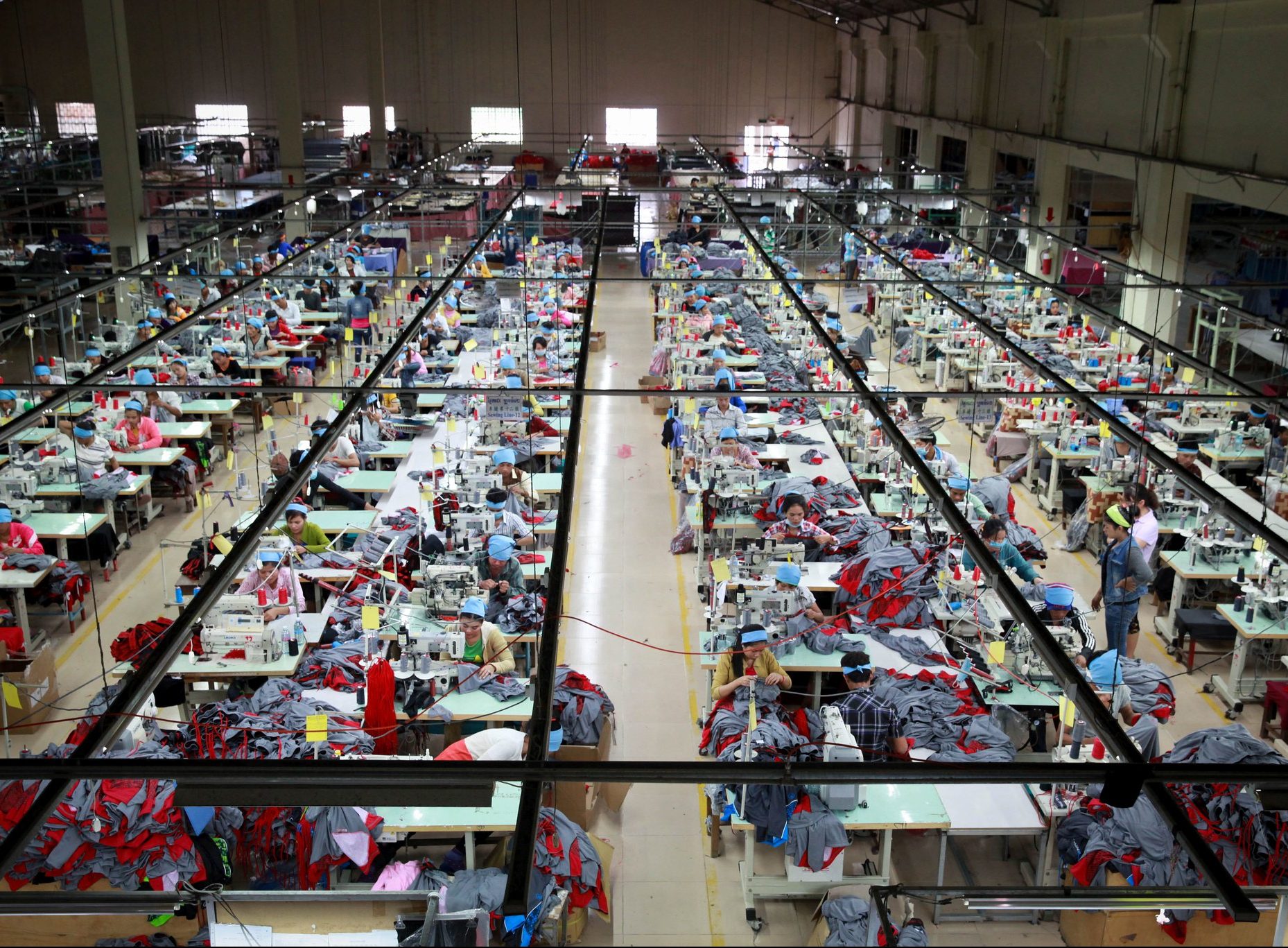
Re-reading Simone Weil’s factory diaries again, I’m struck by how little has changed in the experience of working in a factory. And in reading On the Line, I couldn’t help thinking about my own experience—the factory I worked in was owned by a French national (almost 90 per cent of factories in Cambodia are foreign-owned), so in a way it too was a French factory. Except it wasn’t organised as one. As the French HR manager said to me, ‘We wouldn’t be able to do this in France, but the people here are used to it.’ I didn’t ask what it was specifically, but presumably she meant the long hours they worked, the lack of adequate ventilation or equipment, of basic health and safety—and this was supposedly one of the better operations. It was also presumably the reason why the owner, a Frenchman living in Singapore, had allowed me to work there—because he was proud of the way he ran his factory (he had previously let a documentary film be shot inside it).
The export garment sector in Cambodia has a history of strikes, demonstrations and the jailing of trade union organisers around issues of salary, freedom of assembly and exploitative working conditions. Violent crackdowns have accompanied workers’ protests for raising the minimum wage, as well as the 2004 killing of prominent union activist Chea Vichea. The stories of factories in Cambodia, like in many places elsewhere, is the story of people whom we have encountered only through the things that they make, that have passed through their hands. The ‘stuff’ that makes up our lives here in ‘developed’ countries circulate and are made possible through structural inequalities between nations, and a globally interconnected economy.
*
On the Line sometimes briefly refers to this global interconnected economy on the factory floor:
The prawns all arrive frozen from
Peru from the Mozambique Channel from India from Nigeria from Guatemala from Ecuador
But that is not Ponthus’ focus—nor is his focus on the strike that occurs in the factory while he is working there. Only the permanent workers are striking; as a temporary worker he would lose his job if he participated. This difference in status and job stability between the different kinds of workers is an important point, and something the factory likes to exploit:
People say two-thirds of the workers at the factory are casuals for one-third permanent
But instead of seeing the strike as a moment of collective solidarity, Ponthus views it mostly through the lens of individual grievance. He envies the permanent staff for their benefits and job security, rather than wanting these conditions for all. And he is not that interested in the concerns of the striking workers, besides the fact that it will mean more work for him:
Fucking strike
We’ll be doing overtime for the rest of the week trying to catch up the time lost today
Hardly a permanent on the job this morning
This is perhaps because he sees his role as a factory worker as temporary—it is only what he does while waiting for something better. He does not consider what the strike might mean for those whom this will be a lifelong job. It is perhaps understandable that Ponthus has no curiosity for what the factory is outside of his own experience—his only motivation was to ‘earn a dollar,’ and such apathy is surely a built-in feature of the grinding, exhausting nature of the work.
Ponthus sees his role as a factory worker as temporary—it is only what he does while waiting for something better. He does not consider what the strike might mean for those whom this will be a lifelong job.
But throughout the book, even if only to frame his experiences in the factory—the work that he does, the way that it ravages his body, how it surprisingly heightens his appreciation of life—Ponthus makes many and multiple literary references to writers, artists and filmmakers. Names such as Fernand Raynaud, Georges Perec, Alexandre Dumas, Victor Hugo, Jean-Luc Godard, Apollinaire and more are scattered throughout the text. These names sometimes have a link to his context (he notes that Rabelais apparently first uttered the word ‘prawns’) but other times feel randomly thrown in.
The overall effect is akin to looking at his factory experiences as if through a literary smokescreen, as if he can only make sense of it through that lens. But it feels jarring at best—these references are mostly ones which his factory colleagues would likely not have read or seen, and similarly, the referenced writers and artists themselves are people who probably have never seen the inside of a factory. Their work’s connection to the factory experience seems tenuous at best and irrelevant at worst.
Instead, it ends up feeling like these literary references are a coping mechanism for Ponthus, rather than providing an enlarged insight into the experience of factory work itself. As he writes to his mother in the book:
Maybe you think it’s a waste to end up at the factory
Frankly I probably agree
What you can’t know is that it’s because of those very studies that I’m coping and that I am able to write
Throughout the text, especially in the moments when he is reflecting, there is a tone of slight incredulity about how someone like him ended up in the factory. A sense that this is not his place in life because of his good education, his professional background; because he has an interest in literature and writing, because he references all these grand persons of the arts who are a world away from the world of the factory. It’s clear who the assumed reader is—people like himself who are cultured and literary, rather than the factory worker he has (temporarily) become.
*
As someone who was also very briefly a factory worker, who knew that it was temporary and for research and therefore separate from my ‘real’ life, the question of what I was doing there and for whom came up for me as well, but in a different way.
Knowledge and ‘data’ produced through ethnographic fieldwork hinges on the relationships between researchers and the people we meet—we don’t go into the field just as detached observers, we bring our whole selves. The physical work in the factory was difficult, but what I found most challenging was navigating the inherent power dynamics between myself—an Australian woman of Chinese-Cambodian origin who was privileged enough to go to Cambodia and choose to work in a factory—and the other workers. I was uncomfortable being seen as a resource, as their rich Western friend; I found it distressing and awkward to constantly negotiate around expectations of what I could give, not only financially or materially but also emotionally (though these are not as separate as we would like to imagine them). The question of what I owed and didn’t owe to the people I met during ethnographic fieldwork constantly vexed me.
So much of academic research is approached as a form of extraction, much like the production in a factory depends on labour extraction—that is, the rendering of the worker to her labour power only.
With time and distance, I can see how easily I slipped into self-absorption, into my own sufferings, both physical and inter-relational, such that they obscured or perhaps did not allow me to focus as much on others. But aside from this, I think these questions point to a necessary wider conversation about the ethics of fieldwork.
So much of academic research is approached as a form of extraction, much like the production in a factory depends on labour extraction—that is, the rendering of the worker to her labour power only, and this is maximised and put to use in the production process. In research, how often do we ‘extract’ the other for information to be put to use for the knowledge production process, and consequently for our own careers? And what do we owe to those whom we are writing about?
Given that On the Line is not a research project or documentary, but a piece of literary work, can we demand more of it than what it aims to be? Can I fault it for not being more preoccupied with certain things like class consciousness or wider structural issues, and being too preoccupied with things like Ponthus’ own individual experience of suffering? Or can I just admire his word play (and Smee’s very nimble translation of it), the rhythms that reproduce the beats of the production line, and the graphic descriptions of the abattoir that allow a window into a world that we are all implicated in? But even in just saying this, I see that we cannot separate a work’s form from its purpose, what it does or does not do, and what effect it has both on a reader but also more widely in the literary sphere.
On The Line was very well-received by critics in France, winning numerous prestigious literary awards, in a country where literature and the literary industry is still highly stratified by class. The book has been called ‘confronting’ and ‘astonishing.’ What does it mean that it has resonated so well with its intended readers—literary, comfortable, not doing any menial or physical labour. What are we seeking out when we read this?
Perhaps that it will shock us temporarily out of our apathy (about the agro-business, about consumerism)—But is it such a revelation that many people have to work so hard just so that we can endlessly consume non-necessities? And what about all the information we already have access to, that doesn’t seem to make that much of a difference?
The COVID-19 pandemic has brought the fault lines of global inequality into sharp relief—not only the terrible effects of uneven vaccine access and distribution across the world, but also which countries have to bear the brunt of making sure the wheels keep turning. In Vietnam—a top exporter of textiles, electronics and home goods—some factories have required their workers sleep on-site in tents and makeshift dorms to create a ‘COVID bubble’ so they can continue operations—and so that we over here can continue to shop for cheap goods online while in lockdown.
We are not all in this together, and not in the same way—but we already knew this even before the pandemic.
So maybe making a difference isn’t the point—instead, maybe reading literary work about factory work makes us feel absolved somehow, now that we have an idea of what it feels like, having experienced it vicariously through someone who is like us (sensitive, literary).
I remember making a promise to myself when I worked in that Cambodian factory, as I helped to make those cheap-looking, useless sunglass cases, next to a seventeen-year-old who most likely would be doing many more years of this. I could imagine these cases ending up in a discount bin or two-dollar shop somewhere in Australia, and it hurt to think that we had ruined our backs and strained our eyes for something that could, and would, be discarded so easily, so cheaply, our labour meaning almost nothing at all. I promised that I would never again take for granted the physical ease of my chosen career, that I would appreciate how comfortable my life is, and I was going to be aware and careful of what I bought from now on. That promise to myself has faded over time, and now I only get a slight shock when I see a ‘Made in Cambodia’ tag on a piece of clothing I want to buy.
Does reading about factory work make us feel absolved somehow, now that we have an idea of what it feels like, having experienced it vicariously through someone who is like us?
Perhaps Ponthus’ most successful literary analogy in On the Line is when he references Samuel Beckett and Waiting for Godot. While waiting in line for his pay cheque at the temp agency, he writes:
Knowing the crowds who’d be hanging around
I had a book in my pocket
Anticipating the wait
The absurdity of the work we do
I chose Godot from the great Sam
The absurdity of his position as a temporary casual worker, yes, and the absurdity of the work itself. I think these are all portrayed well in his book. But what remains largely unspoken, as he questions factory work for himself, is what it means for others. What is most absurd of all is the whole system of the global supply chain, production and logistics, the way we consume goods and what it means for those who will engage in this kind of work for a lifetime.
As a poetic documentation of one man’s experience in the factory, perhaps what On the Line explores is enough. But it is not making any real demands, either of society or of the reader herself. Whether or not it should is another question.
On the Line is available now at your local independent bookseller.