Once purporting to occupy the middle ground, Australian news media is now unashamedly polarised. Social media is the usual scapegoat—but what started as a war for advertisers has become an uneasy truce of ideological opposites.


The final year journalism students were seated in front of the expert publishers’ panel. It was 2008—a time period in Australian media that feels, from the nostalgic distance of 2021, startlingly innocent.
The internet was on our phones, but its gutting of the media business model was still gathering steam. We were yet to foresee the rise of fake news and misinformation. Facebook and Twitter were in their infancy. Trump was safely confined to reality TV.
All of us journalism students, we were deluded. We thought we were going to be court reporters and war correspondents and music critics. We didn’t know that most of those job titles would disappear within the decade.
I thought I was smart and cynical. I wanted to be someone who asked the hard questions, so I asked the expert panel, ‘Do you only hire journalists whose political views align with those of your publication?’
The question really cemented my unpopularity among the few people in Adelaide who might’ve been able to give me a job.
It sparked a pile-on of interlinked monologues from each of the publishers, all driving home the non-existence of an ‘editorial stance’ at their outlets and the saintly necessity of objectivity in journalism.
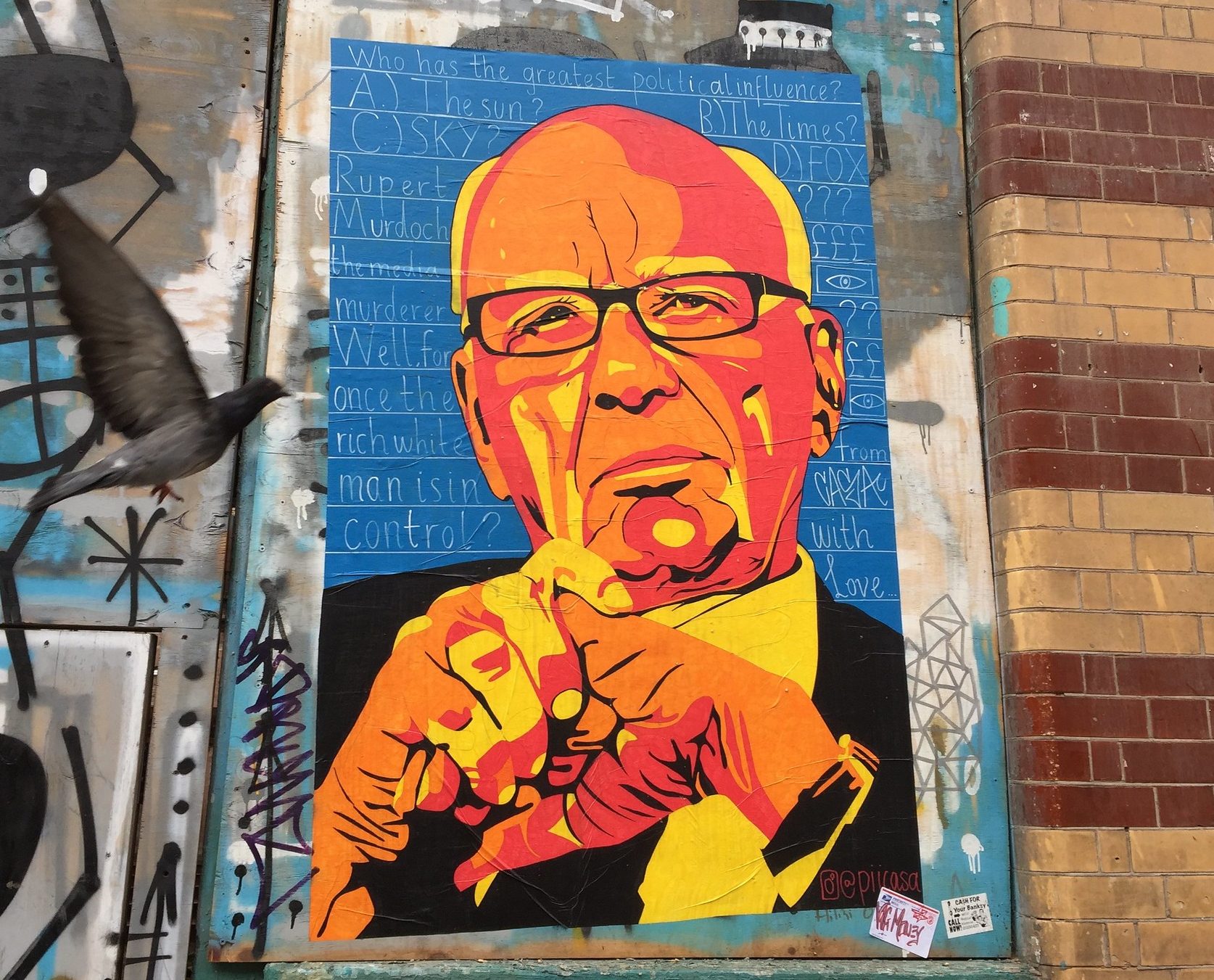
As a chastened 21-year-old, I quickly swallowed this sly equation of occupying the centre with noble objectivity, but that argument has quickly become irrelevant. Over the 13-year span of my journalism career, Australian news media has rapidly polarised. Social media is posited as the usual villain in this debate, but in Australia we grapple with a force that is equally omnipotent and no less responsible: Rupert Murdoch’s News Corporation.
Social media is posited as the usual villain, but in Australia we grapple with a force that is equally omnipotent and no less responsible: Rupert Murdoch’s News Corporation.
The resolve of the man who (impressively) helped force the hand of some of the largest corporations in the world by refusing to blink when Facebook withdrew from Australia during the News Media Bargaining Code debate is legendary. Although he has just celebrated his 90th birthday, media commentators still credit Murdoch as a hands-on corporate leader ready to wield his ‘huge amounts of political power’ in defence of his values and his coffers.
The Sun King podcast, which charts Murdoch’s meteoric rise, begins with an anecdote from Reed Hunt—a former top-dog media regulator in the US. He’s visiting Murdoch in 1994, at the media mogul’s Hollywood Hills home.
Hunt recalls Murdoch’s criticism of the American media industry, the now naturalised US citizen saying: ‘In your country, you don’t have lots of different content for lots of different audiences. You just have this one vanilla, middle of the road, try to please everyone, form of media.’
Murdoch outlined his plans to import what he called the ‘British newsstand model’ of ‘one newspaper for every niche audience’ to the US market. Almost three decades later, Americans are drowning in a rotten quagmire of cultural divisiveness fostered most prominently by Murdoch’s Fox News.
He is, if nothing else, a man committed to his vision.
*
In the mid ’90s, even though the steadfastly anti-vanilla Murdoch controlled more than two thirds of the country’s daily newspaper output, Australian journalism was, for better or worse, slavishly centrist. The Age leant a little left, The Australian leant a little right, but there was an expansive plain of middle ground. Reporting was purported to be factual, dry and restrained; modelled on postwar ideals that repositioned journalists as guardians of truth rather than tellers of story.
But centrism has a wretched underbelly: the ‘view from nowhere’ is the view of the majority, and a united front of media quickly foments into an iron fist ruling public opinion.
The ‘view from nowhere’ is the view of the majority, and a united front of media quickly foments into an iron fist ruling public opinion.
In The Media and the Massacre, Sonya Voumard describes the journalistic culture of the mid ’90s as one ‘that could be overly aggressive, its subjects playthings’. Voumard’s book charts the representation of Martin Bryant (predictably characterised by that hollow word, ‘evil’) and of his mother, Carleen Bryant, in the wake of the Port Arthur massacre. Carleen, especially after voicing doubts over her son’s guilt, was gleefully hung out to dry by an Australian media singing in hearty unison.
The damaging journalistic choir of Voumard’s book that gleefully tore apart not just the person at the centre of a story, but also victimised loved ones, is now a thing of memory (despite the PMO’s best efforts). In 2021, it’s rare to see mastheads, TV stations and radio stations band together in a frenzy of finger pointing.
Instead, we play a game of oppositional reactivity. The Guardian and The Saturday Paper respond to rape allegations against the Attorney General with calls for empathy and a better understanding of trauma survivors. In the opposite corner, Andrew Bolt lines up to call out ‘victim culture’ and a raft of Sky News commentators are mobilised to rake over irrelevant details of the accusation’s substance. And it goes on – whether the subject is Margaret Court’s Australia Day honours, the trials of Cardinal George Pell, a couple of Queenslanders who flouted COVID restrictions, or Yassmin Abdel-Magied – Australian media neatly sorts itself into rabidly duelling and predictable factions.
It could be called a win for representation, and sometimes it is, but to wholeheartedly apply that label would be mealy mouthed. Representation relies on a diversity of views. In a small market dominated by a few players, there’s limited room for perspectives. All we have achieved is a new kind of polarisation where, instead of one community being fed a single story, Australia has been fragmented into the niche markets Murdoch lusted for in America.
*
Our media’s journey to the outer reaches of polarity was unique. Unlike our ever-inspiring American friends, the industry wasn’t replicating increasingly divergent views among the population (although the change would eventually help foster a True Blue version of that phenomenon).
The main product of commercial news media has always been its audience. During more cheerful times, buying eyeballs was expensive—in 2012 it cost about $60,000 to place a 30-second ad on primetime TV. By 2017, that figure had rapidly fallen to $50,000.
Instead of one community being fed a single story, Australia has been fragmented into the niche markets Murdoch lusted for in America.
Traditional media uses blunt tools to sell its audience—with analogue formats, they don’t really know who is watching, reading or listening, so they push volume of captive audience. By comparison, the sophisticated targeting capacity of online platforms is irresistible to marketers. For decades now, advertising dollars have been steadily flowing away from news media pockets and into the enormous glittering coffers of the internet giants.
As ad spend at traditional outlets dwindled, competition became fierce. A race to grab the few remaining dollars by achieving supreme popularity began.
When it comes to crippling the competition, there is no one more practiced than Murdoch.
The initial overtures in the battle were standard price gouges. Between 2008 and 2018, I worked at two publications where advertisers reported that the competitor—a News Corp masthead—was methodically calling anyone who placed ads with us and enticing them to switch allegiances by offering eye-wateringly low rates. We were supposed to be starved out of the market.
The second arm of the campaign for supreme popularity felt much more conniving. Using the might of their newspaper dominance (which fluctuated from about 70 per cent in the 2000s to still more than 50 per cent now), Murdoch’s team set out to win using rhetoric.
It began with a deluge of attacks on the ABC in the ’90s and early 2000s that aligned neatly with the aims of the Howard Government. Virulent allegations of bias were levelled against this publicly-funded competitor who lured away valuable audience.
The campaign to discredit the ABC worked, but only after a fashion. The broadcaster’s budget has been dealt blow after blow, but the ABC did not topple and disappear. Not everyone believed it to be an unhinged communist organisation.
For some though, the sheer prevalence of the message made it resemble the kind of thing that used to pass as truth. These people become suspicious of the ABC and more intimately tied to Murdoch’s mastheads and their allies.
Strength is exactly the image their audience and advertisers crave; a picture of an institution rendered trustworthy by its dominance.
In this change, News Corp saw potential. It widened the definition of the enemy—accusing everyone from the New York Times to Twitter of crimes like pandering to China. By 2020 the practice of laying blame at the foot of competitors was so brazen that News Corp would implicate The Guardian or the ABC in almost anything, including its own business decisions.
These attacks re-ordered the media landscape. News Corp pushed itself to the right. Out there on the cold-hearted verge where neoliberal economic strictures mate with the Australian illusion of a fair go for all, the company found a new solution to its revenue issue.
Suddenly, it could sell to advertisers who believed the narrative they’d been peddling. Clive Palmer and a chastened Commonwealth Bank began to feel at home in these pages.
The flip side, of course, is also true. As News Corp vacated the centre and other stalwarts, like the former Fairfax mastheads listed right in its wake, more liberally-minded readers were unsurprisingly appalled. A space opened up on the left into which newer outlets like The Saturday Paper and The Guardian gratefully stepped. Their survival is built—quite openly, in the case of the Saturday Paper—on distribution of all the advertising messages that would make readers of the Australian baulk—each page flip, click and podcast break is an opportunity for a new campaign from the climate change-aware Bank Australia or a chance for the dairy industry to rehabilitate its tarnished environmental credentials.
A Newspaper without the MURDOCH. #auspol Find out where you can get a copy at http://t.co/wHbOxCBCr7. pic.twitter.com/qa9mbTaQI5
— Lord & Lady Muk Raking. (@IIreckon) April 26, 2014
It started as a war for numbers, but it has ended as an uneasy truce in which everyone agrees to play their roles.
News Corp and its friends act out their hegemony with a ferocity so absurd that former foes are stirred to seek restitution. The company does it because strength is exactly the image their audience and advertisers crave; a picture of an institution rendered trustworthy by its dominance.
Simultaneously, the alternatives have no choice but to fill the little crevices that are left in the market. For small independents like Crikey there’s little to do other than oscillate wildly from left to right in the desperate search for a few extra clicks. Meanwhile, larger progressive outlets act like the opposition to News Corp’s de-facto government, calling out the Murdoch media in columns, presenting a rival viewpoint to the dominant voice’s hot takes, and continuing to publish worthy and difficult stories that aren’t convenient for the right.
All reap the (often limited) financial rewards of this polarity. The new Media Bargaining Code will only enable this further—funding outlets to find more people who fit the pre-conditions for polarisation.
Amid this truce of extremes and an Overton window creeping steadily to the right, the population grapples with an ever-diminishing ability to find the common ground needed for constructive debate. We struggle to agree on the fundamentals of what is good or bad, right or wrong, false or true. We lose sight of the intelligence and intentions of those on the other side. We refuse to speak to them. We refuse to listen.
And that’s before we even open Twitter.