Frankness comes before fiction in Debra Adelaide’s homage to her late friend in When I’m Sixty-Four.


Editor’s note: This piece contains discussion of suicide.
Debra Adelaide’s swift but lasting new novel, When I’m Sixty-Four, draws on her friendship with fellow writer Gabrielle Carey. The connection stretches back decades, across different enclaves of Sydney. The pair grew up in beachside South Sydney—a site Carey made notorious in the Australian public imagination through her ‘surfie saga’, Puberty Blues (1979), a wildly popular novel that, in turn, made her and her co-author, the boisterous Kathy Lette, famous.
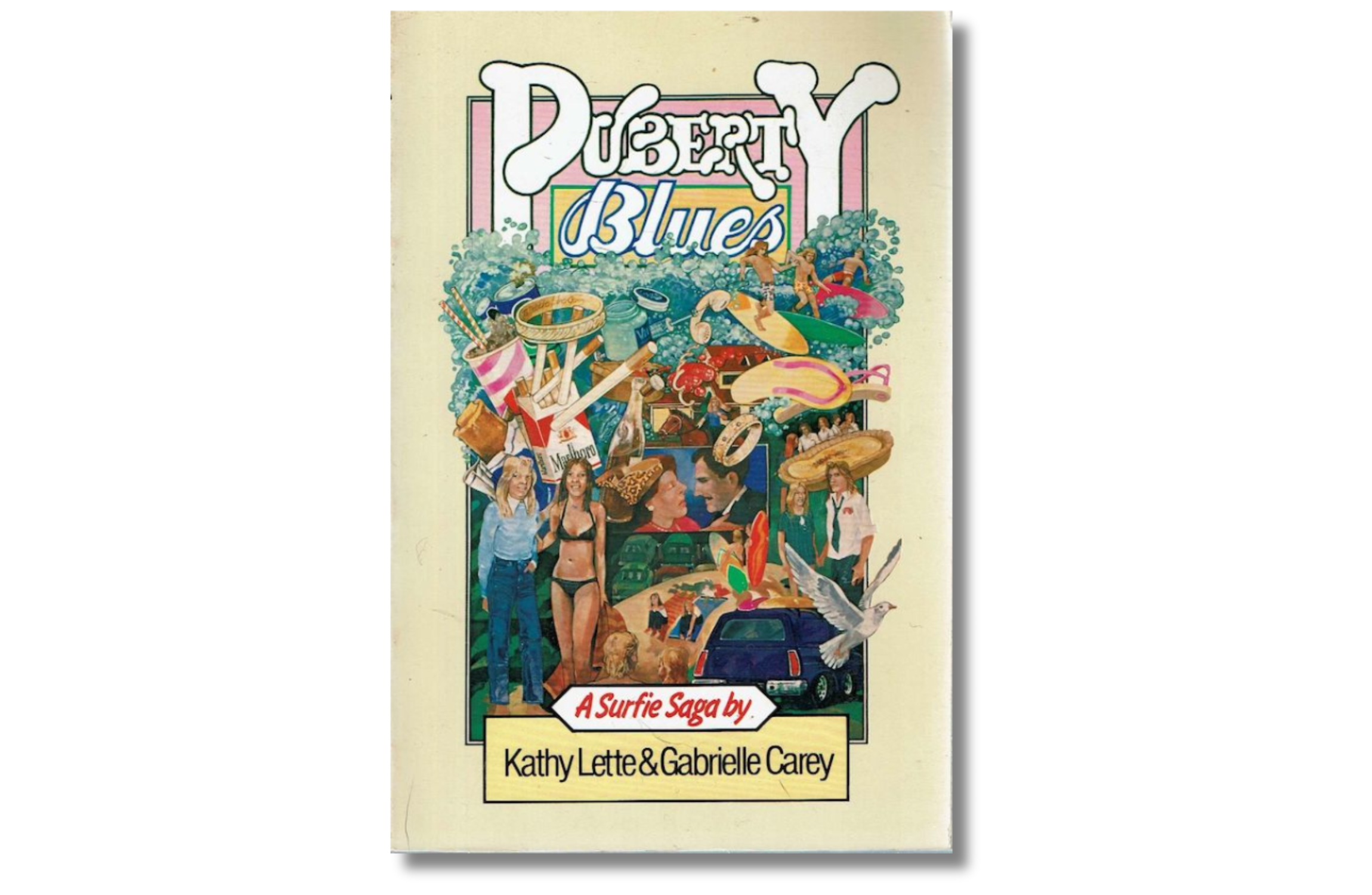
Adelaide and Carey drifted apart after this monumental success—bestseller status, a film adaptation—but came back together years later at a book launch. When Adelaide recognised Carey’s mother from across the room, she was reintroduced to Gabrielle, then freshly back from a life-changing trip to Mexico, newborn in tow.
Carey is transmuted into ‘my friend’ in Adelaide’s novel, not referred to by name. It would be unsurprising if some readers were directed back to Sigrid Nunez’s surprise bestseller The Friend (2018), another short, fragmentary work about the aftermath of a confidante’s suicide where the deceased is also rendered nameless (Nunez employs the second person). The greatest influence on Adelaide’s writing here, however, might be Carey’s own books, such as In My Father’s House (1993) and Moving Among Strangers (2013), characterised by unfaltering honesty in the face of tremendous loss.
Adelaide writes in her acknowledgements that her novel is ‘a work of autofiction’ and one ‘shaped with the tools of fiction and expressing truths that are uniquely mine’. What exactly are the novelistic elements that set this work apart from memoir or biography? A fictional work that advertises itself as being lifted directly from life yet stops short of reportage begs such a question. Does a generic distancing effect create a sense of safety for the author?
The greatest influence on Adelaide’s writing here, however, might be Carey’s own work.
Whatever the guiding principles, it can make writing a review rather difficult. When I speak of ‘Adelaide’ and ‘Carey’, am I speaking of the characters that Adelaide presents to us and the incidents detailed in the novel, or am I referring to the real-life figures and facts I know to be true to their lives? In untangling matters, I have also been pushed out of the realm of the book review and into the personal essay. Which is to say that there are many more ‘I’s here than perhaps should be permitted in a conventional ‘review’, but this I believe is with good reason: I have lived a version of the novel’s story.
Subscribe to stay in the loop
Be the first to read new stories, discover publishing opportunities, and access resources. For people who love great writing.
Unfortunately, many readers will likely feel this pang of recognition from the very first page of Adelaide’s novel. Over seven million Australians are close to someone who has died by suicide or attempted suicide. The book opens with scenes of Adelaide’s character caring for Carey’s character as she struggles with a deep depression, sometimes unable to get out of bed. I had done much the same for a friend of my own—searching through medical scripts, taking him to essential appointments, setting up others he did not keep—and eventually I lost him in the same way that Adelaide loses Carey. I recognised the effort and strain that goes into willing someone to recognise the potential for light in the days we are given and the gut-punch when they decline to see and so depart.
For me, there were other echoes on a much smaller but no less personally significant scale. Adelaide takes on Carey’s books after her death, agreeing to ‘mind boxes of her books until they could be sorted and rehomed’. I had done the same with my friend’s books (we eventually ran a charity sale where his friends could buy a copy of something from his library, a service that proved meaningful for those who had no keepsakes after his death). More odd synchronicities came to the surface: I had bought a second-hand copy of Carey’s penultimate book, Only Happiness Here, shortly before my friend’s death and had to hide it from myself after the fact. I was not suicidal but felt extremely vulnerable to falling into a grief-infused depression. In a similar vein, Adelaide confiscates a big biography of Sylvia Plath from Carey’s bedside table, positioning it as a radioactive reading substance for those experiencing mental ill health. Books can become dangerously loaded emotional objects.
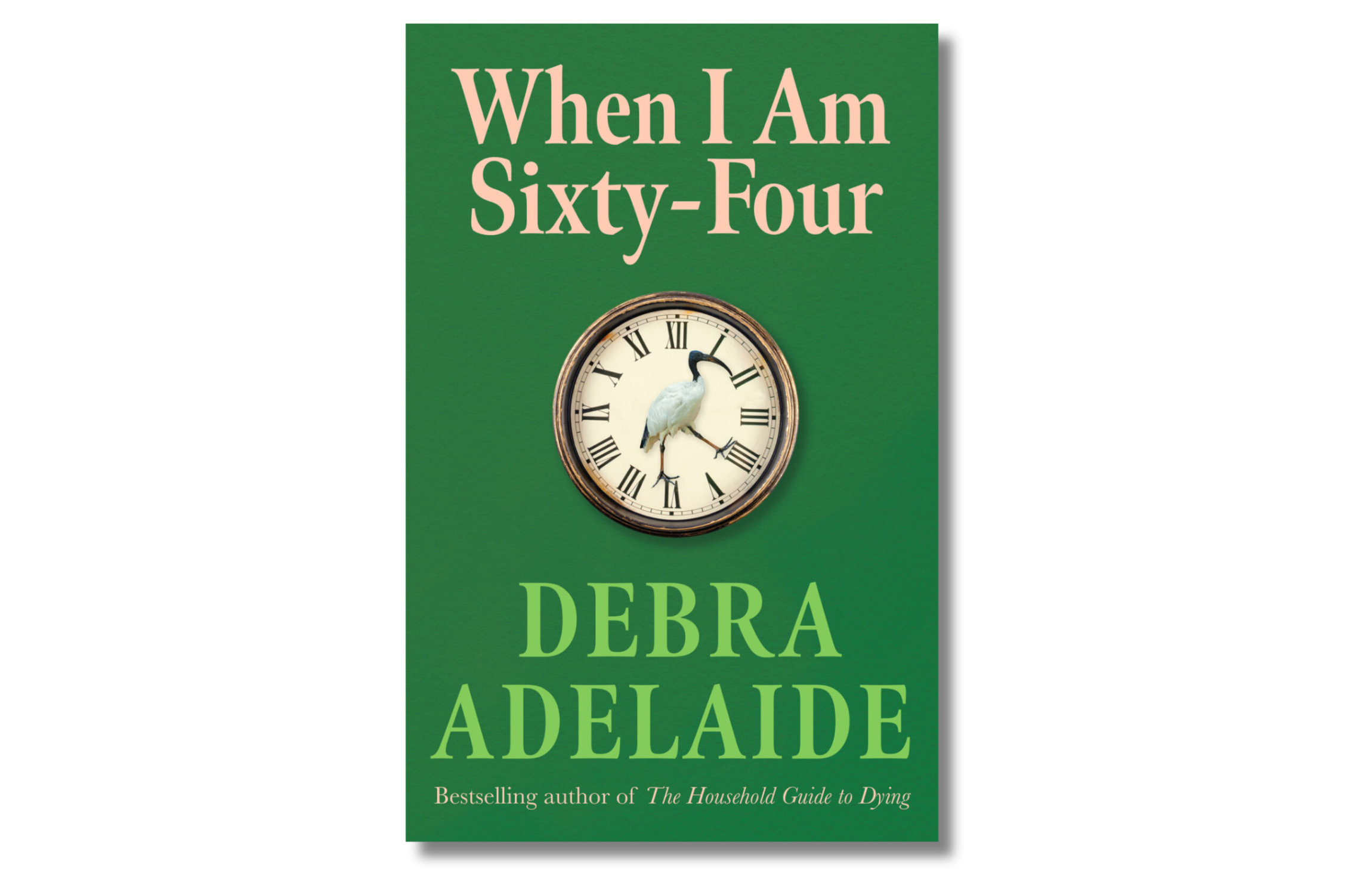
When I’m Sixty-Four is very much a book about reading. Adelaide is, after all, the editor of the anthology The Simple Act of Reading (2015), which collected an essay by Carey on her fabled Finnegans Wake reading group. Adelaide makes abundantly clear that one of the key foundations of her friendship with Carey was a shared love of the act of reading (quite separate to writing). This book is by extension about the sites of reading, where this is done for pleasure and where for the purpose of work. In this case, it is a rare Australian novel about higher education. The advent of Diana Reid’s popular novel Love & Virtue (2021), set at the University of Sydney, led many critics to reflect that the campus novel did not have a long tradition in Australia. Rebecca Croser, writing about Reid’s novel in the Sydney Review of Books, pointed out that ‘antipodean counterparts of the North American and British campus novel tradition are surprisingly few’.
The handful of examples that Croser does reference—including those by mid-century titans Dymphna Cusack and Christina Stead—primarily concern ‘universities as sites in which young women come of age’. Michelle de Kretser’s mighty Theory and Practice (2024) continued this approach and, in keeping with Croser’s thesis, it is the students who have taken centre stage; university teachers have, more or less, been left alone to do their work, appearing as side characters, often antagonists. Adelaide’s book is, at last, about these educators, but by the time we get around to them they are in early retirement and this is a book about their post-campus life.
Which makes the campus a haunting presence, and in this case it is a spectral apparition with a traceable name. Carey and Adelaide were colleagues together at the University of Technology, Sydney (UTS). In fact, they were both teaching there when I did my undergraduate degree under the ‘writing and cultural studies’ banner in the mid-2000s. I took a single subject with Adelaide as a teacher, a productive unit on writing short stories where she was a warm, generous reader and facilitator (doing her best with me as a disruptive student). Carey, however, I missed entirely. I never found a class to sign up to in which she was the tutor, though I had heard others describe her as supportive but exacting (Adelaide writes: ‘It was true she could be unapproachable and aloof.’) In her novel, Adelaide finally explains why I might have missed the opportunity to be taught by Carey, giving a sense of her evasive character within the university system:
In all the time we worked at the same university, she plotted and performed escape, and ended up with such a fractional load she almost had no job.
This presence—or non-presence—gave Carey a bewitching and ethereal character on campus to undergraduates, more talked about than encountered: ‘Is the author of Puberty Blues really teaching here?’ In the end, I did meet Carey, but only the once, and it was only after we had both decamped from the university. It was towards the close of an end-of-year drinks event held by the Sydney Review of Books. We had talked a little that night, and as she was leaving, she said she had read and admired my book The Rapids, a personal and biographical exploration of mania, saying that it had helped her understand a few things about a pressing family matter. The commendation meant a lot to me.
I saw her once more after that, on the red-light rail that cuts through the city we shared, but I was too nervous to go and reintroduce myself. My reticence—a complete inability to make meaningful conversation—felt like a symptom of the stress that anyone passionate about reading and writing was under in those years, and in all the years since.
Unfortunately, many readers will likely feel this pang of recognition from the very first page of Adelaide’s novel.
Gabrielle Carey had a premonition of how bad this would become before her death. In an excoriating piece written for the Sydney Morning Herald in July 2022, she wrote about the passing of a beloved poetry lecturer at a university she worked for (both unnamed in Carey’s piece) and the impassioned response from his students. Carey solemnly noted that:
Despite the uproar from his devoted students, the poet’s position was abolished. Management decided that poetry was no longer necessary to what was then probably Australia’s most successful and popular creative writing department.
I have long felt that the era in which I had studied at UTS was a golden one—both staff and students possessing endless intellectual curiosity and creative energies—befitting an innovative institution that set itself apart from its sandstone siblings. The creative writing disciples had a productive and playful rivalry with the cultural studies players. Both sides seemingly came together within UTS’s leading role in the teaching of ‘ficto-criticism’, a more theoretical precursor to the autofiction boom (Adelaide may once have been seen as more of a traditionalist than some at the university, but her new book brings this into question).
But at the end of 2022, Carey published another opinion piece in the Sydney Morning Herald—a frank argument that the biomedical model for treating depression should be reconsidered in favour of a more social approach, in which she referenced her own working status with the university. Reading this short piece at the time it was published, I was shocked to learn that Carey had been ‘voluntarily separated’ from UTS. I had heard many rumours that redundancies were white-anting the writing department, but this was my first confirmation of any such action in print.
Carey makes a connection between her depression and her father’s, who found himself in financial precarity in retirement, struggling with the ‘sudden loss’ of his ‘important role as lecturer, activist and mentor’. Here Adelaide’s autofictional account adds more detail, suggesting Carey ‘could not wait to leave this position when redundancies were offered’ but found herself unmoored by the realities of such change and fearful for her future. Adelaide suggests that Carey’s financial circumstances were not as dire as her brain might have been telling her. ‘As many times as I tried to remind her that her house was an asset she could use to fund her retirement,’ Adelaide writes, ‘she could not see this.’ Adelaide notes that post-academia neither actually retired but ‘reverted’ back to their ‘real jobs, as full-time writers, albeit underpaid ones’. ‘How was it that I now experienced a freedom I had not had for years,’ asks Adelaide, ‘while she felt like the walls were closing in on her?’
Adelaide’s unwillingness to present her friend’s word as gospel and a refusal to turn Carey into a martyr form part of the power of her book. There are no syrupy indulgences here. Any wry rebukes, however, are still couched within Adelaide’s compassionate narratorial self. It is a testament to Adelaide that she can be both conversational and meandering, and yet also writerly and precise. This is a work of (auto)fiction that feels ‘lived in’, perhaps obviously so because, as its genre dictates, it was lived. This isn’t necessarily true of all works of autofiction. I have certainly discarded some books in the genre because they read as true and yet some integral component is off, like being unable to finish a soft drink after getting stuck on the taste of artificial sweetener.
There are no syrupy indulgences here. Any wry rebukes, however, are still couched within Adelaide’s compassionate narratorial self.
Adelaide’s skill with minute detail avoids this sense altogether; remarkably the subject of food alone locks in the verisimilitude missing from other works. Anecdotes of cooking quite powerfully and quickly reveal character traits. A prized recipe for fruitcake coaxed out of Carey’s mother, drawing for us that particular woman’s tough exterior. Carey’s inability to attend to a soup started by Adelaide reveals the depths of her depression. On a brighter note, there is the complex and joyful cooking of mole—the recipe and enthusiasm for the rich, savoury chocolate-infused sauce Carey had brought back from her travels (the knowledge shared between Adelaide and Carey is encapsulated in small asides such as, ‘she insisted on showing me how a tomato was sliced in Mexico’). Adelaide’s ongoing struggle with myna birds invading her house, ‘shitting on furniture and curtains’, delivers a comic struggle that distracts from Carey’s distressing situation.
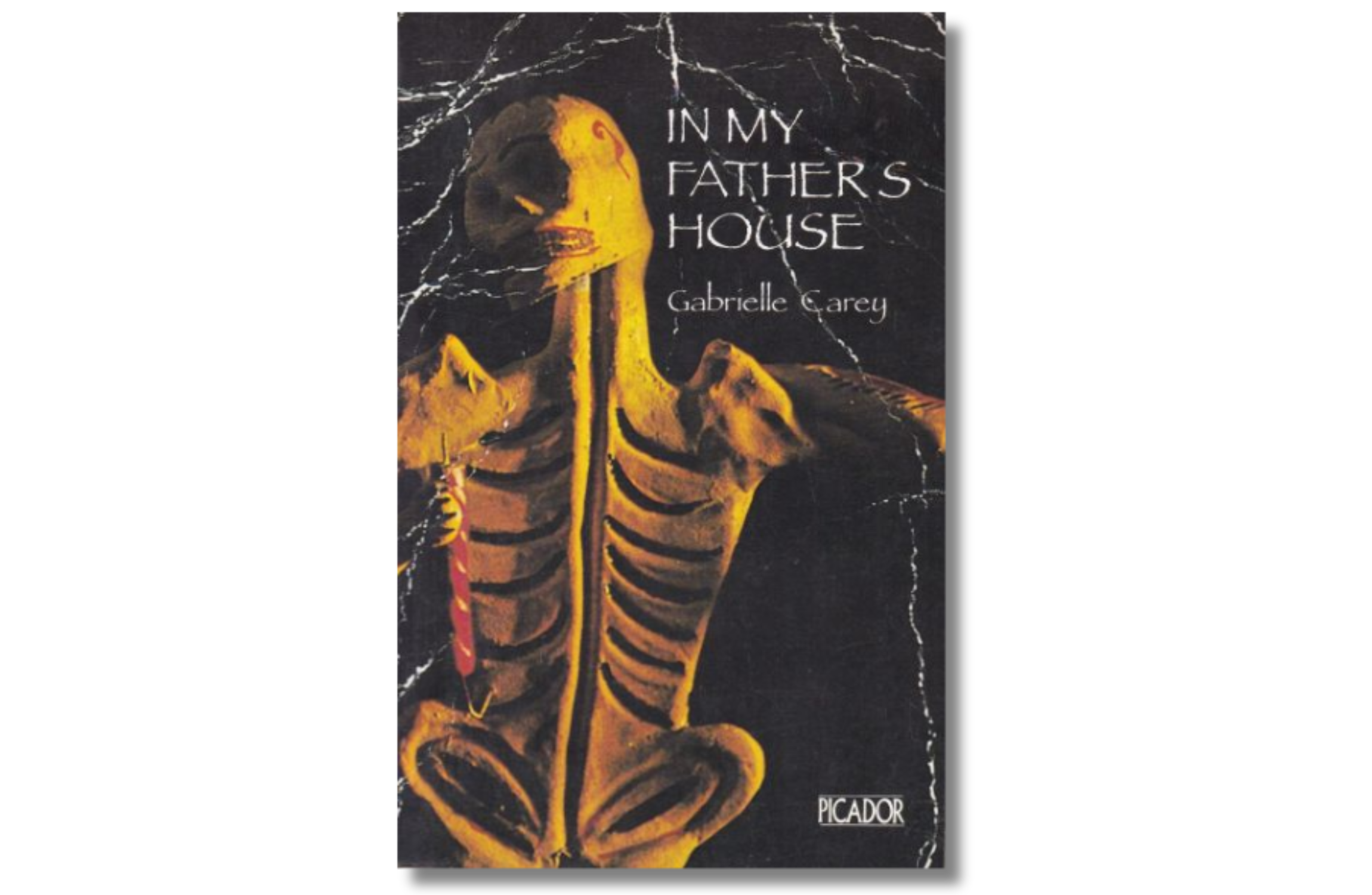
Though these domestic details provide important grounding, this is a book of the life of the mind. In fact, a more essayistic approach of the ‘writer on writer’ genre is found within, not an extended elegy so much as a biblio-biography of Gabrielle Carey. The text that Adelaide keeps returning to, out of all in Carey’s oeuvre, is In My Father’s House. Long out of print, the cover features a ghostly skeleton, evoking the Mexican calavera tradition. It makes sense that Adelaide is in conversation with this work as its text provides a grim mirroring of her own. Carey’s memoir, in its major final section, details the death of her father, by his own hand, at age sixty-four, the exact same age that Carey herself was when she died.
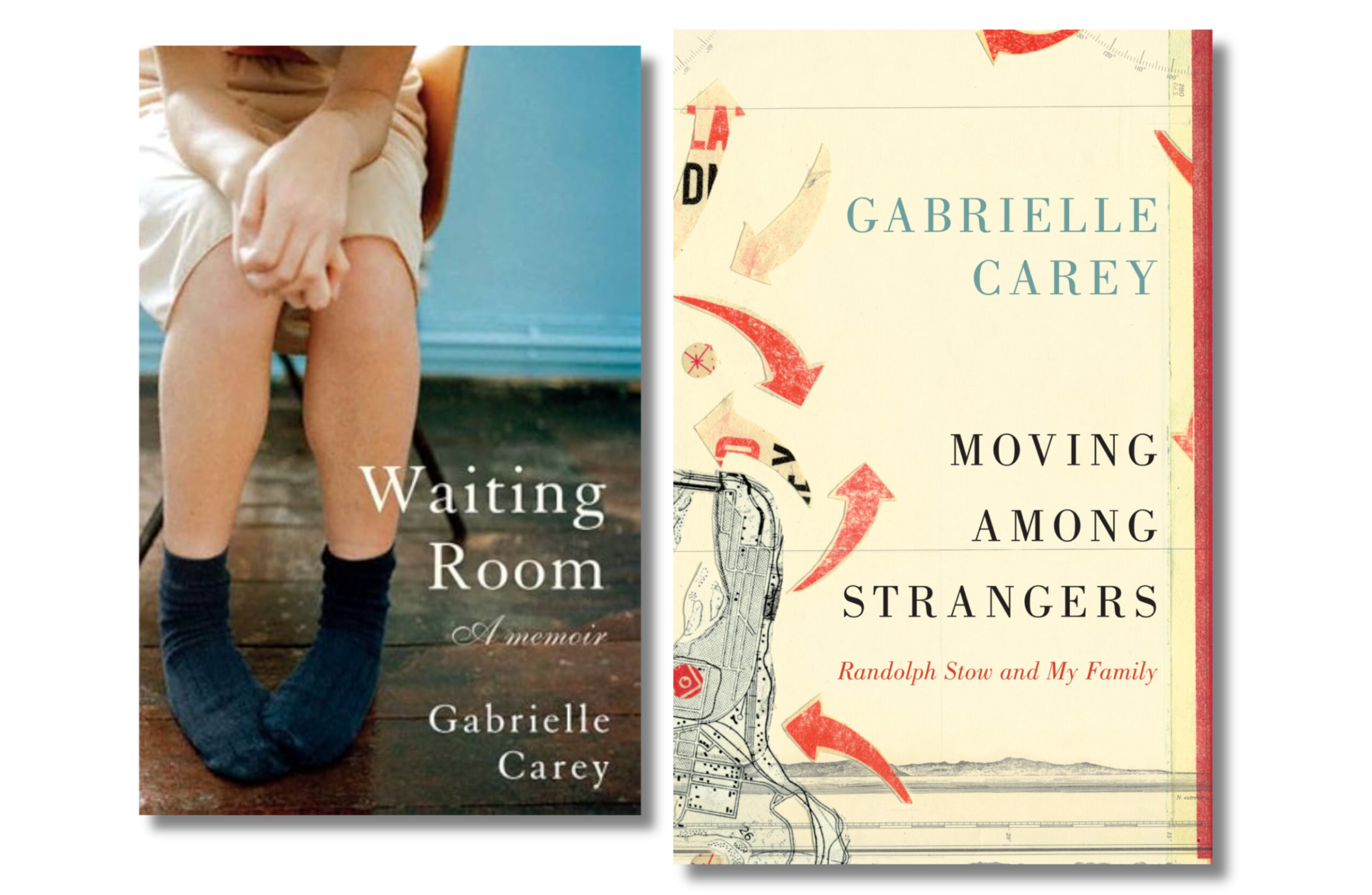
Understandably, Carey became obsessed with death in the wake of her father’s suicide, and this would shape the rest of her writing life. The ending of a life is not a subject out of the ordinary reach of most writers, but it was more than a regular preoccupation for Carey. She co-edited The Penguin Book of Death in 1997. She also spent her later years working primarily in the mode of critical biography, attempting to revive or question the legacy of Australian writers—Randolph Stow, Ivan Southall, Elizabeth von Arnim—and anyone working in this genre can attest that it brings mortality to the forefront of the mind with a concerning frequency (I recognise the immediate, pressing urge to write about someone after their passing). She wrote a memoir of her mother’s decline in health, Waiting Room (2009), and her book on Stow, Moving Among Strangers, is as much about the aftermath of those events as it is a critical biography.
The suicide note that Carey’s father left behind read, quite uncannily, as if he was writing it in concert with his daughter, that ‘none of this should be believable, even in fiction’. He seemed to go out of his way to make the ledger of his death incredulous; he died just days before Carey returned from Mexico after years away, bringing her daughter to introduce to her family. It was a cruelty that would be hard to forgive, and death and suicide became subjects returned to again and again. The questions around the ethics of such representations surrounded her. Like other biographers, Carey had speculated on whether Randolph Stow had attempted suicide, noting such themes in his fictional works, writing:
Stow was a deeply private person and suicide is perhaps the most deeply private decision a person can make, so his alleged suicidal moment was probably not an event he wanted to see publicly discussed.
What do we make of this equation when we replace a ‘deeply private person’ like Stow with a very ‘public’ person—indeed a chronic, serial memoirist—like Gabrielle Carey? This is a question that appears again and again to the close reader of her work; she thought about it in relation to a great number of other writers. In her book about the dwindling reputation and cultural forgetting of Ivan Southall, she wrote the unexpected confession:
Because my father chose suicide, I cannot. I understand too well the fallout for the family. So the exit strategy taken by Virginia Woolf, Sylvia Plath, Charlotte Perkins Gilman, and Helen Daniel is permanently closed.
Has there ever been a personal statement made by a writer that you wish they adhered to more?
Adelaide reveals at the end of her book that driving her writing was a desire to inhabit a philosophical treatise on the end of a life, and there are moments—and this is part of Adelaide’s genius for imparting a sense of earned intimacy—where you might forget who the author of this text is exactly. Is this a Debra Adelaide novel or a Gabrielle Carey postscript, a last-minute coda to a late, posthumously published memoir? The impossibility of the authorship of the latter does not seem to matter in the least.
Ultimately, this is Adelaide’s generous accomplishment. When I’m Sixty-Four is likely to send you straight to the library of Gabrielle Carey’s books. There is great modesty in stepping back and letting Carey move into the light one last time, but in doing so Adelaide has not absented herself entirely. She has revived and archived an enduring record of the dialogue between two writers. Unsurprisingly, Carey herself reflected on why we might pursue such ends in that landmark book on Stow:
This, then, is what I have learnt about the dead: they do not lose their power just because they are buried beneath an oak tree […] and we don’t lose our desire to talk with them just because they don’t have a voice.
Of course, you wish the conversation could go on and on, with more of Adelaide’s reminisces on the life of her friendship with Carey (quite different from wanting more from it—it provides everything you need in its short form). The brevity of what we have in front of us is tender indeed, but the abruptness of the end is true too to the nature of its subject; a fond and familiar interlocutor gone eerily quiet. Thankfully, with a book, unlike with a life, you can go back and start it all again.
For support, please contact Lifeline Australia on 13 11 14.