Australian rural noir has enjoyed global success, but two new releases diverge from the genre’s popular—sometimes whitewashed—tropes to uncover colonial crimes in the city.



Among readers and writers of Australian literary fiction, scorn for local crime writing—OzCrime—is often seen as punching upwards. Though few crime authors are likely to achieve the international success of Jane Harper, who has sold over 3.5 million books worldwide and whose 2016 debut The Dry precipitated the ‘outback noir’ boom, the genre’s comparative commercial viability is hard to dispute. A 2017 Macquarie University survey of Australian reading habits found that the ‘crime, mystery, and thriller’ genre was the most widely read across the nation, while Nielsen BookScan data from June 2026 has shown a 13 per cent bump in sales for ‘crime, thriller, and adventure’ titles in the past year. The likelihood of screen adaptation would also seem greater for plot-driven crime titles than for quieter or more experimental literature; along with Harper, authors such as Chris Hammer, JP Pomare and Candice Fox have reached new audiences through recent film and TV adaptations of their works.
When outback noir became an entrenched marketing category in the wake of The Dry, it was largely presented as a sweltering antipodean counterpoint to Nordic noir—geography as trend. There are obvious issues with such framing, not least of all its ahistoricism. Outback noir can be considered an extension of the Australian gothic, a tradition that historically centred colonial anxieties about the bush as a no-man’s land where life is harsh, even unnatural, and innocence (typically represented by a young white woman or child) is doomed. Narratives about police pursuing wrongdoers and restoring order across hostile landscapes reproduce the logic of terra nullius by presenting government authority over Country as natural and uncontested, while simultaneously mythologising the carceral state as a benevolent force. In Australia, as in the United States and other settler colonies, law enforcement originated as a means of controlling indigenous populations and facilitating dispossession. These colonial origins are manifest in the overrepresentation of Aboriginal and Torres Strait Islander people in the prison system, which saw a 10 per cent jump in numbers in 2025, according to the Australian Bureau of Statistics. Aboriginal and Torres Strait Islander people now make up 37 per cent of the prison population despite comprising just 3.8 per cent of the Australian population in the 2021 census. First Nations people are also more highly represented among ongoing deaths in custody, those who experience racial profiling and overpolicing, as well as those protesting settler colonialism in all its forms.
Narratives about police pursuing wrongdoers and restoring order across hostile landscapes reproduce the logic of terra nullius.
Criticisms of outback noir, whose most visible success stories are white, often hinge on its reinforcement of conservative agendas, be it through the whitewashing of history or disengagement from contemporary realities of crime and punishment in Australia. Writing on Jane Harper’s latest novel, Last One Out, in late 2025, critic Beejay Silcox describes Harper’s rural township as a ‘diorama’ for contained mysteries, ‘real enough to recognise, empty enough to manage’ and fundamentally disinterested in the outback as Aboriginal land and a blood-soaked frontier. For Silcox, such ‘cultivated vagueness’—and its crowd-pleasing quality—attests to a national complacency: ‘Why conduct a cultural inquest when you can play parlour games in a toy town?’
To what extent these charges apply to OzCrime as a whole, and not simply its most recognisable iterations, is debatable. Certainly Silcox name-checks a number of outback noir authors whose work throw history into relief rather than erasing it, among them Julie Janson, Paul Daley and Garry Disher. The current appetite for outback noir specifically is likewise debatable. Independently published author Michael Burge, whose best-known novels interrogate gay hate crimes in outback settings, reported in the Guardian that he was warned as early as 2019 of the oversaturation of the genre by an unnamed ‘literary gatekeeper’. An abundance of remaindered Harper dupes with covers featuring dusty roads and drought-stricken country would appear to support this, as would a recent announcement of an upcoming book by outback noir stalwart Chris Hammer, set in the moneyed coastal town of Sorrento and claiming to be ‘Succession meets The Big Short’. Yet Kooma and Kamilaroi writer Angie Faye Martin’s debut novel Melaleuca, which centres on the murders of Indigenous women within a rural community, was a breakout hit of 2025, going on to win the 2026 Australian Book Industry New Writer of the Year Award despite a dearth of critical attention.
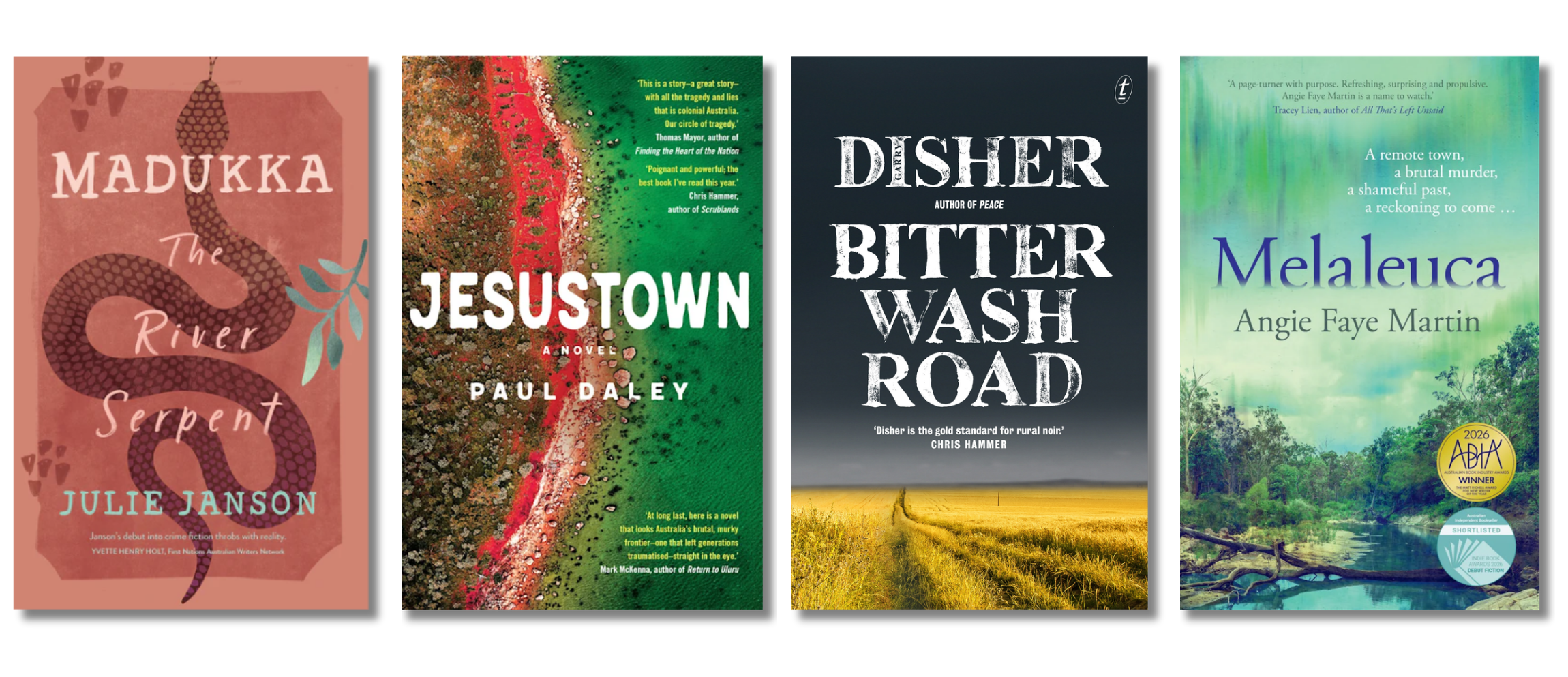
It may be overly optimistic to interpret Melaleuca’s commercial success as evidence of a public hunger for OzCrime reckonings with settler colonialism. Nevertheless, in a genre that lends itself (at least reputationally) to conservatism of style and politics, critical attention to such reckonings is overdue. While the majority of OzCrime titles aren’t presented in a way that shows faith in their unique virtues or the public’s appetite for originality (see: dusty road cover art), it would be remiss to accuse the genre of wholesale uninventiveness because of this—or retrograde politics, for that matter.
Geography may be a trend for some crime readers (bookseller opinion: Japan is hot right now). The consequences of colonisation are, however, enduring—and for some First Nations and culturally diverse writers, crime fiction can offer an appealing lens through which to examine these wounds. Although writers like Martin and Janson have found rich material in isolated, crime-riven small towns, others are not confining themselves to depicting the outback. Metropolitan centres, too, are former frontiers and bear the traces of empire. They are business hubs and playgrounds for empire’s torchbearers, contested territory for its most marginalised survivors. The land remembers, and its oldest continuous inhabitants and more recent arrivals alike are poised to unearth these memories. Two new releases provide windows into these perspectives on the genre.
Subscribe to stay in the loop
Be the first to read new stories, discover publishing opportunities, and access resources. For people who love great writing.
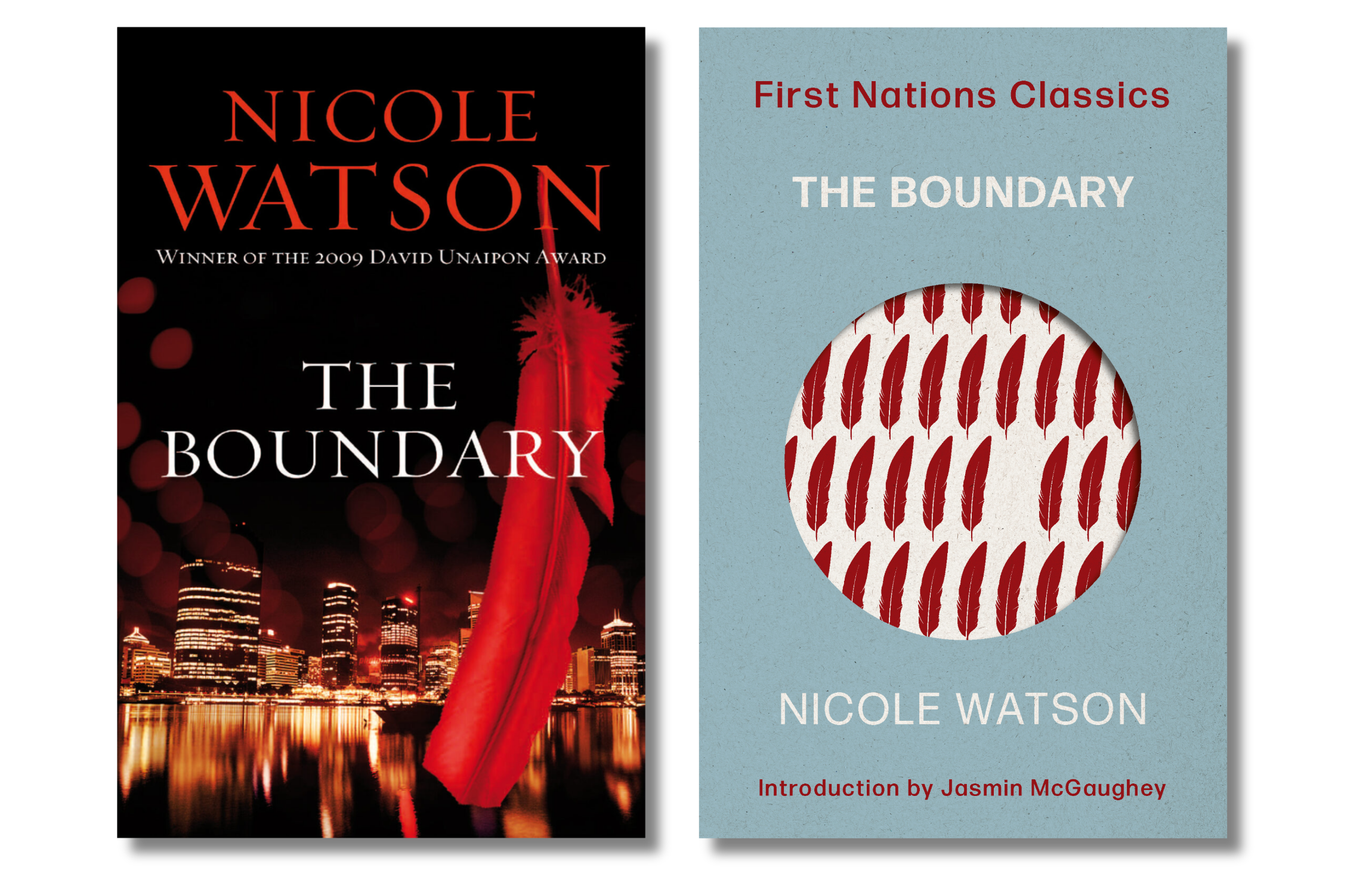
Upon its initial 2011 publication by the University of Queensland Press, Nicole Watson’s The Boundary was packaged as a slick urban murder mystery. Fifteen years on, UQP has given the Birri Gubba and Yugembeh legal scholar’s only novel a decidedly literary second life as part of its First Nations Classics series.
The reissue comes at a complicated moment for UQP. In April 2026, the publisher cancelled a planned children’s book by Wiradjuri author Jazz Money due to illustrator Matt Chun’s controversial remarks about the 2025 Bondi Massacre, which were deemed to contravene the university’s contentious antisemitism policies. In response, over a dozen authors cut ties with the publisher in solidarity with Money, many of them First Nations writers, while several UQP staff members wrote a statement urging the university to reverse their decision.
Although this context is not integral to reading The Boundary, it is interesting to consider how such cultural policing intersects with its themes. The novel’s title refers to the real-life Boundary Street in Brisbane, which in the 1800s acted as a geographical boundary keeping Aboriginal people out of the city centre beyond curfew hours. Those who crossed this threshold, which was patrolled by mounted police, were criminalised as trespassers on their own land.
Watson draws on this troubling past to paint the fictional suburb of Meston Park (based on Musgrave Park). Following the rejection of a native title claim, Meston Park is threatened with overdevelopment, a storied counterpoint to outback noir representations that locate Australia’s violence in the interior as opposed to major coastal cities with their liberal, cosmopolitan centres.
Nevertheless, The Boundary begins as murder mysteries conventionally do—with a body. Specifically, that of Justice Bruce Brosnan, facedown in marble and surrounded by red feathers from the extinct Paradise Parrot. The novel rewinds from the crime scene to the courtroom in which Brosnan rules against the Corrowa’s native title claim hours earlier, and Watson assembles a cast of legal professionals, politicians and traditional landowners. It isn’t a locked room mystery per se, but everyone has ties to the unfolding crimes, whether as suspects, victims or both.
A multi-perspective drama whose players run the spectrum from civil rights campaigners to sociopathic paedophiles, The Boundary has a sympathetic locus in Aboriginal lawyer Miranda Eversley. The daughter of respected Corrowa elder Charlie Eversley, Miranda bears a sense of personal responsibility for the failure, lamenting the morning after: ‘This judgment will poison our insides like Agent Orange. Deform our children before they are born, so that they will never see their own reflection, only the distorted image the law sees fit to provide them.’ Although Charlie sees the ruling as a call-to-arms for the Corrowa to return to the radicalism of his heyday, Miranda’s despair is chemical; the night of the judge’s murder, she gets blackout drunk.
UQP has given the Birri Gubba and Yugembeh legal scholar’s only novel a decidedly literary second life as part of its First Nations Classics series.
In a panel on representing criminalisation at the 2019 Digital Writers Festival, writer and sex worker Gala Vanting described the sex worker’s existence as one of liminal criminality: ‘We exist in a criminal body when we’re at work. And then depending on what other identities we hold […] we may be able to drop that criminality from our bodies as we walk away from that crime scene.’ For the high-functioning alcoholic Miranda, to inhabit a racialised female body outside working hours is to walk headlong into a host of potential crime scenes: ‘Over the years, she’s taken drinks from strangers, jumped into cars with inebriated men at the wheel, woken in her bed with no idea of how she made it home the night before.’ Perceived as brave, she understands herself to possess ‘a recklessness born of self-loathing’.
Such marginality is common in The Boundary. When homicide detective Jason Matthews thinks ‘bodies are beacons of the violence that human beings are capable of’, he alludes not only to the drudgery of murder but the harm that he absorbs and upholds as an Aboriginal man who joined law enforcement due to a lack of options. Estranged from his family, Jason is a workplace prisoner, duty-bound to hold his people accountable while overlooking his colleagues’ lapses.
Others are shamelessly complicit in the dispossession of the Corrowa. Solicitor Dick Payne, ‘one of their own’, goes face-to-face against Miranda in the native title claim. He is also the mastermind behind the Aboriginal Employment Initiative, which aims to get local Indigenous people off welfare by indenturing them as cheap labour for a luxury developer. Lesley Tagem, who grew up in a mission alongside Corrowa matriarch Ethel Cobb, occupies a tokenistic government position while feeding a gambling addiction.
The Boundary is an everything-and-the-kitchen-sink sort of novel, as debuts often are: murder mystery, social realism—not to mention a folkloric supernatural plot pertaining to the parrot feathers. Watson’s characters are primarily moral quandaries who are most compelling when their value systems are in friction with one another’s or with their baser impulses. They are less engrossing when such ethical murk clarifies into moral typecasting, but also when their concerns become more generic, such as Miranda’s romantic disappointments and ticking biological clock. It’s not that these concerns lack plausibility for the career-focused thirty-eight-year-old so much as that their depiction lacks focus and force within a plot so crowded with heavy themes and events.
This is partly a problem of style. At its best, Watson’s prose possesses a panache and humour born of unexpected contrasts. Much is conveyed through naturalistic dialogue and descriptions, such as Lesley’s self-minstrelsy in her role as Senior Indigenous Advisor. ‘During meetings she perches her tiny arms on her belly and delights her colleagues with slang and gibberish. Sometimes she’ll turn her head to the right and pout her lips for dramatic effect.’
Yet, too often, the writing suffers from over-elaboration. Of his womanising, Dick reflects, ‘Blushing cheeks on the fawn’s drunken face are his green light.’ A parliament-set scene opens with an onslaught of mixed metaphors: ‘The light fittings are ice cubes at the bottom of a glass, melting from a bonfire. They’re dressed in suits, but it’s pomp in a puppy pen. Hansard records more clichés than a trashy romance novel. Absorbs more punches than a world title fight. It’s like a schoolyard brawl.’ Such ungainly constructions bring confusion and, occasionally, a dad-joke absurdity to otherwise sombre moments. Even Jason’s budding attraction to Miranda is undermined by a distractingly imprecise observation about her lipstick.
Where Watson succeeds is in creating multifaceted, agentive characters whose struggles speak to wider social rifts. What’s more, she does so with warmth and wit within a genre that (where representation occurs at all) tends to deal in noble savages and one-dimensional victims. A propensity to obviousness compromises these efforts somewhat. I pitied Miranda when she relapsed after bumping into her ex at an art show, but it was easy to see the fall coming and hard to invest in her hopeful sobriety among a crowd of strangers unrelated to the central mystery. Yet there is more than enough in The Boundary to wonder why Watson hasn’t written another novel and promise for what she might yield if she returns to crime fiction more than fifteen years after her debut. In particular, one wonders how her political acumen and skill for complex intergenerational community representation might be calibrated to the current moment of One Nation revivalism and unabashed crackdowns on protest.
Where Watson succeeds is in creating multifaceted, agentive characters whose struggles speak to wider social rifts.
The Boundary can be criticised for trying to do too much at once; weaving land rights, family dynamics, addiction, police violence, the woes of uncoupled thirtysomething workaholics and Indigenous mysticism into a whodunnit that is also a Black Power revenge narrative. Nevertheless, for all its thematic clamour and patchy prose, Watson’s debut has a rough charm—not least because of her evident fondness for the genre whose conventions she upends. Even as she complicates expectations about criminality and victimhood, she knows the value of a well-timed murder. The victims, while often deserving of what comes to them, are imbued with perspective. The possibility that the crimes are a form of divine blackfella retribution doesn’t strip them of real-world consequences. Vengeance may be overdue for the Corrowa, but it isn’t cheap.
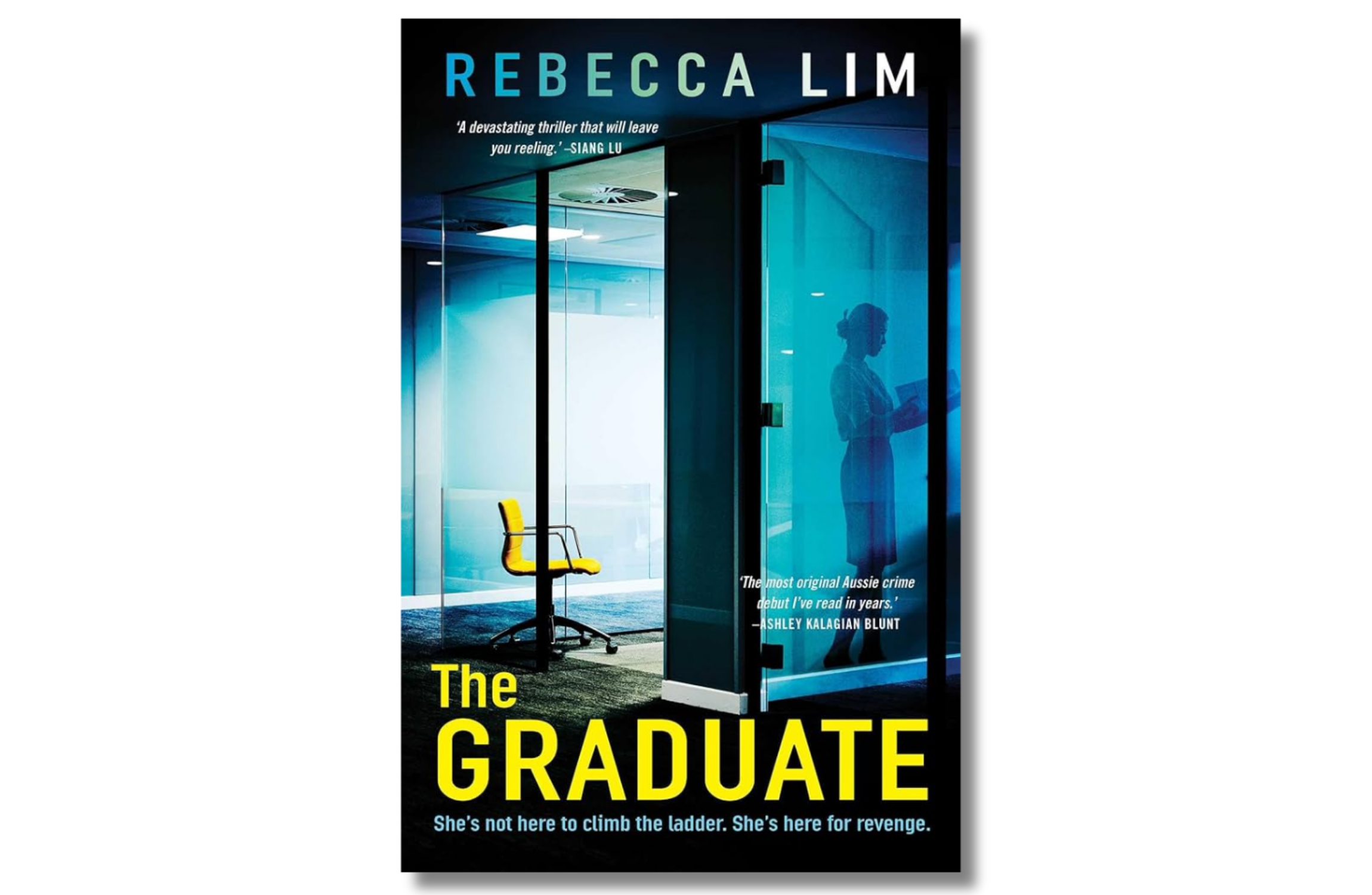
In The Graduate, Rebecca Lim’s new book and first adult crime novel, she poses a bold question: what if the avenging demon were an abused child with a stereotypically Asian work ethic? Years after becoming the second known victim of ‘the ESP’ (Eastern Suburbs Paedo), a child rapist and murderer who victimised three girls from the same Melbourne private school in the nineties, former scholarship student Evelyn Tong encounters a poster on a cold case podcast forum with intel only a fellow ESP survivor could have. A remote law degree and fake identity later, Evelyn is Chou Fei Fei, a ‘diversity unicorn’ hired as part of the graduate program at Eckersley Mapplethorpe + Lincolne (EM+L). Fei is an avatar for the stunted Evelyn, guided by Hailey (aka Jane Doe #1), to follow a paper trail to the ESP—a trace that begins with a single Polynesian word printed on the side of a box glimpsed through a blindfold three decades earlier.
Though eternally bound by the violations they endured as pre-teens, the online collaborators haven’t met: Hailey, pulled out of school immediately after the incident, lives an anonymous, shut-in existence in New York; Evelyn, among family in Singapore. A third victim, Helen (Jane Doe #3), is killed by the ESP. Making a satirical revenge thriller out of such horrifying material comes with the obvious risk of sensationalism as well as plain improbability.
It helps that Lim is uninterested in redemption. Evelyn is undeniably fucked up, with an incurable mother wound, germaphobia, a body that keeps the score and a disregard for her own happiness that is oddly compatible with working in the lowest ranks of a prestigious Melbourne law firm. Her knack for productive dissociation distinguishes her from Hailey, whose breathless messages come littered with suicide threats at antisocial hours, relentless and disembodied as a haunting. Despite the women’s shared memories and gallows humour, their alliance is unsettled by differences of race, class and workload; at one point, Evelyn refers to herself as a ‘coolie’—a historically loaded term for low-paid or indentured Asian workers.
Fei, whose makeup is as clownish as her Singaporean accent, throws these imbalances into relief. At EM+L, where one is more likely to encounter a painting of a white man in Chinese ceremonial dress than an Asian employee, she is the butt of jokes about geishas and Patong showgirls, which intensify when managing partner Tony Lincolne takes a shine to her. Whereas for Lesley Tagem, making a mockery of her race is a means of ingratiation, Fei’s performance of oriental femininity is defiant camouflage: with her ‘Maq’ and lacquered hair-stick, she is at once an eye-catching anomaly and unrecognisable as Evelyn Tong. Even her alias, roughly translating to ‘Ugly Beautiful’, is an elaborate joke on the caucasity of EM+L.
There is a campness to The Graduate, in light of which Lim’s nuanced handling of victimhood is all the more surprising. Fei is an extravagant creation, but the ever-lurking Evelyn is both plausible and refreshing in her non-compliance with the feminist survivor-hero ideal. Diminutive, asexual and devoted to her plushie collection, Evelyn is a collision of arrested development and overtuned defensive instincts. Company psychometric tests, according to her self-appointed mentor Tony, reveal, ‘a lone wolf who wouldn’t take direction well’, ‘not a Jesus or a Nelson Mandela […] far less benevolent—but ferociously hardworking and capable of seeing matters through to the bitter finish’. Moreover, she has a nose for power: who has it, who doesn’t, which powers are in conflict.
EM+L’s upper echelons, a squabbling cabal of high-functioning sociopaths, are as much of a spectacle as Fei. Ageing shark Tony, who smells of Grange at 11:18 in the morning, is simultaneously grotesque and avuncular in his championship of ‘Young Fei’. Matt St John, a ‘diminished nuisance […] who “did charity” and awful gouache landscape paintings that he pressed on people in his free time’, pronounces ‘Chinese’ as ‘Chai knees’ and refers to Fei as a ‘fragrant daughter of China’. Annaliese Merton, the lone female partner, is a ‘stone-cold prize bitch’ who resents the assumption that she is ‘genetically more caring’ than her peers. They’re a colourful bunch, whose linguistic quirks (‘boo to a goose’, ‘This is he!’) would seem unlikely were they not upper-class Australians of a certain vintage who’ve made their livelihood off public speaking. Like Watson, Lim is a lawyer, and her evocations of a corporate environment in which women appear ‘largely decorative in their jewel-bright, colour-blocked outfits and vertiginous heels’ and a foreign accent has ‘the effect of auditory processing kill switch’ ring true.
What if the avenging demon were an abused child with a stereotypically Asian work ethic?
There are some rare misfires, especially regarding the surgically enhanced appearance of a secondary villain, Nina. Even with the subtext of Evelyn’s discomfort around adult sexuality, the repeated disparaging references to Nina’s pneumatic body and overfilled face were jarring in a narrative otherwise critical of misogyny. Given Lim’s skillfully depicted male monsters, Nina’s characterisation was disappointing; the motivations for her vendetta against Evelyn were oversimplistic and not quite credible. Although Lim’s emphasis on Fei’s looks is a useful reminder of the mask (or Maq) she wears and the tireless white gaze she exists under, this chronicling similarly became repetitious; there are so many ways to describe shiny black hair.
For a novel that takes as many big swings as The Graduate does, these are minor complaints. It might seem from my account thus far that Lim is primarily concerned with the intersection between sexual violence and everyday misogyny and racism. Yet this is to overlook the novel’s most startling element; a subplot of colonial land-grabbing and environmental devastation, which can be traced—like the ESP—back to a Polynesian word on the side of a box. In The Graduate, innocents and civilisations can equally be destroyed by the greed of powerful men. The abused child, in seeking her revenge, bears the weight of civilisations. Landing at a time in which accelerated climate change cannot be separated from the state-supported ecocide of warfare and data centre investments, The Graduate is a white-hot burst of anticolonial rage, channelled into the unlikely vessel of a well-plotted crime thriller. Evelyn’s anger—and Lim’s—is at once personal and political, archival and attuned to a rapidly diminishing future.
To make sweeping declarations about the state of OzCrime off the basis of these two novels would be specious. Reading The Boundary and The Graduate together, I’m struck as much by the differences in packaging as by their thematic similarities. While the former, rebranded as a classic with an accompanying introduction by Jasmin McGaughey, does not register as genre fiction at first glance, the review copy of the latter came to me dotted with such selling points as ‘Outback noir is oversaturated: we’re ready to come back to the city’ and ‘there’s a lack of Australian POC thriller writers’.
As with any kind of literature, crime fiction requires more than progressive politics to be artistically significant. A lack of engagement with political realities can, however, reduce a work of art to low-stakes escapism, stodgy fodder, as much as a lack of ambition or style. Watson and Lim’s novels may not be the sole voices among Australian crime fiction grappling with the ongoing effects of colonisation. Yet, in their idiosyncratic approaches to this common theme, they offer a firm rebuttal to accusations of sameyness within the genre. On top of this, these novels do something that compelling fiction—regardless of genre—often does. They beg one to look at the world beyond the contained universe; to acknowledge the boundary streets that whisper of segregation, the resource-rich islands reduced to rubble. To look and not look away.