We are all just one step away from the sea in this essay on addiction, grief and polluted inheritances—a winner of the KYD Creative Non-Fiction Prize 2025.


In my earliest dream, I am swimming. I call it a dream. This is largely because the phrase I remember what it felt like to be in the womb is an impossible one. Hence, a dream.
I am floating. There is a voice above me, muffled, the way music sounds when you’re underwater.
It is dark.
I am very small.
The voice is very close.
There are three things of which I am certain. One is that the voice is my mother’s. The second is that she is upset. The third is that this proximity to her pain is unbearable.
Perhaps there is also a fourth thing: the water is not safe.
〰
For the longest time, we thought she was just drunk. Evening phone calls that circled back on themselves, messages that descended into confusion. Her voice had lost its robustness. Her words trembled a little, as though she was on the brink of a hiccup, the pressure all wrong.
It is hard to distinguish between cause and effect. A few years before, she had fallen from the attic ladder and shattered her heel. Maybe the fall spurred the unravelling. Maybe she was already out to sea.
She sat on the sofa for months, barred from walking by doctors. Initially, friends asked what groceries she needed. Generosity wore thin. On the phone, she described one who had eventually refused to bring her anything more.
‘I’m not a fucking slave,’ the woman had said.
My mother sounded surprised. ‘I only asked for another few bottles of wine.’
〰
There are many strange truths in this world. It is extraordinary, for example, to think that we were all once fish.
It was the evolution of eyes, not limbs, that began our passage on to land. In water, a fish can see about the length of its own body. It is a myopic world. In the air that range of vision increases drastically, and so fish began to change. Their eyes expanded and slid, with millennial slowness, to the tops of their heads. Fins thickened. Insects wallowing in the shallows became victims of sudden scaly lunges. At some point, the lunges got bigger. More powerful. Eventually, a fish stood up and walked.
〰
Become a KYD Member
Unlock writing and publishing resources, discounts on writing courses and editorial services, plus exclusive workshops and events.
It wasn’t that she had a problem. Nobody would have said that. She was a baby boomer, and she was an Australian, and so, at the confluence of those two things, she drank. Just like everyone else.
At home, it was rarely neat liquor. Wine was her thing. Cheap and cheerful. Bubbly or white. Poured into glasses that would hold half a bottle with room to spare. Sometimes when we raised eyebrows, she’d play at mock offence. What? I’ve only had two drinks. Wink. Laugh. Cheers.
When we travelled, she would buy bottles of vodka and cartons of tomato juice. The smell of it made my nose wrinkle with recognition.
As children, my brother and I had been as blond as the stuffing in a cushion. Over summers spent swimming in the heavily chlorinated local pool, our hair slowly turned green. My mother would stand us in the shower and pour tomato juice over our heads to take the tint out. She’d swig from the carton between pours. She took no pleasure in food. She claimed never to be hungry. She would drink, though, in great joyous gulps.
Every five or six years, she would dredge up a memory from the seventies and buy a bottle of Drambuie. I’m going to make Rusty Nails, she said. I always liked those. I never saw her drink the results of these purchases. It was only once that I even saw the bottles open.
〰
You can’t expect something from another world to move into ours without damage. To drag a fish from the deep water to the air is to destroy it. Way down, the pressure of the ocean itself functions like muscle and bone. It holds the fish into form. On the surface, the fish disintegrate. In photos they look both absurd and sad.
〰
We went to church, for a time. I sat upright and attentive during the readings, ready to recite the responses, old words polished with much use. The certainty of it, the reification of language. I was playing the oboe in the church band the day of the reading about the swine. It was tradition that a member of the congregation read from the Bible, but I do not recall who was speaking on this day. I just remember the image: the madman, roaming the wilderness, cursing and cutting himself with stones. A mind in anguish, violence turned on the self. Sharpened stones carving into flesh. The wailing. And God commanding the demons in the man’s mind to leave him, casting them out into a herd of waiting swine. The way the pigs ran for the cliffs and threw themselves into the sea.
Sitting flanked by flutes and violins, my fingers tightened on the keys. I could hear the screaming. The man, alone in the hills and the tombs, and then the voice of a thousand pigs, their blood-turning wet screams so human. The shiver of dark power in the words: our name is Legion, for we are many. And the leaping off the cliffs—down, down into the waiting jaws of the waves.
〰
Once, in a high school swim class, at the conclusion of months of soggy, chlorinated tedium, the teachers had us leap into the pool and swim in our clothing. A test of endurance, mimicking an unexpected fall overboard. I dressed in jeans, a flannel shirt, a pair of Dunlop Volleys. I remember the weight of the denim in the water, the way that once sodden, it dragged. We moved our legs like eggbeaters, and the teachers said, ‘See how much harder it is to stay afloat?’ Once the water has you, it will not let you go.
〰
She was born in February, so she was a Pisces.
I read through the traits: gracious, sympathetic, compassionate. Creative. Dreamy.
I scoffed at the description that bore little resemblance to her.
〰
Life dragged itself out of the ocean. The original amniotic fluid. In the same decade we began ultrasounding babies, we also started finding plastic debris in the water. The first rumblings. In 2023, the estimate was 170 trillion pieces of plastic in the ocean. More plastic than fish, by some order of magnitude. Some of the pieces are large: bottles, bins and bags. Many are tiny; microplastics, broken down by sun and air and friction, the way rocks become sand. They will never decompose entirely. They will become smaller and smaller, but they will always be there. They will never go away. When they’re small enough, they are carried by water currents and lifted by the wind. There are microplastics in the deepest part of the Mariana Trench. There are microplastics on the top of Everest and in the Arctic ice. We breathe them in. We drink them. They are in our blood.
This year, scientists found microplastics in the placentas of unborn babies. Even there. Even in the deepest part, the innermost chamber. Plastic in the place of mysteries, below the heart.
This feels to me somehow intolerable. The desecration of the temple. Sometimes when I think of this fact, it feels like a tsunami. Sometimes, I cannot breathe.
〰
On some childhood holiday, my family went to a trout farm. Someone must have taught me to cast, but in my memory I was alone, standing on a little spit of manmade land, holding a rod. At the end of it writhed a beautiful, glistening fish, sharp and bright like a slice of sun. I brought it close to my face, close enough to see its eyes rolling madly in its head, the desperate puff of its gills, dragging against the thin air. I knew that feeling. During my worst asthma attacks, my ribs flared in the same way, trying to draw in something, anything, that I could breathe.
The trout bucked, drowning in the sky. I pulled the hook out and threw it back, watched it dart away into the doomed waters where its future held only death. I wiped the blood on my shorts.
〰
I arrived at her house at nine on a Tuesday morning.
‘Do you want a wine?’ she asked, and then frowned a little, like she had almost remembered that there was something strange about the question but couldn’t pinpoint exactly what. Later we watched a panel show.
‘Oh, he’s so funny,’ she said, with the first close-up. And then, ‘She’s so funny! Oh, him, he’s so funny!’
She said it every time the camera moved. She laughed at their faces. She wasn’t listening to their words. Couldn’t have heard them over the sound of her own voice.
〰
It’s not that goldfish don’t have long memories. It’s that, swimming around and around in a tiny glass bowl, what is there to remember?
〰
I have never been good at drinking. I don’t have the constitution for it. I am too dry. Dry-skinned, dry-mouthed, dry-witted. It’s been years since I’ve been piss fit. A ridiculous phrase. It does takes practice, though. You have to put in the hours, working little by little until you can sail into the next day unscathed.
Don’t think I don’t understand it. The appeal. The way everything floats and sways, suffused with refracted light. How conversation flows. Cinematic kisses. The most extravagant sex. Joy that comes in waves. A flood of it.
〰
My mother had grown up by a silty river, the type where you can’t see your own hand an inch below the surface. Her father had drowned in it, diving to collect a shot duck. When he went down, the water held him fast. His body nudged the roots of trees, nipped by yabbies, for hours before the divers found him.
As children, we spent Easters at the property. The kids swam and the adults drank. While my cousins leapt, shouting, into the river, I shuddered. I hated the thick water. The stinking mud clung to my feet. The silt left grit between my teeth. Whenever something unseen touched my ankles, I screamed.
〰
It is almost impossible to comprehend how far you can sink. Imagine: you’re in a boat in the western Pacific Ocean. The sun is blazing. The seas are calm. You are playing with a five-cent piece. It’s been a long time since you could buy anything with one, so you’re rolling it between your fingers. Perhaps someone brushes past your shoulders. Perhaps you’ve had a little to drink.
At any rate, the coin skitters off your knuckles and hits the water with a bright plink. Possibly, with the horizon all around you, you don’t even realise quite where you are. Certainly, under the blue sky, you can’t imagine the depths below you. Your coin is falling, unbuffered by currents, out of the blue and into the black, into water that has never seen the sun. It is falling past things whose forms would collapse on the surface, whose bodies ripple with their own eerie light. It is falling out of weather, out of light, out of time. It’ll take three and a half hours to reach the bottom, and it will sit there in the dark until the day the earth dies.
〰
Perhaps there are two types of people. Perhaps there are two types of fish. Those who are still walking out of the water, and those who are crawling back.
〰
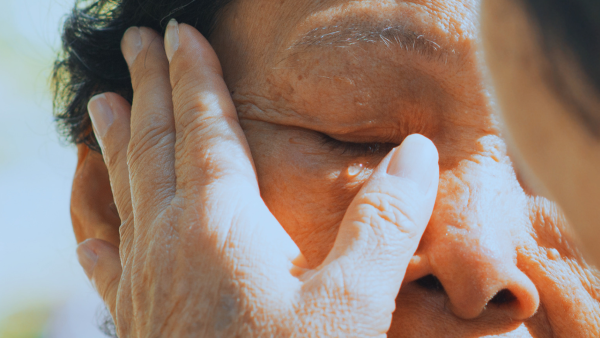
In the specialist’s office, three medical students sat in on the appointment, awkward and attentive. I braced myself for a lecture about the drinking. Instead, the doctor showed her the MRI, the white streaks, the way her brain had atrophied. Depths had opened up without our knowledge.
He told her that her mind would fail, that there was no prospect of recovery. The medical students watched her say, ‘Well, it is what it is,’ and then, while I was asking questions, they watched her softly start to cry.
They scattered from their seats when the doctor announced an eye test. He brought her to within a few metres of a printed set of letters and asked her to cover one eye and read. She was so small, standing there, hunched a little, swaying. The tears made it hard for her to see the text. Water refracting light, just beyond her own length. The doctor reached for the tissue box, and she dabbed at her eyes, her mascara coating her cheeks, dark and clumpy. The medical students looked at me with embarrassed expressions of pity.
In the waiting room, I held her, and she cried, and the social worker cried too.
Overhead the speakers played ‘Girls Just Want To Have Fun’.
〰
For years, when I was angry, or unreasonable, or sulking, I told my partner: I am afraid I am turning into my mother. He would hold me and say, You’re not. You’re not like her. You’ll never be like her.
〰
At the funeral, there were so many toasts. She loved a drink, people said, laughing. Cheers. It’s what she would have wanted. None of this expensive shit, though. A bottle of Yellow from Dan Murphy’s. She always could drink, you know. Like a…you know. Just like that.
I don’t like to speak ill of the dead. But she was ill. She was ill and then she was dead. When we arrived at her house, the paramedics had already rolled her over. Rigor mortis had set in sometime overnight, with the television blaring across the dark living room. The bottle of Drambuie. A plastic cup filled to the brim. Her hands were up near her face, her elbows out. Her knees were bent. She looked as though frozen during a lap of perfect breaststroke.
It wasn’t until then that I realised.
She wasn’t the water; she was the fish.
〰
The coroner’s transport team arrived. They laid her out on a table. Sacrificial, yet snug. It was like a living-room day spa; discreetly trained staff zipped her tight to the neck and requested a washcloth to conclude her facial, such as it was. (To wipe off the vomit and spittle and blood.) The one I found was crunchy with years of laundering. It softened in the tap’s easy flow. The water was cold. She wouldn’t mind, I presumed.
In the brittle bright after the unremarkable van with its remarkable cargo had slid down the drive, I was struck by the washcloth, tossed in the sink. Jellied with viscera, junked in a slick of cold water. I lifted it gently and slopped it into the plastic-mouthed bin with the receipts and the crumbs of her last day alive.
In the shower later, the water was hot on my skin, and as I felt my fingers shrivel I considered my last act of care: not even a warm cloth to pass over her face.
〰
There were phone calls and police and reams of paper. And they decided, in the end, that she had just forgotten. Forgotten how much was the right amount of liquid. She had leapt into the murky brown water inside that red-capped bottle, and just like that she had slipped away.
〰
We emptied the house, stripped it of her presence. Made it clean and neat and scrubbed of history. When the last of the furniture had been sold to hagglers on Gumtree, and the skip had been stamped down and collected, and all that was left were a few power boards and curtain rods, we sat outside, under the pergola. We lit cigarettes and we drank beers, and thus we marked the end of the chaos.
I felt untethered, my vision milky and soft. I perched on the brick barbecue, decades of grease seeping into my jeans. I blew out smoke and watched my breath spread into the night. I lifted the beer. As the first foamy sip of lager hit the back of my throat, god, it felt good. It felt so, so good.