MIFF Critics Campus: On depictions of silence and solace in Outside the Oranges Are Blooming and The Plastic House


KYD presents a selection of film writing from this year’s Melbourne International Film Festival Critics Campus. Now in its seventh edition, Critics Campus is an intensive five-day lab which enables eight emerging Australian film critics to develop their skills in a live festival setting, including mentoring sessions with eight prominent film critics, and access to key Australian industry and media players.
For more great film writing from this year’s festival, check out the MIFF Blog!
Powerful emotions lie just below the surface in Outside the Oranges Are Blooming and The Plastic House, two experimental documentaries screening as a double feature at this year’s Melbourne International Film Festival. Though crafted in different corners of the world—Outside the Oranges Are Blooming was shot in the mountains of Portugal, and The Plastic House, in South Australia—they feel deeply related, reflecting on themes of loneliness, isolation and grief through a similar slow-cinema mode. Each film is interested in the walls we put up between ourselves and the outside world, and only rarely are we afforded a glimpse beyond them. The intricate ways they both walk the line between intimacy and guardedness are involving.
The first sound that we hear in Outside the Oranges Are Blooming is the steady thump of a train moving across the tracks. Writer/director Nevena Desivojević’s central theme is isolation, and here this far-off sound signals to the viewer that escape is going to be something that’s always out of reach—something longed for, but never attained. The film’s subject is an unnamed man who lives alone in an isolated village, deliberately cutting himself off from those around him and suffering (mostly) in silence.
Desivojević, along with her collaborator Cristina Haneș, handles the cinematography, and together they capture stunning images of the slow speed of life in the village. We see a woman sitting silently in her backyard, staring off into the distance; an old man wheeling a cart down an empty street; and a woman picking an armful of lilies from the crop. They also capture the surrounding wilderness in eerily serene frames suffused with overcast skies and shifting mists. Static shots are favoured here, in which action and movement unfold slowly and deliberately. There are moments reminiscent of Andrei Tarkovsky’s Mirror (1975). Both films capture moments of a similar stillness.
Each film is interested in the walls we put up between ourselves and the outside world, and only rarely are we afforded a glimpse beyond them.
Static setups also abound in Allison Chhorn’s The Plastic House. It’s an incredibly assured work full of rich and textural images, all of which were crafted by its writer/director who also took on cinematographer duties. Occupying a space somewhere between documentary and fiction, Chhorn’s film is an exploration of a future grief. Chhorn has said that she ‘constantly fear[s]’ the death of her parents, and so her film imagines what life might be like if her parents die. She inherits the family greenhouse and takes on its maintenance, setting up her camera within this vast space and capturing her work. One of the rare times we hear someone speak is in a scene where a woman (presumably Chhorn’s mother) speaks on the phone in Khmer about how, ‘If you can do a little work, it’s good for you. It’s good for your wellbeing.’
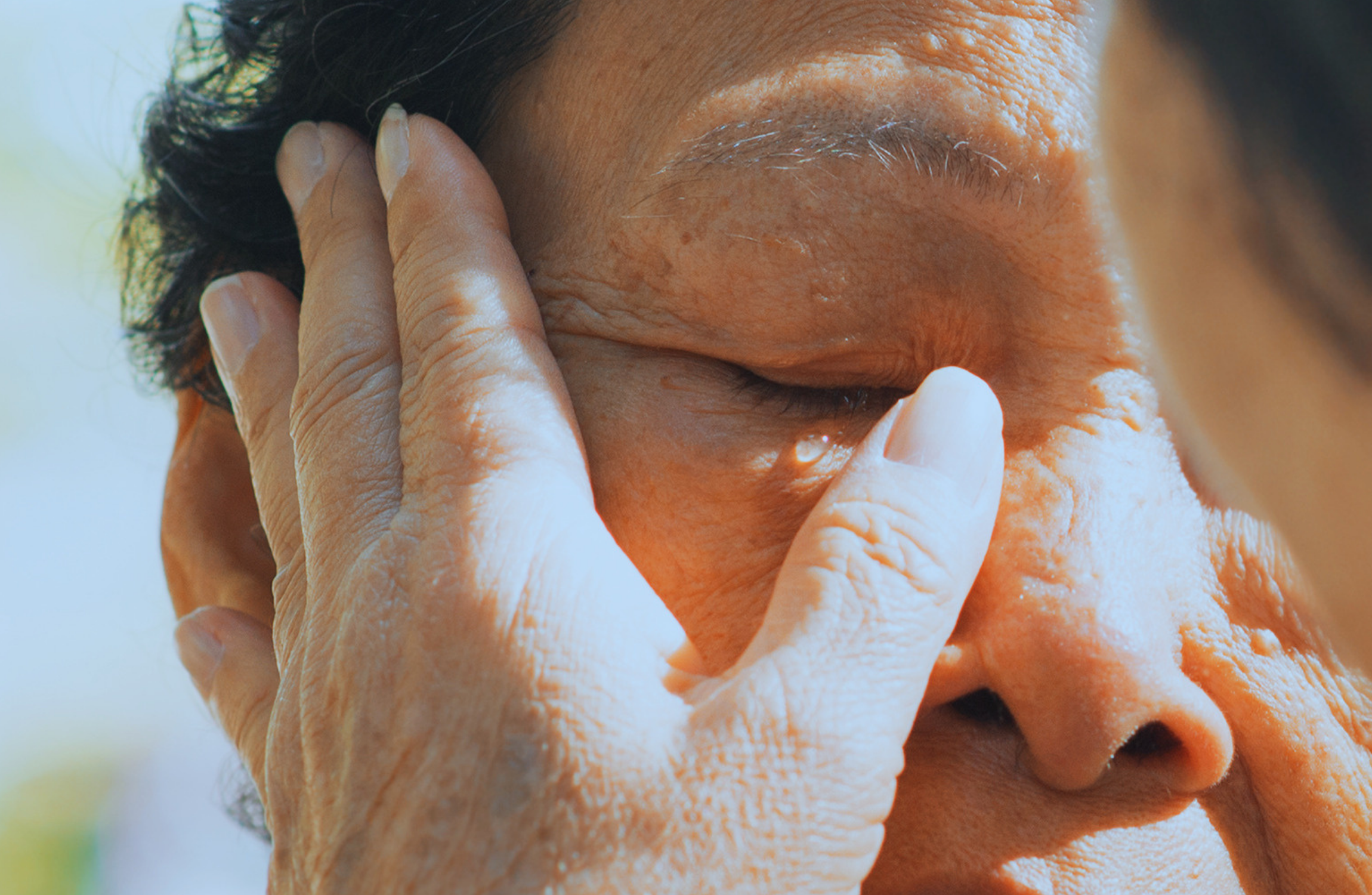
There’s a palpable sense in each film of the camera’s capacity for intrusiveness, of the possibility that it could perceive too much. The first shot of a villager in Outside the Oranges Are Blooming shows a woman standing at the end of a path, staring directly into the camera. She doesn’t say anything, and she doesn’t move. She looks almost as if she’s been caught by the camera. This notion extends to the film’s subject, who, in an early scene, says to Desivojević, ‘Don’t shoot! You are pointing that gun at me.’ There’s a tension and discomfort in all of his interactions with the director. We see him often resorting to covering his face with his hands. The most we hear him speak is when he’s asked by Desivojević about a letter he received from the employment centre. He talks about how the cost of travel to and from the job interview is a barrier. When pressed, he says he might take the job but insists that he won’t ‘work for crumbs’. When he’s told the time of the appointment, he says scornfully, ‘These people do only as they want.’
In Chhorn’s film, this sense of the camera’s intrusiveness feels like it’s being actively resisted by the screens that she positions between herself and the lens. There are numerous shots throughout of hands or bodies behind the greenhouse’s sheets of plastic or its dense crops. Wide-brimmed hats often partially obscure Chhorn’s and her parents’ faces, and there are many scenes of Chhorn working where the camera focuses not on her, but on the crops in the distance. Among the most stunning of the images in The Plastic House are the shots captured on grainy digital video of her parents tending to the greenhouse’s roof after a storm. Chhorn captures the dark shadows they cast on the plastic, which is tinted a deep blue by the stormy sky. In these shots, the pair become spectral figures.
Where Outside the Oranges Are Blooming’s structure is loose—shuttling back and forth between its subject and scenes of the village itself without much of an underlying logic—Chhorn’s film is shaped around the steady rhythms of routine, returning throughout to recurring images and sounds. There’s also more modulation in The Plastic House. The mood shifts in subtle ways throughout, rising to moments of palpable menace, which are heightened by the droning synth soundtrack that’s sparingly featured.
Outside the Oranges Are Blooming and The Plastic House each place great emphasis on what is excluded and unsaid. While we get some sense in the former of the impact of the isolation that its subject both bemoans and brings upon himself, we don’t learn much at all about him as a man. He’s in a state of perpetual stasis throughout, and seems in some ways surrendered to his fate. The Plastic House affords us a glimpse into an immense grief that colours everything around it, but only rarely are we given a view unobscured by the film’s many screens. Chhorn includes a quote from William Faulkner that concludes with the line, ‘I don’t know what I am.’ Both films capture subjects who are grappling with this question of self-knowledge.
The Plastic House and Outside the Oranges Are Blooming are available to stream until Sunday 23 August via the MIFF 68½ website.