From digital mapping to location tagging, our perception of our bodies in physical space has become increasingly filtered through technology. But every knowledge system has gaps and ghosts—what does the impulse to chart our lives online teach us not to notice?


When we first moved to the new suburb, we mapped it with lemon trees. We kept mental lists of where each tree was, how far their branches overhung to allow ease of fruit picking. It was the most natural way, we found, to learn the names of streets in this unfamiliar part of the city. There was one only a few hundred metres down the adjacent road, which reminded us where to turn left on our way to the local oval. Another two or three further along, which we’d flag on our way to the local bottle shop. Whenever we passed a new one, we made a mental note of it; another tree we could return to later, like any old neighbour you might pass on the street.
In April last year, spirals of online research introduced me to the concept of feral fruit maps. I found a communal resource called ‘Fruit trees for picking Melbourne’, hosted on a website for urban hunter-gatherers looking for feral fruit: that is, fruit that falls outside the lines of a private property, usually by growing over or through fences, making it legal for the public to take. Most of the trees marked on the map were a suburb or two over from me, densely clustered around Sydney Road in Coburg, with some locations marked much further afield in Thomastown and Pakenham. I soon found a considerably larger public fruit map named Falling Fruit, spanning multiple continents with over a million marked locations. Yet again, I could only find a couple marked in my own suburb.
Both maps are either made with or hosted by Google’s My Maps feature, a participatory tool allowing users to mark destinations on a customisable template, with various options for keys and layers. I became excited at the prospect of creating my own fruit map, virtually plotting all my local neighbourhood trees to help cover the gaps.
I started by returning to and logging the ones I already knew. As I kept walking, and with my partner’s assistance, we found about 25 more trees of nine different kinds that met the feral fruit parameters, with additions like grapes and fuzzy pears. A few days later, we found twelve more. Quite quickly, I discovered the limits of my ability to identify infant fruit, like when it came to distinguishing between an unripe peach and an apricot. This required more research than first anticipated, on leaf shape and seasonal patterns—particularly when encountering something entirely new to us, like a kurrajong tree (eventually identified using Google Lens). After each trip, I transferred my notes to my personalised map, colour coded by category. Yet where the first stage of walking my neighbourhood, taking notice of, and researching different trees felt so lively and generative, the process of sorting my data, such as it was, left me much colder.
Where the first stage of walking my neighbourhood, taking notice of, and researching different trees felt so lively and generative, the process of sorting my data left me much colder.
To encounter a map is always to encounter a certain rendering of space, a particular application of knowledge. But every knowledge system has gaps, finds tension in the friction between a thing and its representation, what’s recorded and what’s excluded, the ghosts. Histories of Western cartographic navigation are inextricable from conquest and the definition of geopolitical borders. Official maps of modern Australia are almost always colonial constructions: they name, divide, and record as a tool to project a cohesive national identity; they present the illusion of objectivity while operating as instruments of power that erase the truth of First Nations sovereignty. As academic Simon Ryan has written, ‘maps do not reflect reality but produce it in a number of ways, and in so doing represent particular interests and create various realities.’ The idea of any fixed perspective casts objects into a static relationship relative to the viewer; a false, flattened worldview that nevertheless claims mastery over what it represents.
Traditionally, maps are stylised to represent land from a distant, bird’s eye perspective. Viewed from above, places are categorised as stable entities, with those who use the map positioned outside of the depicted world. Digital maps are much less static, however. As geographer Clancy Wilmott writes, mobile mapping is more akin to ‘a system of thinking, rather than a fixed representation’. The map is interpretive, acting and reacting as we move. ‘Mobile phones become intimate mediators between bodies, spaces and the systems of knowledge that determine the limits of our representations,’ says Wilmott. Now, we find ourselves inscribed in cartographic imagery like never before: roaming blue dots envisioned as the centre of the landscape. As we gaze upon the world, we look down upon ourselves.
*
In her essay ‘In Free Fall’, Hito Steyerl writes that the dominant visual mode of digital maps folds our subjectivity into methods of surveillance, our gazes ‘outsourced to machines and other objects’ according to capitalist spatial formations. After all, Google’s geolocation technology was partially developed according to the interests of the CIA, and the data it captures is frequently used in hidden ways by governments and cops. For Real Life, Leijia Hanrahan has recounted how the sophistication of Google Maps is dependent on tracking users, personalising its terrain based on hazy approximations about our identities; Google will not ‘simply show you where you are but direct you to go to certain places and absorb certain information while placing you under observation.’
We find ourselves inscribed in cartographic imagery like never before: roaming blue dots envisioned as the centre of the landscape.
More and more, we project our personalities and interests onto a smooth, seamless map, rather than viewing these places as a collective, shared space. If we use these maps often enough, our visions of our cities become shaped in part by their navigational logics; what we project as well as what the apparatus assumes about us as users. Of course, there are some alternative models—OpenStreetMap uses open data sourced communally by volunteers to attempt a more transparent mapping scheme; decolonial and counter-mapping projects like The Decolonial Atlas use alternative cartographies to challenge settler presumptions about Indigenous lands. Nevertheless, Google Maps remains the internet’s most dominant digital map technology with over a billion users worldwide, thanks in large part to the convenience and breadth of the information it provides.
It would be disingenuous not to acknowledge how useful these technologies can be for navigating and discovering new places. When travelling overseas, I’m almost totally dependent on digital mapping to avoid getting lost. But when directed by my phone, it’s startling how little spatial awareness I require to reach a destination, how easy it is to rely on the disembodied voice telling me where to go. The nearest Coles is only a quick drive from my home, yet it took me an embarrassing number of trips before I could remember to make certain turns on my own. It was as though I had to force my attention away from the automated voice delivering me directions for the route to feel real enough to be worth remembering.
Digital mapping’s method of direction also privileges efficiency: showing me the quickest route based on traffic calculations, sometimes even offering me a new, time-saving option mid-drive. Moved along by the algorithm, there is no time to dwell in place. The joys of noticing are supplanted by whatever action I’m asked to perform next, where I might save time, how long it will take me to arrive.
*
As I walk my neighbourhood looking for fruit trees (and later, herbs), I try to focus on what I can see, hear, smell, and feel in my immediate environment—birdsong (sometimes soft, sometimes rapturous), freshly mown grass, a neighbour washing their car, conversations spilling out of open windows. I become newly aware of the prevalence of public loquat and olive trees in my area, which I’d never before taken time to inspect. Halted beneath a large tree of small oranges, someone walking their dog stops beside me to discuss its possible uses for marmalade. ‘These ones are very bitter,’ they warn, a fact I later add to the location notes in my map.
I think of Rebecca Solnit in Wanderlust: A History of Walking: ‘Walking reshapes the world by mapping it, treading paths into it, encountering it; the way each act reflects and reinvents the culture in which it takes place.’ There’s no neutral way to occupy or regard space. My presence in a place always affects it in some way, much as I’m affected by it in return.
The way we apply attention is hardly neutral, either; it’s social and historical, increasingly informed by the technologies that mediate our interactions with the world. For French critic and theorist Yves Citton, attention is best understood in terms of an ecology: a series of resonances between people and things, shaped by various relations, asymmetries, hierarchies, and digital protocols that always pre-exist us. While attention is individuating, it is also inescapably collective: ‘Even when I think I am gathering on my own, it turns out that we are gathering together: we apply criteria and favour forms which unite us in one community.’
Moved along by the algorithm, there is no time to dwell in place. The joys of noticing are supplanted by whatever action I’m asked to perform next, how long it will take me to arrive.
I’m struck by Citton’s (and translator Barnaby Norman’s) use of ‘gathering’ here, where directing attention might be akin to seeking sustenance. While our attention is often exploited and distorted by the structures referred to above, there’s a kind of attention that, practised considerately, prioritises communal nourishment. The feral fruit maps enact this idea literally: they are the product of users taking notice of their surroundings and applying that information toward a public resource, assisting people in want of free, fresh food. As Citton says of an attention ecology, ‘the quality of our existence depends on our consideration of the quality of the relations that simultaneously weave our environment and our being.’ On one of my walks, I find an overgrown guerrilla garden full of herbs; it brings me the same spark of excitement as the collaborative maps, with their modest efforts toward social responsibility and care.
Citton is also understandably suspicious of the algorithms and data capture technologies employed by companies like Google, whose ‘magic’, he suggests, ‘rests on the automation of the collective process through which we attribute value to the things that make up our world.’ These platforms are sophisticated and useful precisely because they learn from our behaviour. But our behaviours are likewise guided by the manner in which cartographic information is shown to us, the valorisation of certain search results, and what these results exclude. In response, Citton emphasises the value of ‘apparatus-based intervention’—a practice that aims to sabotage hegemonic communication flows from within, introducing ‘elements of blockages, crashes and sudden bifurcations.’ In a sense, culture jamming.
A well-known example of this occurred with Google Maps in 2020 when German artist Simon Weckert dragged a wagon around Berlin containing 99 smartphones with location tracking turned on. After an hour, the line on Google Maps representing whichever street Weckert was on at the time would turn red, indicating slow road conditions. Cars were subsequently redirected away from the chosen areas, to avoid what Google had interpreted as a traffic jam, but was in fact just the artist and their wagon. While some outlets reported the performance as a ‘prank’, Weckert’s intention was to emphasise how power is exercised through digital mapping technologies, with demonstrable effects on how we move through physical spaces.
On a smaller scale, there’s the creation of fake locations—but instead of scams, think spam, which Hito Steyerl has suggested can be part of a withdrawal from the demands of representation. You can write a message to your lover in the form of a fake business listing, like an alleged restaurant I find in Ecuador named ‘I LOVE YOU JEY FROM MARTIN’. Or try a tongue-in-cheek digital monument. Type ‘Harry Styles’ into Google Maps and you’ll likely find multiple locations dedicated to the pop star, sometimes listed as sites of worship, with fan photos and video edits that help drive traffic toward them. Teens with grudges have also been prone to renaming their high school’s listings, like this famous case in the UK. While rarely politically consequential, a little chaos can be worthwhile.
Type ‘Harry Styles’ into Google Maps and you’ll likely find multiple locations dedicated to the pop star, sometimes listed as sites of worship.
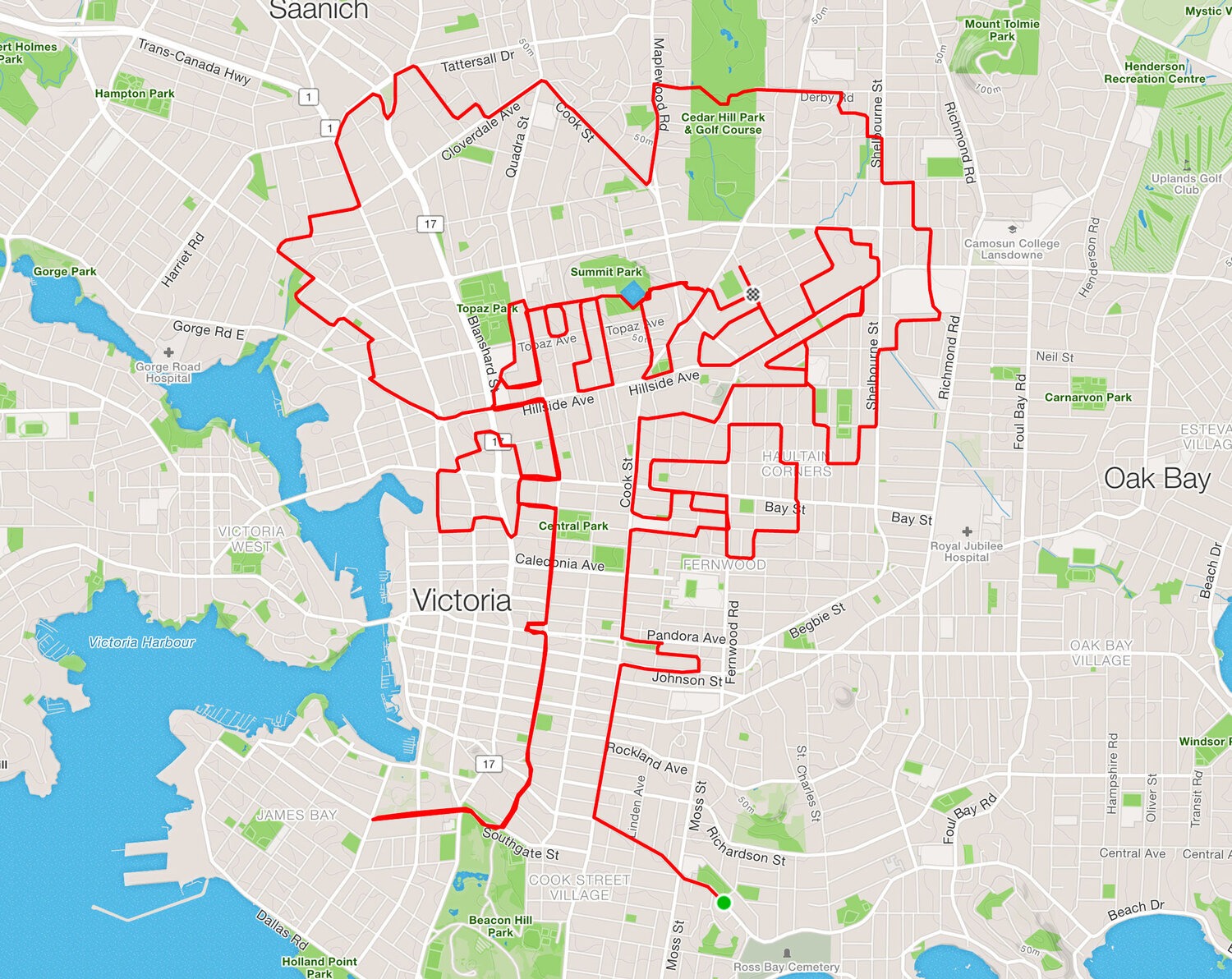
We also find this desire to play with GPS technology on other platforms, like the popular fitness app Strava, which tracks individuals’ physical activity and allows them to commemorate a successful run or ride by sharing a map of their journey with friends. Strava’s location tracking has been criticised in the past for serious potential privacy violations. A few years ago, their heat map feature accidentally exposed military bases in the US. But users have also toyed with the tech, to produce Strava Art: routes resembling certain objects and icons, from a portrait of Breaking Bad character Walter White to surprisingly proficient nudes.
Then there’s Instagram which, like Google Maps, also allows users to add new locations. Earlier in its life, the app let users tag their location on posts as anything they wanted, with the ability to add new places to Instagram’s database with ease. Use of wordplay and fictional locations (eg. ‘Shrek’s Swamp’) proliferated. Nowadays, though, the process is much more involved: to add a custom location to Instagram requires going through their parent company, Meta, where the effort required is usually not worth the joke. The reasoning behind this change is banal and expected—Instagram wants its locations to refer to real life, so that physical places and associated content can be more easily found and tagged by their proper names. There’s much to be said here about surveillance and the demand for more accurate user data, how the request that our online activity be rooted in physical reality inevitably incorporates mapping into our cyber identities. As Apoorva Tadepalli wrote in 2019 of this practice: ‘Place becomes absorbed into person; it is a function of person, rather than the other way around.’
Our attentional capacities develop slowly. Having the time to truly pay attention is a privilege. But culture jamming can be one form of reclaiming attention in the digital sphere, or at least a tactic of wilful distraction. By altering our behaviour against a technology’s capture methods, the conditions by which it maintains its reality can be exposed. This purposeful wielding of the user’s attention declines to be attentive to the ‘right’ information, diverting from one thing and drawing towards another. It has the potential to alter the terms on which we engage with a platform by wilfully misusing it, thereby dulling its effectiveness (Let’s be honest, Google Maps is already prone to glitches and misdirects, and Apple Maps remains the butt of many a joke). It’s attention as refusal, by which I mean refusing to give it up easily, in the forms a company like Google demands it.
*
Sometimes, adding to my personal feral fruit map feels like plotting my own memory. I form a deeper relationship to my suburb by understanding it through the lens of something more meaningful to me than roads, property, and businesses, all of which serve some form of capitalist, nation-building purpose. Every logged location recalls an embodied encounter. But while personal cartographies can help counter hegemonic depictions of space, there’s clear irony in using a corporate, privately-owned technology to do this, one premised on a Western, colonial, ‘God-like’ gaze. By marking my neighbourhood discoveries on the virtual map, I’m still engaging in a fraught history of narrativising through mapping, inserting myself into the land (or Google’s projection floating on top of it). Every Google Maps production is beholden to what its protocols make possible, though they might seek radicality in other ways (see also the many projects dedicated to queer cartography, like Lucas LaRochelle’s fantastic Queering The Map). What other absences haunt cartography’s enclosures?
We cannot help assigning meaning to the places we inhabit. We shape them with memory, with ritual, with relationships. Yet we might try to unsettle our gaze, disturbing its presumptions.
We cannot help assigning meaning to the places we inhabit. We shape them with memory, with ritual, with relationships. It’s how we get around, engage, and make sense of our world. Yet we might try to unsettle our gaze, disturbing its presumptions. Like a map, attention is exclusionary by nature; we take note of some things to the exclusion of others. But we can be open to a multiplicity of gazes and histories. True attentiveness ruptures the individual as a discrete being, tending towards something, away from oneself, both self and space constantly being remade. When searching for fruit trees, I try (perhaps naively) to look with someone else—with a future urban hunter-gatherer, all the previous passers-by who might’ve paused in the same place—and with a relation of living things around me. Openness to the openness of space. Citton again: ‘we see better because we endeavour to see with.’
I add my local fruit tree discoveries to one of the larger public maps, limited as my knowledge may be, hoping to contribute something small to the communal feral fruit database. While these resources may be limited by the possibilities of Google’s platform, they’re still the result of large-scale attention, individual and collective. The pleasure of noticing is contagious. Alone, my private fruit map may be an elaborate way of personalising the landscape. But as part of a larger resource (guided by a common code of ethics), I have to believe there could be the glimmer of something else. I am not anywhere, but the collective effort, dispersed virtually, spreads everywhere.