

Glimmer
This morning there is dirty seafoam like a coffee stain along the lip of the shore. It trembles and collapses, calling to mind the time you had an affair with a married man. You walk along the beach, sometimes kicking up the abject froth so that it flies off in the wind, remembering how it happened. It was a while ago now, but you still think of him from time to time.
Next year, you will graduate. The creative writing program has taught you that the best short stories should contain a single grain of truth. You have learned to use bright adjectives and dynamic phrasing. You are supposed to be poised and precise. You are supposed to write what you know. Well, what do you know? You know that love has always been the most compelling source of knowledge in your life. You want to write about the affair but worry that your story, your imperative, is deeply unoriginal.
One of your creative writing teachers says originality is a redundant category: all contemporary writing, she says, already suffers from the affliction of intertextual polyvocality. You consider this and kick up seafoam. If you wrote it, you would have to change some names and dates and places. If you wrote it, it might begin like this.
One Friday there’s a party after work to celebrate the acquisition of a new, important manuscript. You work for a publishing company although you’re not a publisher, just one of the girls from Reception. Mostly, people look down on you. The women are too busy doing all the work to pay you much attention and the men are like most others. An older gentleman has asked you why you dress like a dolly. A junior publisher dropped a highlighter in between your breasts, claiming it was accidental. Another one, the man who hired you, said that it’s good to keep the pretty girls at Reception because it makes the business seem successful.
The man in question is different. If he thinks these things, he doesn’t say them. He is exceptionally tall, with very dark hair and very light eyes, a combination of extremes. His features don’t quite fit together, which makes him handsome in a peculiar way. And there is something unsettled in his carriage too; he seems skittish, a strange mix of confidence and nerves. You don’t know when it was that you first noticed him, but as he steps out of the lift tonight, he smiles.
You are supposed to be poised and precise. You are supposed to write what you know.
The party is something you’ve helped organise and you are anxious for the whole thing to go well. You take photos of the happy revellers for the company’s socials, greet important guests and in the downtime drink champagne to calm your nerves. You should probably slow down but it’s expensive stuff, the kind you can’t afford, and you want to drink as much of it as possible. At some point in the night you catch his eye across the room and after that you can’t stop looking at each other. Furtively at first, and then with open wanting.
There are speeches to be made about the book. It’s the next big thing, a book of essays written by a hot young writer with a slick resume. Most of the essays are about partying, fucking, art and the sublime. The writer arrives dressed in black, sulks beautifully and never smiles, even though this must be one of the most important nights of his life. Everyone wants a photo. Marketing is palpably excited about adding his book to the company’s vibrant queer collection.
Even though you’re just a receptionist, you are not without your wiles. You persuaded one of the publishing assistants to let you read an advance copy and believe the book will be successful, even if its transgressions are more aesthetic than exciting. Still, you liked the bit about the birth of Aphrodite, how Kronos castrates his father Uranus and throws his balls into the sea, which roils mightily and churns itself to froth, and out from the foam pops Aphrodite. Aphros is actually the Greek word for seafoam, which turns out not to be a benign substance but the residue, so the writer argues, of erotic excess.
Eros is catching.
Professional standards are cast aside like useless garments and the night becomes debauched. A blonde woman takes her shoes off and starts dancing on the table. The bosses bring out more champagne. Singles start to couple and uncouple, while established couples take on thirds and fourths. In this spirit, you and the man flirt shamelessly. He invites you for a cigarette and you follow him down to the car park, where he licks the TALLY-HO paper and desire bubbles up like something primordial in your loins. Yes, you’ll use the word loins, because it’s funny and accurate. You will ask him if he’s read the book, but do not be deterred when he says he found it unoriginal.
‘Any wanker with an arts degree could have written that.’
‘Do you have an arts degree?’
‘English Lit. I thought I wanted to write novels—’ he drags on his cigarette, then offers it to you, ‘but they quickly beat that out of me.’
You’re not sure what he means about the beating, although you’re titillated by its kinky undertone. The way he laughs about his failed dream is quite endearing. ‘You must have read a lot,’ you say, all drunk and googly-eyed. ‘You must be a really great reader.’
He shrugs, finishes his cigarette. Then he steps right up and kisses you. To think that any minute someone might come down to get their car and spring you! He pulls you in and kisses you harder. It is difficult to breathe. You make out for a while and then he says he should go home.
Afterward, remember how he said I want you. You want him to say it again, even if it’s cheesy. Start noticing things that rhyme with I want you, many of them to do with cheese: cheese fondue, danablu, brocciu. But also, seafood stew, beef ragu, pad see ew. Oh yes, you want him to eat you all up! Would he be a noisy chewer or a silent one? Fear noisy. Dream the two of you are on a beach when a storm whips up a great big wash of seafoam and the man says he is hungry and bends down, suddenly, to scoop a palmful of foam into his mouth. I want you and your seafoam, too. What a weird dream. You wake and masturbate energetically, foaming and gushing like a mythical sea.
Monday morning: everyone at the office looks seedy or sheepish. You send an email on the office server, something admin-related though covertly suggestive, and when he replies you agree to meet for drinks.
Afterward, remember how he said I want you.
You arrive at the appointed spot a little early, which makes you seem overeager, and then he is late, which makes you think he isn’t coming. Clinging to the bar stool as the corporate crowd gets drunk and then goes home for dinner, you read your book and try looking serene, as if reading alone in bars is just something you do. Think: I am cool. I am a very cool person.
About forty minutes later, just as the date is beginning to seem lost, he walks in wearing cowboy boots. ‘I’m sorry,’ he says, ‘we couldn’t get the kids to sleep.’
It’s distinctly unsexy, as far as openers go, but you can’t help admiring his bold choice of footwear. His jeans are lightly tucked to expose the high stiff leg, the tall curvaceous heel and shining cherry leather; they make him stand a little taller. He looks sexy and desperate: a hot literary cowboy part way through a midlife crisis.
‘You look familiar,’ he says.
‘Do I know you?’ You look around the room. ‘Have we met before?’
He gives you an indulgent smile. ‘What are you reading?’
It is Lorrie Moore’s Self Help; the first story is called ‘How to Be an Other Woman.’ Allow yourself a nervous smile. Tell him that the narrator is sharing a Reuben sandwich with her colleague, making a lot of tragic puns.
‘Yeah, I’ve read it,’ he says. ‘Not really my thing.’
Feel embarrassed. Accept his offer to bring you, next time, something better to read.
A routine is established: he lends you books and you interpret his reasons for lending them as you would decipher code. He prefers the type of künstlerroman which has gained cachet in recent years; it’s your suspicion that he fancies himself a secret Knausgaard or perhaps a Cusk. Even more than this, the man admires feminist autotheory, and you can’t decide whether this is evidence of his good taste or a studied pose to get you into bed.
In any case, it is an education. While reading, you take a pencil and underline suggestive passages. You spend a lot of time with I Love Dick, trying to impress and arouse him with your coy marginalia. At other times your messaging is pretty obvious, such as when you underline, in Chelsea Girls, I only like getting drunk and being in love. Above all, you understand what Maggie Nelson means when she writes about the pulsing of a pussy in great need of fucking. You know that he will flip through the book when you return it and read your desire all the way through.
For the sake of character development, consider the difference in age. He is older than you by fourteen years; enough to make it thrilling for being hardly inappropriate.
Sometimes you think of his domestic life, the one he carries on without you. It is easy enough to look up his address at work; coincidentally, it is not far from your house. Walking to the shops one day, you cannot help but travel past it. There is a lemon tree, an SUV, a family of bicycles, some planter boxes and a cubby house in the front yard. A fluffy cat sits in the window, glaring. You hate his car. You hate his cat. You wish you hadn’t gone there. From now on, even when your curiosity is meowing at the window, do not ask about his artist wife and two small children, whose names are Sebastian and Claudette. Glean this in passing, like any good mistress. But don’t think of yourself as his mistress, because that character arc is limiting and has been way overdone.
Instead, think about your part in a long hysterical you mean historical tradition. As an aspiring writer it’s a rite of passage. You’re in it for the story. You’re gonna write the next Karenina or Bovary or whatever, this is an experiment, it’s autotheory; you’re Chris fucking Kraus.
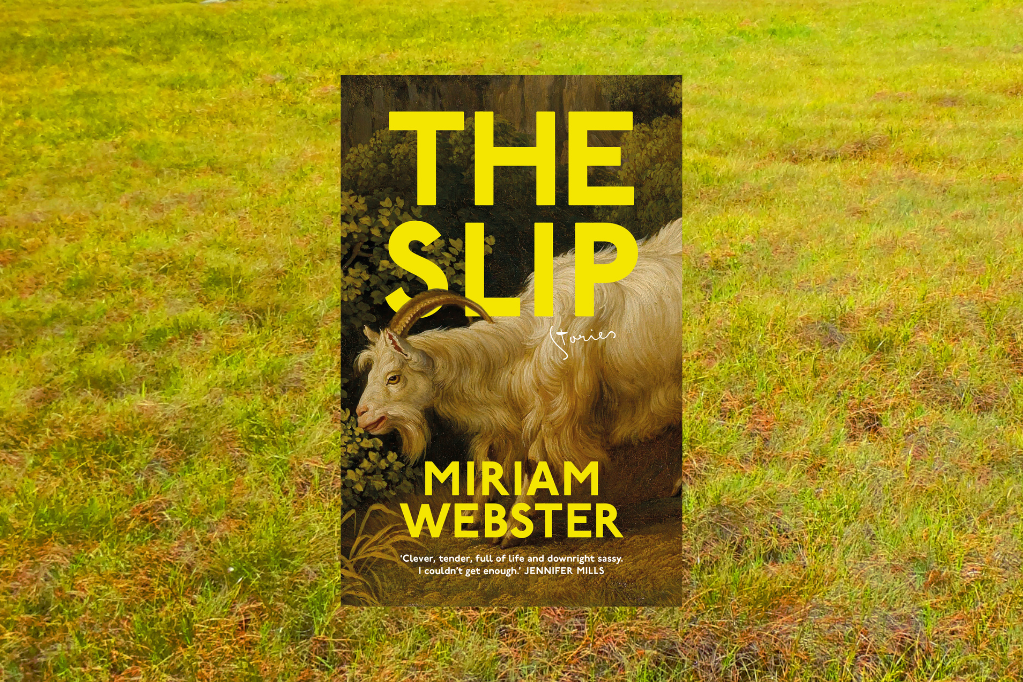
This is an extract from The Slip by Miriam Webster (Aniko Press), available now at your local independent bookseller.