The writer and playwright on bringing Cory Taylor’s final book, Dying, to the stage.


You’ve written a play before, but this is your first time adapting someone else’s work for the stage. How did this come about?
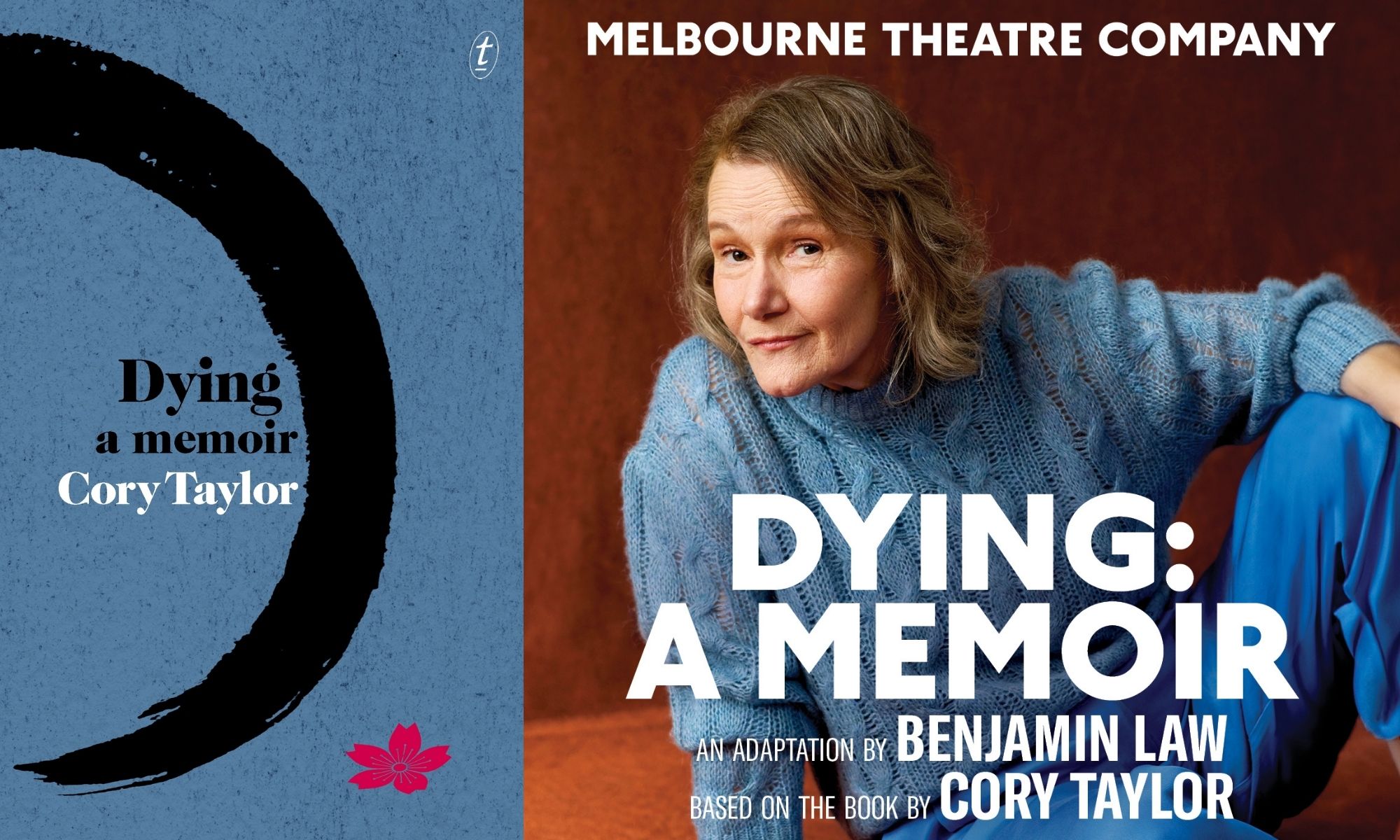
Melbourne Theatre Company and I kept in touch after I wrote my debut play Torch the Place for them. When I started talking to artistic director Anne-Louise Sarks about the proposition of adapting Cory Taylor’s Dying: A Memoir—a slim book about what it means to die, which very few Australian readers know about despite international acclaim—neither of us could really shake the idea. Jean Tong came on board as director, and between us, Genevieve Morris was one of the first names we discussed to play Cory, which felt right for several reasons over: Genevieve has her own lived experience of cancer, comic actors make the best dramatic actors and Genevieve is an often-overlooked Australian legend of her craft, just like Cory.
You were a part of the Brisbane literary community at the same time as Cory. What do you remember about her and this time?
Cory was witheringly funny, ferociously smart and plain no-bullshit. We knew each other from Avid Reader, the legendary independent Brisbane bookshop, where I worked as a bookseller, and she was a voracious reader and customer with exceptionally good taste. She was finishing off her PhD in screenwriting just as I was starting mine, so she quickly became a mentor, as well as a friend. And because we were from different generations, we introduced each other to books we’d otherwise have never encountered. Also, two of our family members dated for a while, so she was unerringly accommodating and patient with my completely deranged family for years and years—bless.
In the book, Cory writes, ‘death is a taboo subject, absurdly so’. Why do you think it’s important that this is something we talk about?
Our culture is in constant denial about death. We intellectually know that it’s inevitable, but we don’t make plans for it, don’t discuss it and lack the language for it, which makes it profoundly terrifying when we need to face it. And terror shouldn’t be what we are forced to experience in the last and most vulnerable chapter of our lives. But this book is also for those of us who are facing the prospect of our loved ones dying, and forces us to ask: what does a good farewell look like? Cory writes with brutal matter-of-fact clarity about the shitty farewell she and her siblings gave her mother, and how the lack of ceremony and ritual haunted her. But theatre is, in itself, ceremony and ritual, and we want to give audience members that sense of gathering and remembering, sharing sorrow and love in the same room.
Our culture is in constant denial about death. We intellectually know that it’s inevitable, but we don’t make plans for it, don’t discuss it and lack the language for it.
The book had an amazing reception on release, with endorsements as far-reaching as Hilary Mantel and Barack Obama. Why do you think it had such an impact at the time?
The book is very Australian—there are references to skinks, kookaburras and the Brisbane River—but death is universal, and Cory’s writing is world-class. There are so many important books about grief, but very few about what it is like to die. And it takes a writer like Cory to not only take us there, but give us an unsentimental, wry and wise insight into what it might be like for all of us when we get there. That’s such a gift, and one that hadn’t really been given widely in publishing before Dying: A Memoir.
You’ve said that dutifully faithful tributes don’t tend to make for compelling theatre. How did you manage to adapt this work while staying true to the person who wrote it?
Cory and I used to talk about plays and playwrights quite a bit, including David Hare. And it was Hare who said, ‘The great mystery of adaptation is that true fidelity can only be achieved through lavish promiscuity.’ It was director Jean Tong who really encouraged me and helped me find a path towards—by divorcing myself from the book’s structure and ensuring the work earned its place on the stage. The last thing we wanted to create was a live in-person audiobook reading of someone’s work. We needed things the book didn’t ostensibly provide: dramatic tension, a central quest and a plot. Paradoxically, pulling the book apart and making sure it worked as theatre ensures that spiritually, it’s very aligned with the book’s feel and mission statement.
The act of writing is such an important part of the book itself. Is this something you have incorporated into the play?
There are so many beautiful passages about writing itself in Dying: A Memoir. ‘It is my bliss, this thing called writing,’ Cory writes. ‘It isn’t just the practice that enthrals me, it’s everything else that goes with it, all the habits of the mind. Writing, even if most of the time you are only doing it in your head, shapes the world and makes it bearable.’
One of Cory’s key missions—both in the book and this stage adaptation—is to produce her final book. And yes, it’s writing that provides the on-stage dramatic breakthrough for her wrestling with the prospect of dying.
Cory wrote that she’d like to be remembered by what she’d written. Aside from Dying, where would you direct readers discovering her work for the first time?
Sadly, Cory only wrote two other novels. But this also means you can blitz through her incredible back catalogue very quickly, and both of her other books are as sublime as each other. Me and Mr Booker is an instant coming-of-age classic, witheringly funny, quite fucked-up and sexually complex. It won the Commonwealth Writers’ Prize and you’ll read it in a day. Then move on to My Beautiful Enemy—a gay romance set during Japanese internment during WWII in Australia—which showcases her ambition. It was shortlisted for the Miles Franklin Award for a reason.
Dying: A Memoir is on at Melbourne Theatre Company from 25 October to 29 November 2025. Special offer! MTC is offering KYD readers exclusive $75 tickets. Get in quick—this offer is strictly subject to availability.