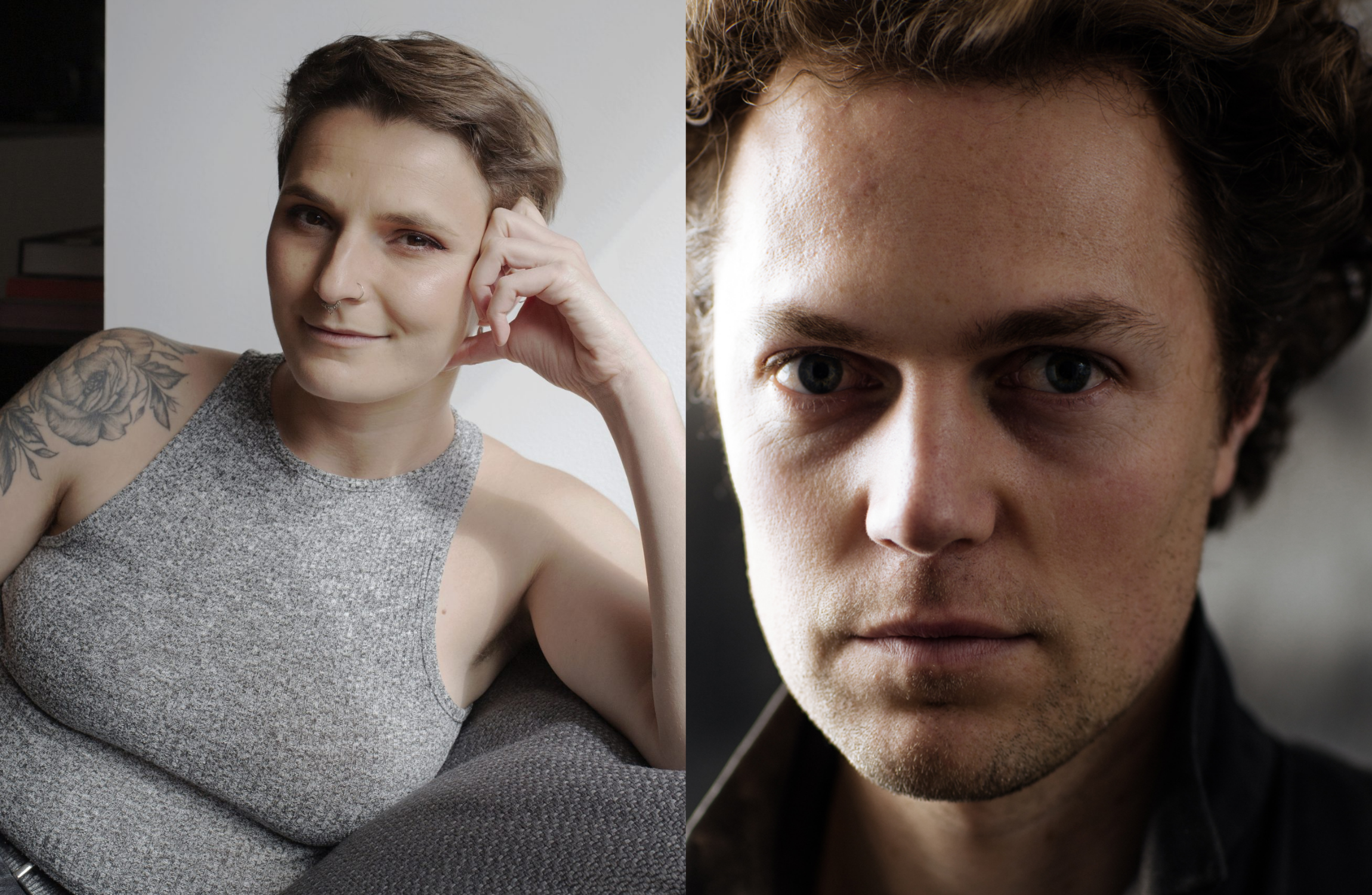
An industry interview with Emily Hart and Margot Lloyd, founders of an exciting new Adelaide-based publishing house.


Pub Talk is an interview series where we chat to some of Australia’s most experienced and influential people in publishing and the arts.
Congratulations on the launch of Pink Shorts Press! For the uninitiated, could you tell us what it is?
Margot Lloyd: Pink Shorts Press is an independent publishing house. Emily and I have worked in the book industry for over ten years, but we always wanted to do it ourselves, and it’s finally happened!
Emily Hart: We publish fantastically readable, socially conscious and slightly offbeat books, and we’re proudly South Australian.
Could you explain the name?
ML: First of all, it’s fun, which describes us to a certain extent. But ‘pink shorts’ is a very specific cultural reference. Don Dunstan was the premier of South Australia in the 1970s, and he loved the arts and embraced them wholeheartedly. He set up the state theatre company, the state opera and various other arts organisations that continue to this day. And he’s very well known for wearing a teeny tiny pair of pink shorts to Parliament House very proudly.
EH: He was also very socially progressive. South Australia was leading the country when it came to decriminalising homosexuality and Indigenous cultural policy. It was a golden era for the state, and we wanted to pay homage to that time.

In your newsletter, you talk about ‘literary villages’—places that may be overlooked but have a vibrant love of storytelling and book culture. What makes Adelaide literary?
ML: We always knew that Adelaide was a pretty literary place. Adelaide Writers’ Week is the oldest writers’ festival in Australia and one of the most storied. Griffin Press, which is in Salisbury, an outer suburb of Adelaide, prints most of the paperback books sold in this country. You’ve also got the Angry Penguins history—there’s a bar here called Ern Malley that hosts readings. You’ve got MidnightSun Publishing. Rigby was huge…
EH: Rigby was the biggest publisher in Australia in the 70s. We also have the oldest writers’ centre. Also, Melbourne, the classic example of a ‘City of Literature’, is so sure of itself. I feel like Adelaide has this ongoing identity crisis that is much more interesting. There’s room to be a bit more playful outside the clear boundaries of the industry. A big driver for us is the fact that the east coast kind of forgets that the rest of the country is here, in a lot of different spaces, but also in book publishing.
ML: You have to take the piss too. Like that wonderful story about Salman Rushdie coming here for Writers’ Week once and finding it too creepy. (Laughs.) But the writing community is incredibly supportive, and people like to have a drink and enjoy the arts.
Subscribe to stay in the loop
Be the first to read new stories, discover publishing opportunities, and access resources. For people who love great writing.
You both bring different experiences to the table. How did you both get started in publishing?
EH: That’s nice, because sometimes we feel like we bring too much of the same thing. We’re both editors first and foremost. Sometimes we’re like, ‘Wouldn’t it be great if one of us were an accountant?’ (Laughs.) We met while working at Wakefield Press. Then I decided I needed my Melbourne time, a rite of passage for lots of people from Adelaide, and I worked at Hardie Grant. I was there for six or so years, as an editor and then as publisher. I was working on some big commercial books—some beautiful books, a lot of fun books and some serious books as well.
A big driver for us is the fact that the east coast kind of forgets that the rest of the country is here.
ML: And in that time, I was studying and working at Text in Melbourne, and then went up to Brisbane to work for the University of Queensland Press (UQP). I was working on lots of literary books and poetry. But then I left and went to Griffith Review, where I still work one day per week. My training was a bit different: I have a formal qualification in editing and publishing from Monash, though that course doesn’t exist anymore. Emily’s experience was more of an apprenticeship…
EH: Yes, I started at Wakefield as an events coordinator, and everyone kindly showed me how to edit a book. (Laughs.)
Without a publishing qualification, how did you get your foot in the door, Emily?
EH: I worked at a bookshop in Adelaide called Dillons, which was a wonderful experience. When I went for the job at Hardie Grant, they were almost more interested in my bookselling experience than my publishing experience. You see how customers make those decisions in store, what types of book covers don’t wear well—that very practical stuff.
But when I was applying for jobs in Melbourne and Sydney, and realising that the other people going for those jobs did have a publishing degree, working at a small press like Wakefield helped. I saw every single part of the publishing process. We did our own distribution. We did the publicity for our books. We were answering the phone for a customer who didn’t receive their copy. I saw everything right from start to finish.
I also did a marketing degree once upon a time, and I always say that publishing is really marketing. If you ever do a marketing course, they talk about product, packaging, placement and promotion. As a commissioning editor or publisher, you’re thinking about those elements all the time.
How did starting your own publishing house come about?
EH: Pink Shorts Press came together when we were both doing the Residential Editorial Program in Sydney. It’s like editorial nerd camp, and we went on a morning swim every morning, and the idea formed on those swims.
ML: We spent a lot of time talking about what we loved about the industry and what we loved about our jobs. But we also spoke about the things we would like to see done differently. And that was inspiring too, having that at the back of our minds when we went back to our jobs afterwards. Then there was a point during the pandemic where we had a phone call and were just like, ‘Is there ever going to be a good time to do this?’
EH: A few years back, there was a real unionisation push in the industry. I was seeing that play out at Hardie Grant, and Margot was thinking about that a lot at UQP. And it spurred a lot of our conversations. It’s not like we have an answer for all those issues. It’s hard not to work within the structures, for example, when it comes to distribution or royalty systems. We thought that being a bit smaller could help us change things up.
You launched in March with Sea Green by Barbara Hanrahan, which was first published in 1974. Why this book?
ML: It’s hard starting a publishing house from scratch, because so much of your income comes from having a backlist. But also, it’s hard to tell people what you’re going to be when you don’t have an identity yet. We wanted to republish a South Australian classic book to launch ourselves as a publishing house and give people an idea of who we are and the kind of work we want.
A lot of things in publishing are the way they are because that is the way they’ve always been.
Barbara Hanrahan’s The Scent of Eucalyptus is something quite a few South Australians would have read at some point. It’s still in print at UQP, and it’s a book that’s based heavily on her childhood here in South Australia. She’s better known as a visual artist, but she did write fifteen books during her lifetime. And she died at fifty-two, so she was very prolific. We started looking at some of those other books that are no longer in print, and Sea Green just absolutely stood out to us.
EH: Sea Green is about a young woman who feels like she has to move away from Adelaide to take her next step in her creative career.
ML: Obviously, this felt pretty synchronistic for us. (Laughs.) Keep in mind, we were reading this book when we were living interstate, so it spoke to us. But aside from the general themes of it, it’s the writing that grabbed us—it’s incredibly modern and fresh, and it feels like it could have been written yesterday, even though it’s based on her experiences in the 1960s and was first published fifty years ago.
How did you get the rights from the estate?
ML: Tracking down the rights was relatively easy. Hanrahan’s life partner, Jo Steele, is still alive and lives in [Adelaide suburb] Hyde Park in a house that’s a shrine to her. It’s an incredible house full of her artwork. He’s an artist too, a sculptor, and an incredibly lovely man. We reached out to him, and he was just thrilled at the idea that some more of her work would be brought back into print. He’s been so supportive.
EH: He also allowed us to use the artwork for the covers (we’re also publishing Hanrahan’s Annie Magdalene in August), which has been a massive thing because it means the books are so inherently beautiful.

It’s also a feminist classic. There have been recent articles in the Australian about the ‘disappearance of the white male writer’ and the validity of the Stella Prize. Why do you think it’s important to continue to highlight women writers and promote inclusivity in general?
ML: Reproductive rights are still so important to talk about, as is what happens in relationships when there is a power imbalance. All of those things are themes of Sea Green and are issues that we’re absolutely still grappling with today.
In terms of broader diversity in Australia, we have a problem with representation in this country. We’re both passionate about trying to make sure that’s addressed, and that writers, when they get their work published, are supported properly through that process. Sea Green is a great example of a book that would have been difficult to write and to promote for the author. We want to make sure that when people publish work that may make them feel vulnerable, they’re given adequate support through that process. In publishing, sometimes it doesn’t feel like that happens, and it can be quite devastating.
Do you think the development of writers, especially in the early stages, is lacking in the publishing industry?
ML: Short answer, yes. I think that, unfortunately, large parts of the industry don’t have a lot of time for this developmental work. There’s a real need to keep moving, to keep publishing more books. You often don’t have the time that you would want with emerging authors to develop a relationship with them, to develop their work with them, to be able to say, ‘You know, we’re interested in publishing this book, but it might need several more rewrites and that might take several years.’
We want to make sure that when people publish work that might make them feel vulnerable, they’re given adequate support.
EH: We also can’t pay authors for a lot of that work up front—an advance will only take you so far, and we know that the pay that authors get in Australia is woeful. I wish that I had a better solution for that, but what we can offer is editorial support. We’re keen to support writers over a longer period. For a lot of people, their first novel is not their best novel. It’s what comes next that’s more exciting.
You are releasing debuts by Alex Cothren and Olivia De Zilva in August. How did you find those manuscripts?
EH: When we first sat down, we wrote two dream lists to get that sense of what our publishing house would be like. The first was books that we wish we’d published, and then we did a list of our dream mix of writers. Olivia was on that list. We’d read her work in various online publications and loved her voice. So, we reached out to her, and the manuscript for Plastic Budgie was sitting there ready to go.
ML: Alex was more of a surprise. Playing Nice Was Getting Me Nowhere came to us via an agent and was sent through the day I gave birth to my son. It was meant to be.

You are currently open for submissions. What would you like to see from budding authors?
ML: We said initially that we were interested in non-fiction, and then we launched with four fiction books. (Laughs.)
EH: Which feels like it has been good timing—it’s been a bit of a tricky time for non-fiction.
ML: We kept finding fiction work that we think is incredible, so we’re open to it. We’re also open to poetry. But we’re looking for things that have a little bit of a quirk to them, things that are often on the shorter side as well. Things that might struggle a little bit to find their foot in the door with one of the larger publishing houses.
EH: The only thing we’re not doing is kids and young adult—it’s such a specialised skill set and something we don’t have heaps of experience in.
ML: We’re also looking to publish writers who are living in South Australia or have a connection to South Australia. It is not a hard–and–fast rule for us, but it’s what we’re prioritising.
What should writers send in?
EH: We ask for 20,000 words or about a third of a manuscript—a representative portion to give us an idea of the work. On a practical front, one of the things we want to do with Pink Shorts is to be collaborative and supportive. We’d be happy to commission from an excerpt and sit down with an author and give them that real editorial hand-holding and expertise that we’ve got.
ML: We’re also very inspired by McPhee Gribble. You know, if a Helen Garner-type author wants to ride their bicycle over to us and hand-deliver a manuscript, we’re open for business. (Laughs.)
Do you have any advice for writers when it comes to pitching their work?
EH: Our submissions page has sections that prompt people to think about the pitch differently from the synopsis. Some people still put very similar things in those two prompts. Writers should see a pitch as not what happens in the book but the place to explain why people would want to read it and who those people are. It is tricky to pull those things apart because authors think that if people want to read it, it’s because it’s about these things. But it’s not the same.
We’re looking for things that have a little bit of a quirk to them.
ML: It’s great to go into a library or a bookshop and look around and think, ‘Where would my book sit? What would it look like?’ It can help people think about who your reader might be and how you could reach them. That being said, a lot of that’s our work.
The industry has been in a state of flux lately. What do you make of it all?
EH: We launched around the same time as the Adelaide-based lit journal Splinter. For us, it feels like such an exciting moment to have a new literary journal and a new publishing house launching, not just in South Australia, but in Australia in general. It’s a tricky time for the industry, with some pretty high-profile buyouts of independent publishing houses.
ML: It is a difficult industry. The margins are incredibly tight, and there have been some real shocks in terms of rising paper prices in recent years. But the history of publishing is a history of mergers and acquisitions. It’s always been like this. And people always read. There’s always a lot of doom and gloom about the end of publishing. When I first got into the industry, it was all over because of ebooks. At the moment, it’s all over because of AI. I don’t think anyone declared it was all over because of audiobooks. Did they?
EH: I think audiobooks have been such an excellent thing for books.
You must be optimistic to start this publishing house in this climate?
EH: That is probably the biggest prerequisite for starting a small publishing house: blind optimism. There’s no real reason to do this apart from loving it and having a good time.
ML: But also realising that people continue to love books. People love good stories. That’s not going anywhere.
You use a nationwide distributor and have a traditional publishing model. Are you able to outline what that means for your authors?
ML: The fact that we’re distributed by Simon & Schuster means that we are available in bookshops all over Australia. It’s fantastic having this support, it feels like we’ve got a whole team behind us. They’ve got sales reps who are just wonderful at getting our books out there, and we’re grateful for that.
EH: In terms of the advance and royalty system, it means that we’re not a hybrid publisher. We’re not a self-publishing enterprise; there’s no pay-to-play. We’re a traditional publisher in the sense that we will give you an advance for your book, and then we’ll pay you a royalty rate, which essentially just means that we always pay you, not the other way around.
Your publishing schedule is currently to release books twice a year. Will this be an ongoing strategy?
EH: Yes, definitely. With big publishers, we were churning out books all the time. Sometimes you feel like you’re on some kind of ride that you can’t get off. There’s not a moment to take a break and look back to see what worked. We wanted to be able to make a bit of noise around those two release periods with our reps, with the media, with some events here in Adelaide. Was there another reason? I think there is…
ML: (Laughs.) There are also only two of us!
How do you plan on supporting the sustainability of writing careers for your authors?
EH: As a new small independent publisher, our advances are not big. But our royalty rate is above the industry average. The hope is that even if you might not get as much money up front, potentially your ongoing income could be better than it might be at another publishing house.
ML: In terms of supporting our authors more generally, we hope to nurture our relationships and really explain the publishing process. We’ve got a very comprehensive welcome pack. I think sometimes this industry can be opaque, and we want to be transparent. One of the wonderful things about having both lived interstate for such a long time is that we have a robust understanding of how the industry works, and we can share that access and knowledge.
This industry can be a little bit opaque, and we want to be transparent.
EH: Looking at that traditional model, we knew we couldn’t make this a full-time job for ourselves. We want the money from books to go to authors and to the next book. We still both work other jobs, but we wanted to throw ourselves into this as much as possible. To do that, we came up with Wordshops to share our skills with the business world. There’s so much content out there, and it could be better. A lot of people are also using AI to help them write these days. When you’re using AI like that, it’s so important that you know how to edit, to make sure you’re not publishing something that has been hallucinated out of nowhere. (Laughs.) AI has basically made everyone an editor.
Do you have an editorial stance on AI submissions?
ML: No book created without a huge amount of human input is going to be worth reading, at least from our standpoint. At Griffith, we were getting AI submissions, not a huge number, and you can tell straight away. We’re fortunate that we work with creative non-fiction and fiction—I think it’s easier to spot than in more formulaic writing.
EH: We were having an interesting conversation with some creatives the other day about these policies. Perhaps they don’t allow people to work with AI creatively? For example, using it to comment on AI itself, a meta way of playing with that tool. But AI is still pulling that information from somewhere, and I think writers can end up inadvertently plagiarising, which is always an issue in publishing—AI or not—that we need to be mindful of as editors.
Sustainability is one of your core values. Why, despite environmental implications, is the print book still important?
ML: It is difficult to justify printing books when we know that the environment is in such dire straits.
EH: Even just the postage element, you just feel like every book that you put in the post has that double level of impact.
ML: At the same time, we’re very aware that online engagement is so bad for people. Many people read before they go to bed because it’s a good way to engage with stories without having that hyper-stimulation from being on a screen. Recent conversations about AI and the amount of energy it uses show how the idea that digital is greener is wrong anyway. There’s still a real need for print books.
Where do you see Pink Shorts Press in ten years’ time?
ML: The other day, we were joking, ‘Do we pursue the full media empire?’ (Laughs.) Future plans involve selling rights to our works overseas, and we also hope that occasionally we might be able to buy a book from elsewhere that we feel would suit the market here.
EH: In terms of book publishing, we don’t necessarily hope that we’ve grown heaps. We hope that the list still feels exciting and important, and even that the books that we published this year are still exciting and important. We want our books to be read and loved for a long time.
This interview has been edited and condensed for concision and clarity.