Don’t miss out—Our EOFY sale is ending soon! Browse discounts on all writing courses. 

Minor Detail Asks if Language Can Ever Truly Bear Witness

May Ngo

Culture

New Critic: Palestinian author Adania Shibli’s novel explores how the violence of occupation stretches through history—and the inadequacy of language and translation to fully express it.

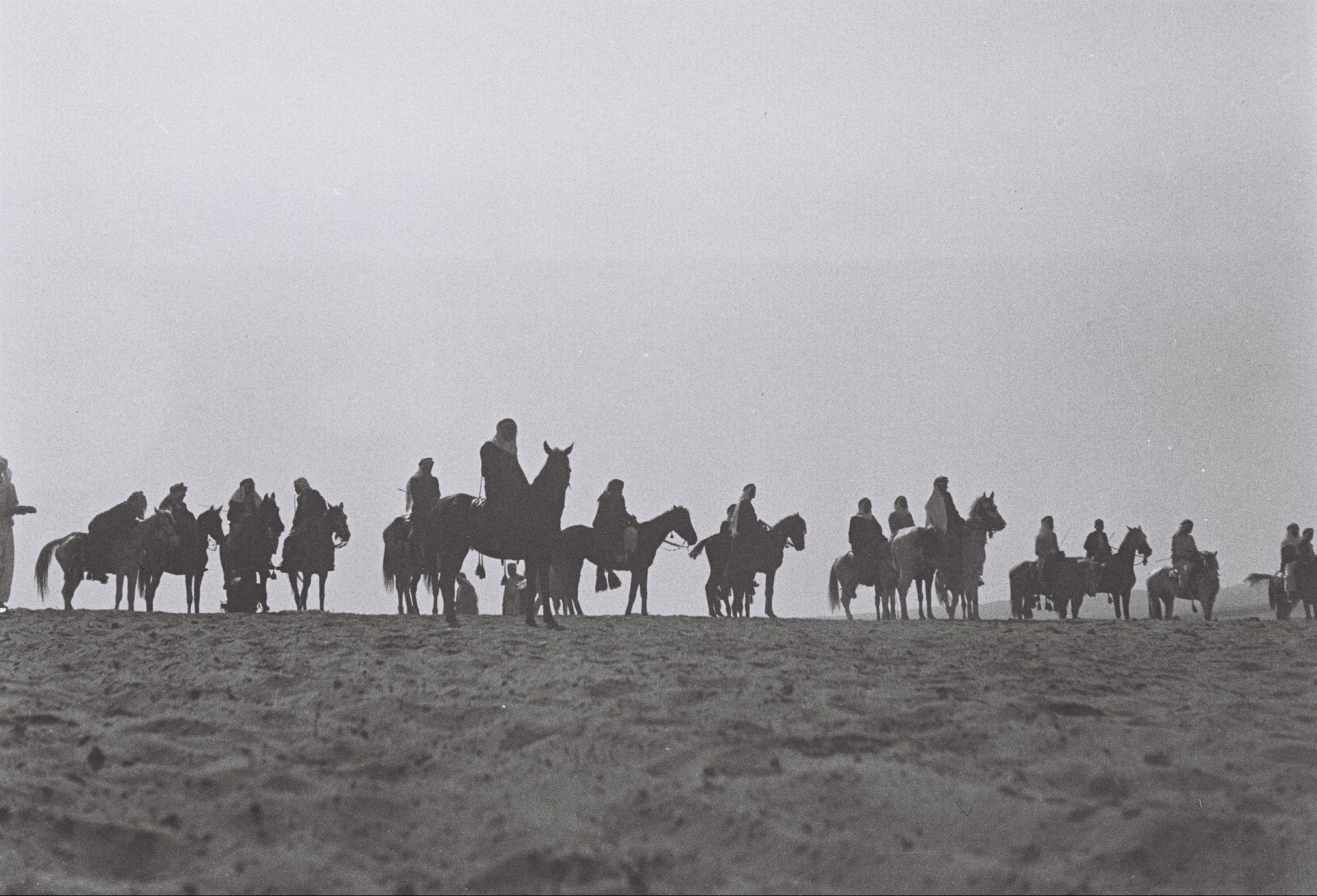
A black and white photo of Arab men in traditional clothing, on horses in the desert. The men are in the middle distance and mostly in silhouette.
Bedouin horsemen in the Negev desert, 1934. Image: Government Press Office, Flickr (CC BY-NC-SA 2.0)

Minor Detail (Text, 2020), written by Palestinian author Adania Shibli and translated from the Arabic by Elisabeth Jaquette, is a novel that revolves around a crime; that of the rape and murder of a young Bedouin girl in the Negev desert by Israeli soldiers. This crime occurs one year after the War of 1948 which Israelis refer to as the War of Independence and Palestinians mourn as the Nakba. By zooming in on this incident, a ‘minor detail’ within the context of larger crimes—during this period more than 700,000 Palestinian Arabs fled or were expelled from their homes and continue to live under occupation—the book raises the question of when a crime begins and ends, and if we cannot clearly define and outline the parameters of a crime, whether we can envisage its correlate—justice. But it is primarily a book that explores what kind of language is possible under the conditions of occupation, delving into language’s capacity and failure to bear witness, particularly in the face of violence. Reading the English language translation, in particular, raises questions around ​translation’s own limitations.

The novel is structured in two parts. The first begins with an officer and his platoon situated at the southern border with Egypt in the Negev desert, one year after the Nakba. Their mission is to secure the border after an armistice line has been declared with Egypt, to prevent any attempts to breach it and to ‘cleanse it of any remaining Arabs.’ This first of two parts is narrated in the third person from the point of the view of the commanding officer, unnamed and often silent. In sparse, precise language we follow his routine daily activities over the course of a few days—going on patrol, inspecting his room, washing himself. His washing is described no less than four times, each time in painstaking detail:

He filled the tin bowl with water, took the towel from the nail where it was hanging, dipped it in the bowl before wringing it out, then wiped down his face, chest, back, and armpit.

At the same time, though, we are not given any access to his emotional or psychological interior—we never enter into his thoughts or feelings.

The effect of following the character’s actions so closely and repetitively, while effectively being shut out from his mind, is to feel slightly suffocated. We stay closely tied down to his physical and sensory experience while having no emotional access—that is, we are made to stay with this person without any emotional investment, and after a few pages of this it feels stifling. The desire is to pull away but the text does not allow us to.

The space around the violence is distinctive in this novel, doubling the distance from the crime at the centre of the story.

While on patrol, a Bedouin girl is found in the desert and brought back to the camp, along with her dog. The men in her group and their camels have already been shot and killed. The officer, who up until then has been stoic and extremely controlled in his actions in the harsh desert, betrays his usual discipline in the way he reacts to the girl’s odour: the ‘putrid smell’ of her body ‘forcing him at times to turn his head to avoid breathing the air around her.’ But even then, we still have no access to the officer’s interiority.

The girl is stripped, washed with gasoline, and eventually raped multiple times and murdered. We never have access to the girl’s mind, even during moments of the most brutal violence done to her. Her murder is told in spare details—indeed, any violence in the novel is always shown at an angle, indirectly, in the form of a bed squeaking or the sound of gunfire. The space around the acts of violence is distinctive in this novel, doubling the distance from the crime at the centre of the story; creating a tension between making the reader unflinchingly present, yet distant psychologically from both the officer and the girl. It raises the question: does it matter what a perpetrator of a violent act thinks, or why he does it in that moment? And in wilfully not allowing us access to the girl’s interiority, to know her suffering, what does it say about how we witness acts of violence? Is it that we, as witnesses, cannot know anything of either the perpetrator or victim’s inner experience? Do we even have a right to?

What we can know is that this crime, or crimes, can stretch out in time, both forwards and backwards, and in this novel it stretches out to the second part of the book, set decades later. Narrated in the first person, the story now follows a young woman in Ramallah who reads a newspaper article about the incident and notices a ‘minor detail’ that grabs her interest:

A group of soldiers capture a girl, rape her, then kill her, twenty-five years to the day before I was born; this minor detail, which others might not give a second thought, will stay with me forever.

This coincidence is startling enough for her that she goes in search of the scene of the crime, to find out more about the girl and what exactly happened. She borrows her colleague’s ID and with the help of another colleague, rents a car. There begins her journey to a military museum and Israeli settlements in the search to uncover more information.

One major complicating factor in her search is that the crime occurred in an area she is not legally allowed to cross. Like the officer in the novel’s first half, the woman is largely unknown to us: her characterisation mainly comes through her relationship with borders, of which she is very familiar living as she does in occupied Palestine: The borders imposed between things here are many. One must pay attention to them, and navigate them, which ultimately protects everyone from perilous consequences.’ However, she describes herself as a person who cannot navigate borders, who cannot stop herself from trespassing: ‘As soon as I see a border, I either race toward it and leap over, or cross it stealthily, with a step.’

Again we stick close to the physical actions of the narrator over just a few days, and there is a mirroring of the first section in its details: the presence of a dog howling, the smell of gasoline, the close descriptions of washing. But this time, the repetitive actions described are often around navigating borders, as the narrator moves through multiple checkpoints in search of the scene of the crime.

The repetitive actions described are often around navigating borders, as the narrator moves through multiple checkpoints in search of the scene of the crime.

Throughout this, unlike the first narrator, we are inside her head and thoughts non-stop. But there is a similar experience of suffocation, in being part of her anxiety and fears as she does seemingly simple things such as driving on the streets or entering a museum. These seemingly simple things are not simple under occupation.

I’m so clumsy; this is exactly the kind of border I cannot trespass. I can’t seem to calm down. But I can’t stay here either; my car is still obstructing traffic. I turn back onto the road, and my hands are trembling, they feel weightless now, while my feet barely manage to press the accelerator, the clutch, or the brake, and I make it to the end.

Gradually, the second part of the novel begins to mirror the first not only in the details but in scenes: in the museum she visits there is a display with equipment and mess kits used at the time, including a shaving kit and bar of soap, which echo the shaving kit and soap the officer repeatedly used in the first section. But the ultimate mirroring is revealed at the end of the novel as the narrator becomes mired in the tragedy of the Bedouin girl: she unknowingly enters a military zone, still searching for the scene of the crime. As readers we recognise all the same elements that are present from the original crime: the desert, camels, a group of Israeli soldiers, and tragically, the sound of gunfire.

*

In an interview, Adania Shibli said that her starting point for writing Minor Detail was a question about language. How do you write from within (as opposed to about) the conditions of occupation—what kind of language and literature is possible?

The fracturing and silencing of language is explicit in the way dialogue is used in the novel. We are told that the woman in the second part of the novel speaks with a stutter. In addition, there is no real dialogue in the whole novel except at two moments, when speeches are given by the officer to his troops in the first part, and by a museum official in the second part where he erases the crime by saying that the Bedouin girl had been killed by her own people. The only people who can speak, in both instances, are those with power: seamless speech therefore is only possible in an official capacity for explanation and justification.

And he begins speaking in a voice so calm and clear, so untouched by stuttering, stammering, or rambling, that it feels as if he is smoothly unraveling a delicate thread, one which cannot easily be cut.

Language failure and inarticulation, Shibli suggests, is a condition of living under occupation, and writing from within oppression reveals the limits of language and its capacity to tell a coherent story. This is reflected in the structure of the novel itself; in its avoidance of linear structure and dialogue, in its adoption of a form that involves repetitions and mirroring. In the architecture of the novel there is no seamless beginning, middle and end, just like perhaps there is no beginning and end to crimes in the context of an occupation.

How do you write from within (as opposed to about) the conditions of occupation—what kind of language and literature is possible?

The novel renders absence and erasure in language, similar to the way that narrator in the second part uses two maps to navigate, one from before 1948, and the other an Israeli map where all the Palestinian villages have been removed. The spaces and silences around what is said, the significance of which words are chosen, is heightened. You can feel this in the preciseness of the actions described (the daily routine of the officer, the actions of the female narrator), but also what is not fully described—the violence.

In a novel that is specifically interrogating what kind of language is possible from within conditions of oppression, it is interesting to reflect on how the words as well as the silences were translated from the Arabic into English by translator Elisabeth Jaquette. The language in English is sparse, clear, and consistent in its repetitions. The translator also consistently employs the recurring images and motifs in both sections of the novel.

Tellingly, both the author Adania Shibli and translator Elisabeth Jaquette have stated in separate interviews that they found the translation process intensive. Shibli states that the text ‘came with an added burden for the translator because the language had been formulated by a specific experience—in this case, the ways it was violated by colonization and oppression’. In this sense I can’t help wondering what might have been lost in translation from Arabic to English by an American translator, and what could have been gained by a translator from a similar background. In Kitchen Table Translation, Madhu Kaza ​discusses translators who identify as being part of an immigrant diaspora and how they might bring a particular set of concerns and questions to translation that is distinct from the mainstream literary translation establishment which is overwhelmingly white. She asks, what can the act of translation become when it is not only language that is translated, but a translated self? When the movement of texts coincide with the movement of bodies, where ‘issues of language and culture necessarily collide with questions about politics, history, race and imperialism—the very contexts of migration and diaspora.’

Reading works in translation, we are also crossing borders, and something inevitably gets lost along the way.

Lina Mounzer, in translating first-person accounts by Syrian women living under siege and war, wonders how to convey to English readers the sense of urgency particular to wartime conditions. She speaks of how her own personal experiences of war in Lebanon makes her aware of language when she translates from the Syrian texts into English:

It reshapes your vocabulary. It becomes part of your language. A barrel will no longer ever be a barrel again; shrapnel will always explode from it. The word mustard will forevermore carry a whiff of gas, rashing your skin, smarting your eyes.

At times I felt that the translation I was reading in Minor Detail was missing something, but not being able to read Arabic, it’s hard to know precisely what. It makes me curious about the process of translation that occurred here, what questions were asked, what concerns. And it’s hard also to know what, if anything, could mitigate this—perhaps leaving some words in Arabic, or having a translator’s note, of which the book has neither.

In the end, perhaps the text itself in English is an example of the untranslatability of war, of oppression, of occupation—what is language capable of in the face of such violence? Perhaps it’s a testament to the novel’s own point about the impossibilities of bearing witness, and language’s failure to do so. Perhaps it is also an example of the act of translation itself being both one of language and of silence. Reading works in translation, we are also crossing borders, and something inevitably gets lost along the way.

Minor Detail is available now at your local independent bookseller.

Latest

My God, It’s Full of Stars

Jennifer Down

Goodbye to the Body

Jack Vening

Who Can Afford to Be a Writer in Australia These Days?

Nina Culley