Carving out a sustainable career as a freelance writer requires incredible tenacity, but as a recent memoir shows, it wasn’t always this hard.


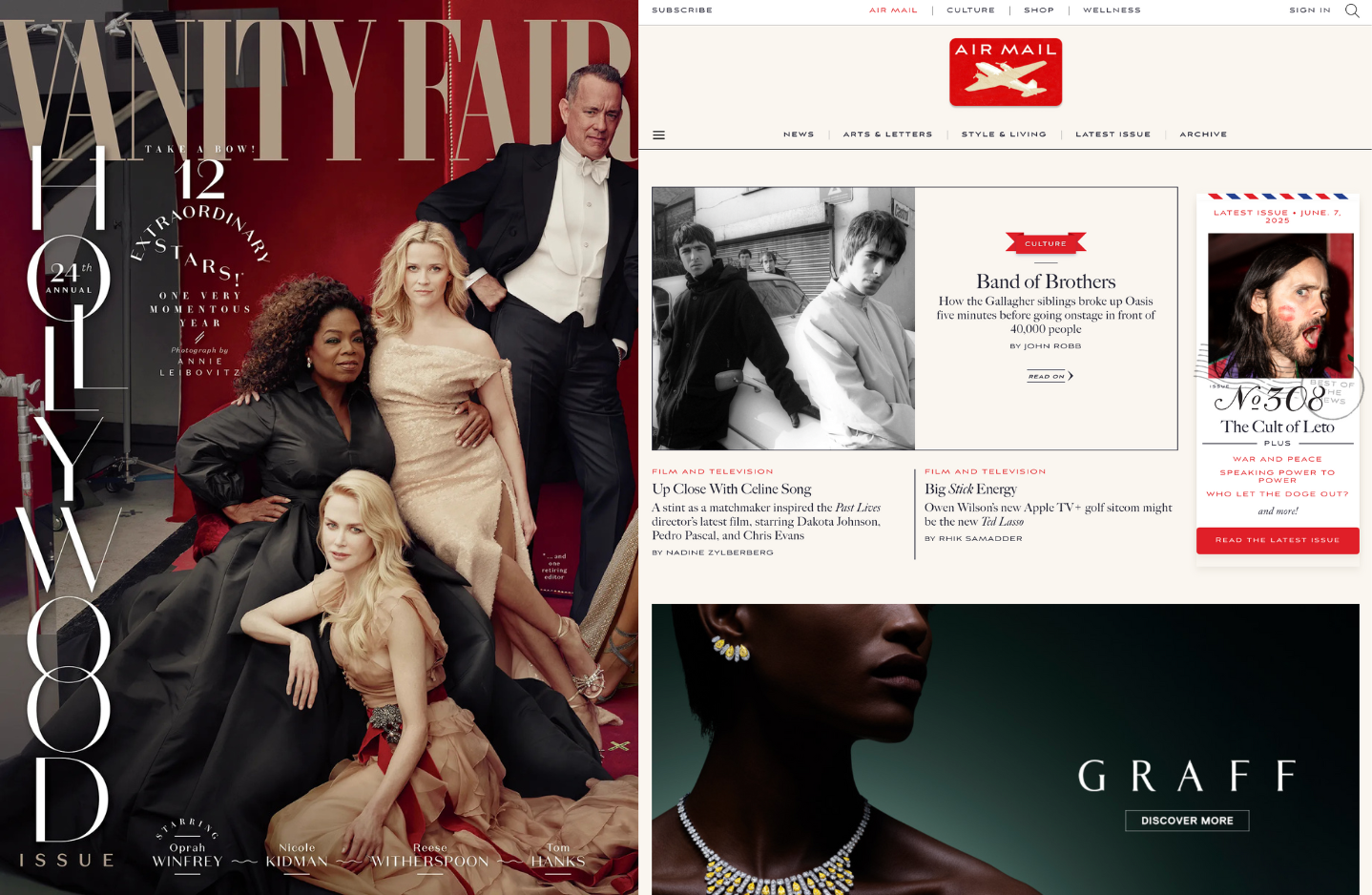
‘You never know when you’re in a golden age,’ writes former Vanity Fair editor Graydon Carter in his recently published memoir, When the Going Was Good. ‘You only realise it was a golden age when it’s gone.’ The industry stalwart, who left Condé Nast’s prestige publication in 2017 after a twenty-five-year tenure, points to the 2008 global financial crisis and the ‘relentless appetite of the internet’ as the cause of the decline. ‘This great era of magazine invention and influence that had so driven the culture for the past three quarters of a century was most surely coming to an end.’
And wouldn’t you know it, I graduated from an undergraduate writing degree just as the glory days were waning. I remember whiling away hours at the periodicals sections of Borders (RIP) and Mag Nation, discovering titles like Bitch (also RIP—thankfully not before I got to write for them) and paying exorbitant amounts for foreign-language fashion mags I couldn’t read but damn the pictures were pretty. It was also there that I unearthed a love for Vanity Fair, with its longform articles and Annie Leibovitz photo spreads, and discovered one of my favourite writers, Dominick Dunne, who was a prominent columnist for the publication. It seemed like every visit—sometimes multiple times a week—offered a myriad of titles to discover, few of which still exist today, with more shuttering as I write this.
Subscribe to stay in the loop
Be the first to read new stories, discover publishing opportunities, and access resources. For people who love great writing.
Mia Freedman’s time at Cosmo inspired me to become a writer. At twenty-four, she was the youngest person to edit Cosmopolitan locally or internationally. (Her career now has a you-either-die-a-hero-or-live-long-enough-to-become-the-villain quality.) I interned at the magazine under subsequent editors while at uni, but the industry had already started to turn web-heavy by the time I was entering my chosen field.
Then it was feminist blogs—Jezebel, Feministing—and writers like Jude Doyle and Jessica Valenti that motivated me to launch my own blog and send out my pitches to write articles for online publications, often for a pittance. Many of those sites now produce a 404 error code. (I spent a few months earlier this year collating Wayback Machine caches of my work lost to the digital wasteland.) It wasn’t until last year, after twelve years of freelancing, that I had my first proper print piece published in a major title.
I graduated from an undergraduate writing degree just as the glory days of magazines were waning.
The glamorous lifestyles depicted by magazines and the pop culture about working for them helped develop my romanticisation of a traditional media landscape that was crumbling at the time and is now long gone. The thought of working in-house like the modern heroines of Suddenly 30 and How to Lose a Guy in 10 Days was aspirational. I imagined a world where hungry writers could pitch stories to a room full of peers, for publications with seemingly unlimited resources. Carrie Bradshaw’s lifestyle seemed even more idyllic—a regular column could fund her New York apartment and her Manolo Blahnik habit. But these representations were already removed from real life, as Carter writes in When the Going Was Good. ‘I don’t think I had a proper editorial meeting the whole time I was at Vanity Fair,’ he says. ‘At least of the kind you see in movies.’

Yet Vanity Fair’s heyday had an ‘expense account chicanery’ the magazine industry could only dream about today. Editors had private cars and drivers, à la Miranda Priestly in The Devil Wears Prada, assistants a plenty (You get an assistant! And you get an assistant!) and, incredibly, an ‘eyebrow lady’ who came to the Condé Nast offices once a month to ensure everyone’s arches were on fleek. ‘There were interest-free loans to buy houses or apartments. Even the moving costs were covered by the company,’ Carter writes. ‘Flowers went out to contributors at an astounding rate, sometimes just for turning a story in on time.’
As someone who has never missed a deadline, I wouldn’t mind a congratulatory bouquet every now and then. But I would much prefer the Vanity Fair pay rates of yore. According to Carter, star columnist Dominick Dunne earned close to half a million (USD!) per year (‘plus generous expenses and months of free and continuous accommodation’) for his crime reporting on the celebrity trials of the Menendez brothers, OJ Simpson and Phil Spector. In Australia, such fees would always have been a fantasy, but local writers also report a decline in fortunes over the last two decades, as highlighted by the 2025 MEAA campaign to end falling pay rates.
And Carter never paid a kill fee. At first I thought that meant he wouldn’t pay work-for-hire contractors for writing that wasn’t published, as I (and many of my fellow freelancers) have experienced. But no, he would always honour the invoice in full, which resulted in him paying Norman Mailer $80,000 (again, USD!) for two articles that never ran, the first because Mailer ‘phoned it in’ and the second because Carter terminated Mailer’s contract. Not a bad severance package! I haven’t written for Vanity Fair—yet—but somehow I think the terms and conditions would be significantly different nowadays.
Vanity Fair’s heyday had an ‘expense account chicanery’ the magazine industry could only dream about today.
While Vanity Fair still exists in print (and recently named Mark Guiducci its first ‘global editorial director’ after former editor-in-chief Radhika Jones stepped down in April), not all magazines made it past the pinnacle. Locally, many notable glossies hung around for another decade or so before they disappeared. More recently, some underwent a relaunch, with Cosmopolitan and Elle returning to newsstands in 2024.
Of the publications that have remained, both at home and abroad, they’ve had to reinvent themselves. Many have pivoted to video, online-only publication and partnering with AI. Respected editors have started their own outlets, including Carter, who came out of his short-lived retirement in 2019 to launch the ‘mobile-forward digital weekly’ Air Mail. Editors and writers have had to adapt to the decline of traditional publishing (a theme that’s making its way into pop culture, such as in the Substack storyline from the Sex & the City reboot, And Just Like That…, and reportedly the upcoming The Devil Wears Prada sequel). But that’s if they even remain in the industry, with key people heading to the greener pastures of tech or even Hollywood (despite its own challenges).
For Australian writers like me, embarking on a career in the entertainment space requires a tenacity that is not for the faint of heart. After all, the average income for local freelance writers is notoriously low, so most of us have day jobs and side hustles.
After more than a decade of working a menial customer service job, I was finally able to make culture journalism my main gig. In my first year, I made about the same as what I was earning in part-time salaried employment, which is no mean feat if I do say so myself. But I have started to feel the pinch in the last couple of years as some of my main clients have ceased publishing, freelance budgets have shrunk even further and AI has encroached on the industry.
Even though legacy titles are returning to our shores, they’re not often taking on freelancers and have the barest of staff working across multiple titles. I’ve also found the local writing scene to be very insular—I usually see the same handful of bylines and panellists at writers’ festivals. It’s for these reasons that some of us have taken to breaking into international markets, daunting and highly competitive, but without as many barriers to entry.
‘It can be a more even playing field,’ says Cat Woods, a Melbourne journalist who has written for such publications as Interview, Harper’s Bazaar Australia and CNN, highlighting that you don’t need to hobnob with editors at events to ‘get an in’. You can successfully sell yourself on the pitch rather than on who you know.
Dr Clem Bastow has written for Australian culture publications at home and also while hustling to sell their scripts in Los Angeles, an experience they recount in their memoir Late Bloomer. They note a connection between the lack of investment in Australian stories, including on free-to-air TV and worldwide streaming, and the dearth of opportunity when it comes to entertainment coverage. Bastow laments that this is even more precarious now as Trump’s proposed tariffs threaten co-productions. ‘I don’t do much culture writing anymore, in part because there’s just not much work available,’ they say, explaining that they now make a more sustainable living tutoring in screenwriting at the University of Melbourne. ‘[In turn,] I’m much more selective in which story ideas I am keen to pursue.’
After more than a decade of working a menial customer service job, I was finally able to make culture journalism my main gig.
Personally, I’ve found greater success writing for overseas publications than local ones. In recent years my work has been featured in US Vogue, New York Times, Los Angeles Times and BBC.com, where I’ve interviewed celebrities like Dolly Parton, Tina Knowles (mother of Beyoncé) and Geri Halliwell (as the member of a primary school Spice Girls cover band, I was pinching myself!). But by the same token, I’ve had US publications refuse to work with me for tax reasons, which presumably will also only get worse with the Donald Trump of it all. I once indulged in my ‘lovable’ job pipe dreams by applying for staff jobs at US publications. Given recent hostility to immigrants, visa holders and anyone who speaks out against Israel’s genocide in Palestine, it’s a good thing I didn’t.
Perhaps the saddest thing about Carter’s memorialising in When the Going Was Good is the concept of time. With shortened attention spans, word counts and budgets, writers are seldom able to sit with their subjects. The days of shadowing a cover profile interviewee over weeks or allowing a topic to percolate for months or even years seem long gone. Carter writes about one Vanity Fair feature by William Prochnau and Laura Parker that was a fixture on the monthly storyboard for sixteen years until Carter finally committed to publishing it in his final issue. Prochnau was ‘thrilled’ and then died shortly thereafter.
Life is short but also long, a point that seems especially resonant when Carter concludes his memoir by noting that he’s been an editor for ‘more than half a century’, beginning in a time when ‘there were no computers, and obviously there was no internet’. While the rest of us cobble together some semblance of a career, coupled with steadily paying side gigs, he remains in the game, ‘still in love with it’. In 2024, he launched Air Mail Newsstands, brick-and-mortar stores in New York, London and Milan that sell, funnily enough, glossy magazines (including an eight-page print edition of Air Mail). And this June, Air Mail made headlines worldwide with its exposé on actor Jared Leto, a testament to the fact that despite the end of the golden age, publications are just as vital as ever.
However, it’s hard not to wish for better working conditions. Recent news of the Atlantic’s big spending spree on writers sparks a bit of hope that austerity isn’t the only way forward, but the future of making a living in magazines feels precarious. ‘Some mornings I just wish I had properly retired,’ Carter writes. We should all be so lucky.