Tech’s big threat to the modern man offers few laughs in Steve Toltz’s fourth novel, A Rising of Lights.


For the last two years, across a couple of universities in Sydney, I have stood in front of classrooms and, perhaps foolheartedly, made attempts to convince students about the ills of using artificial intelligence to complete their assignments. This involves a whole song-and-dance routine about the reported environmental degradation involved (rote repeated fact: a single email created by ChatGPT wastes a bottle of water), followed by a plea that the use undermines the entire purpose of being at university—that is, to develop critical thinking. Then there is the official administrative line to roll out: they can use it, but they must cite it as a methodology. Come marking time, the tutor is faced with a new, unexpected level of unknowingness trying to figure out reasonably what is AI and what is not. Spending time—as a human being—reading work that might be written entirely by a machine is to encounter the opposite of awe: to be pitted directly up against soullessness.
It was only going to be a matter of time before AI wormed its way out of the historic confines of science fiction and into the realm of the social realist novel. The first mention of AI in fiction is usually credited back to Samuel Butler’s Erewhon, published in 1872 and partly based on his early pastoral experiences in New Zealand. Three chapters at the back of the novel serve as an invented treatise on machines gaining consciousness. (Erewhon—an anagram of ‘nowhere’—is a name better known now as an obscenely upscale grocery chain in Los Angeles.)
Subscribe to stay in the loop
Be the first to read new stories, discover publishing opportunities, and access resources. For people who love great writing.
For contemporary novelists, the arrival of AI in all its ugly guises is an opportunity to face up to that which was once projected as ‘the future’. It presents as a shiny, new, open-ended ethical quandary for writers to play around with, and perhaps hard to resist, given that it has impinged on their livelihoods. In 2025, Meta was exposed for having pirated millions of books—including those of Australian authors—to ‘train’ its generative AI models. Who wouldn’t want to get stylistic revenge on these inhuman plagiarists? A quick search of LibGen—the file-sharing network Meta employed for its mass copyright infringement—shows that all three of Steve Toltz’s existing novels were scraped by Mark Zuckerberg’s machines.
Who wouldn’t want to get stylistic revenge on these inhuman plagiarists?
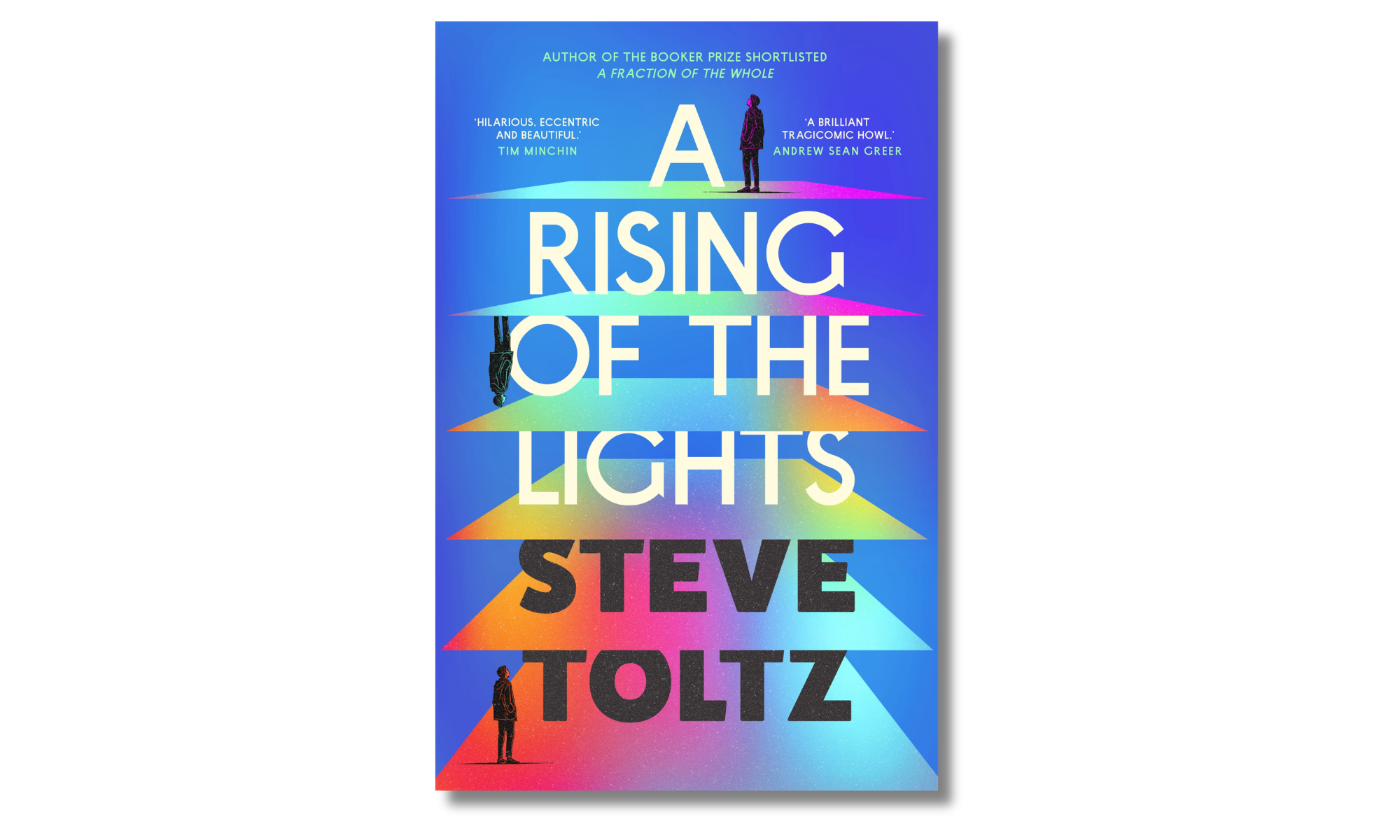
In his fourth novel, A Rising of the Lights, Toltz takes aim at AI as his chief parodic target. The book is a lolling—if not quite lol-ing—comedy of human errors. Russell ‘Rusty’ Wilson, the satirist’s tired and trying fifty-something lead, is a former child psychologist turned human resources officer at the NSW Department of Health (the unhinged reasons for this career transition are revealed later). Wilson finds himself out of work when he is replaced by an AI unit ‘designed to eliminate the grind’—code-speak, of course, for ‘eliminate the worker’. Toltz doesn’t stick around long enough to give us a comedy of the new office realpolitik, which is a shame, as many workers who now find themselves cohabitating with incompetent, water-guzzling apparitions of functional intelligence—and their human boosters—may have welcomed a novel sending up this already farcical situation.
This restlessness—not willing to stick with a single scene for too long—is perhaps baked into Rusty’s upbringing. When their parents decide to split, the fates of Rusty and his twin sister, Bonnie, are decided by a literal roll of the dice. Happenstance becomes the defining mode from there. Rusty falls back in with some old high school mates after his marriage disintegrates and he is offered the role of a school counsellor without so much as an interview (or, indeed, a working with children check). There is a merry ‘making it up as we go along’ spirit to the novel, in keeping with Toltz’s demonstrated skills in crafting the picaresque (which in Australia might best translate to Peter Carey-esque).
Nothing feels quite urgent (Rusty even admits to a ‘love of not giving details’ despite being, you know, the narrator of an entire novel). It’s dangerous to consider, but the book almost dares you to question whether a computer could come up with anything better. Is AI capable of recreating the kind of pointless, though entirely pleasant, digressions of the first-person narrator writers like Toltz are so fond of? The sort of gentle patter and waffle we might expect from a character like Rusty seems within reach—but is it really?
And more to the point, is it capable of comedic writing, the kind of which Toltz has received praise for throughout his career? A recent study from Cardiff University concluded that large language models could understand the basic structure of a pun but could not deliver the punchline. They fed in the wordplay, ‘I used to be a comedian, but my life became a joke’, only to have the machine reply: ‘I used to be a comedian, but my life became chaotic.’ A variation of this exact joke appears in A Rising of the Lights when Russell is conversing with a friend, Fergus:
‘Why are you unemployed? Fergus asked. ‘Aren’t you a child therapist?’
‘I was, but I grew out of it.’
‘Is that a joke?’
‘Yes. But I’m really not a therapist anymore. I haven’t been for nearly a decade.’
Reading this, I had to side with Fergus. If you rework the quip into its more generic stand-up formula—‘I was a child therapist, but I grew out of it’—the mild punchline is more immediately evident, but this also shows how jamming a joke between the dialogue of two characters distracts from it (one-liners aren’t designed for two). The constant back and forth between characters in these snapping, often overly sarcastic speech patterns comes to feel strained. In my notes, I wrote multiple variations on the same question: ‘What happens when a humourist is inhabiting a largely unfunny character?’
There might, however, be a point to the accumulating comic misfires. Part of the story of A Rising of the Lights is that Rusty’s whole schtick has grown tired and this is a key factor alienating him from friends and family alike. Rusty’s wife, colleagues, parents and his sibling at various points isolate themselves from him. This is all logical in a novel of disconnection and reconnection, Rusty’s social relations dropping in and out like bad wifi.
The book is a lolling—if not quite lol-ing—comedy of human errors.
The comic novel is often hard to place in a definitive tradition. Satire, parody, tragicomedy? A sense of humour is highly individual (also a problem for the critic who doesn’t find a supposedly comic novel funny). Toltz’s first novel, A Fraction of the Whole (2008), debuted with multiple critics pointing readers towards a particular aesthetic sensibility as a landmark. Emily Maguire, writing for the then Fairfax papers, noted ‘Steve Toltz is in many ways a perfect example of what British critic James Wood calls “hysterical realism”’. Louise Swinn in the Australian Book Review expanded on this idea: ‘Wood’s critique of hysterical realism is that it fails to move, and that is not the case here.’ Richard Cooke, writing for the Monthly, revived the citation in a review of Toltz’s second novel Quicksand (2015) to observe that the default setting of the contemporary novel might be comic anyway.
Wood was reviewing Zadie Smith’s White Teeth when he wrote his jeremiad accusing Smith—and her forebearers Thomas Pynchon, Don DeLillo, Salman Rushdie and David Foster Wallace—of overworking realism to the point of incredulity and pointless expansionism. Reflecting on a particular passage, he laid out the ouroboros conundrum at play: ‘As realism, it is incredible; as satire, it is cartoonish; as cartoon, it is too realistic.’ Wood worried that the novel was tying itself in knots:
Stories, after all, are generated by human beings, and it might be said that these recent novels are full of inhuman stories, whereby that phrase is precisely an oxymoron, an impossibility, a wanting it both ways.
Wood’s damning summation was that reading the mammoth fin de millénium works left him feeling that ‘language and the representation of consciousness’ are no longer the ‘novelist’s quarries any more’. His ultimate observation that ‘information has become the new character’ in these books rings true now of the priorities of AI-generative text. While we might plausibly contest that AI cannot produce a ‘human story’, it is surely able to produce entirely convincing works of ‘hysterical realism’ as Wood understands it (or perhaps we should upgrade the genre to ‘hallucinatory realism’ given AI’s frequent tendency to ‘hallucinate’ facts and its core aesthetic skewering towards the uncanny).
Now, of course, these days we can technically—with great emphasis on that technically—have it both ways: stories can now very much be human or inhuman-generated. You could open your phone or laptop and ask inhuman ChatGPT to attempt a human story that might come out as a close replica of a human story but, just like these era-defining novels, how much it convinces is perhaps up to the individual.
But it would be hard to accuse Toltz of subscribing to ‘hysterical realism’ any longer. For one thing, it seems clear that the totemic ambition and scope of his earlier books have been replaced by a style far more economical. A Fraction of the Whole, after all, ran for over 700 pages. Briefer, sketchier writing isn’t necessarily a bad thing, but the fact that Toltz is providing running commentary on such a zeitgeist issue as AI, while blending in broadstroke comedy, risks reducing the endeavour to the form of a topical skit straight from Saturday Night Live.
In an interview following the ‘hysterical realism’ charge laid by Woods, Zadie Smith confessed that her work ‘could be condemned in certain places for having a sitcom aesthetic’. In defending herself, she also self-deprecatingly admitted that, at twenty-one, she ‘wanted to write like Kafka’ but unfortunately ‘wrote like a script editor for The Simpsons who’d briefly joined a religious cult and then discovered Foucault’. That, at least, sounds like an interesting starting point for a writing career. Such a position might prove professionally sustaining too. Indeed, the world of television was encroaching on my own reading experience while writing this review. Penguin had run out of advance reading copies by the time the book was assigned to me, meaning I was forced to read a PDF on screen, but I was simultaneously able to see on Instagram that Evangeline Lilly, best known for her role as The Wasp in Ant-Man and the Wasp and before that Lost, had received one. She told her followers that Toltz is one of her ‘absolute all-time favourite authors… ever’ and that she had read his earlier work as part of a book club.
It would be hard to accuse Toltz of subscribing to ‘hysterical realism’ any longer.
The endorsement perhaps speaks to Toltz’s ‘other’ career as a screenwriter. Gary Shteyngart—a good career touchstone for Toltz—recently served as a ‘literary consultant’ on HBO’s mega-hit Succession, but the practice goes back to the days of William Faulkner skulking to Hollywood to make money between books. There is little worrying that Faulkner’s time writing screenplays had a negative impact on his fiction, but he was adapting novels by Raymond Chandler and Ernest Hemingway for Howard Hawks. Toltz’s screenwriting drafts are certainly not being delivered to a Hawksian figure. Instead, he has become a stablemate of the Nine Entertainment-owned streamer Stan, having contributed to their surprisingly charming Population:11, the American adaptation of the Stan original No Activity and, more recently, something called Good Cop/Bad Cop, a strange, flavourless collaboration between Stan, CW and Roku.
Zadie Smith’s ‘sitcom aesthetic’ is not such a terrible charge for the populist novel, and the moonlighting novelist might pick up a trick or two as a hired gun in the writers’ room, but the concern is whether anything interesting is being said about AI in A Rising of the Lights in an intellectual fashion or if it is simply just set dressing. In the novel there is an AI game show—MindMeld—where players seem to be in some sort of escape-room scenario. An AI therapy program—TherapEase—allows Rusty to ‘craft’ a counsellor called ‘Freudo’ with an Eastern European accent and attitude. There is a ‘Humanoid Nursing Robot’ to assist with the elderly both with practical tasks and ‘expressing empathy’. It’s difficult to say how interested Toltz is in any of his inventions. The TV show doesn’t make it past a single ad break, the therapist not more than one session and the nursing robot is kicked to ‘death’. However, finally, there is a major set piece towards the end of the novel that plays to Toltz’s strengths. Here, he intuits that AI might be one long con. He gives us a hint that the boom is an economic bubble ready to burst and that feeble-minded but asset-rich men are being taken for a ride. Toltz mounts an investor shakedown involving drug-induced impersonation that might not produce a guffaw but does deliver a wry nod.
The existential dilemmas posed by AI—on the environment, our humanity and, indeed, on art itself—seem to pass Toltz by. Perhaps A Rising of the Lights was never designed to be a novel of ideas, a contemporary Erewhon. The human factor, however, still shines through. Hiding beneath all the near-futurism is a story about the current challenges faced by Gen X-ers: what happens when the ‘slacker’ generation faces caring for ageing parents? Generation X’s supposed cynical apathy thaws when mortality encroaches. This softening is perhaps like that of any other generation when the one directly above fades away. Rusty’s eccentric parents, Sigrid and Gordon, estranged from each other, are in separate nursing homes with their own set of challenges. His twin sister is willing to help but only to a point. All remedies and approaches are considered, including a logical endpoint (rendered illogical in Toltz’s style but movingly so). In this final act, it was a pleasure to be reminded of Steven Amsterdam—a writer and palliative care nurse—and his thoughtful The Easy Way Out from 2016, which worked with similar themes around end-of-life care (begging the question of when we might get a new Amsterdam novel now that we are ten years on from the last).
It is here that Toltz taps the real, blood-filled vein of his book: machines will likely never have to face the obsolescence of loved ones and so will never be able to express to us exactly what that means. It requires something much less than a large-scale language model. A simple novel will do.
A Rising of Lights is out now via Penguin Books Australia.