Genre fiction is often looked down upon for its adherence to established plot beats. But as a fantasy writer, I celebrate these ‘predictable’ narrative structures because they are powerful modes to explore—and reshape—our understanding of the world.



Any avid reader of plot-driven, formulaic fiction knows the moment: when the face of a professed fellow book enthusiast, upon hearing your readerly interests, registers embarrassment on your behalf, followed by disdain, then settles on something akin to pity. ‘Oh,’ they say politely. Then they explain, sometimes briefly and sometimes at length, a position that amounts to: ‘I don’t read genre.’
‘Genre fiction’ is a funny term. Rather than defining stories based on what they are, it defines them according to what they’re not: literary fiction. The term lumps together works as disparate as romance, thrillers, science fiction, fantasy, horror and—prior to Hilary Mantel’s Wolf Hall—historical fiction (now it includes only the kind of historical fiction that comes with a woman on the cover). This kind of writing, it is allowed, may be entertaining. Popular, even.
But there’s an idea that the way its stories are constructed upon pre-existing structural formulae means that readers are trivially engaged. It’s the pleasurable pursuit of pattern recognition—I knew he was the murderer! Now they’re in love!—rather than the difficult work of interpretation. If the bias of literary awards tells us anything, it’s that many readers consider ‘genre’ a fundamentally unserious category of literature. (Works of ‘genre-bending’ literary fiction, in which an author co-opts the subject matter of genre fiction while strenuously denying that they are writing actual genre fiction—I’m looking at you, Ian McEwan—are often lauded by the establishment as daring formal experiments.)
The whole concept of literary genres, though—the idea that there are distinct and recognisable kinds of narratives—is premised on the understanding that some stories are more alike than others. This likeness is derived from adherence to conventions: not just of story structure but also of affect, character, degree of interiority, voice, prose style, the weight afforded to plot and theme, pace and accessibility. It is not just genre authors who use conventions to position their writing within a canon and put them in conversation with other stories. We struggle to categorise outsider art because of its solipsistic tendency to be in conversation with nothing but itself, yet we face no such trouble placing literary fiction. It is a genre, too.
‘Genre fiction’ is a funny term. Rather than defining stories based on what they are, it defines them according to what they’re not.
The work of literary fiction may involve moving towards novelty by eschewing the earnest use of familiar story structures and archetypal characters—by refusing sentimentality, closed endings and moral judgement; by scrupulously avoiding cliché in both form and language. But that is the specific work of literary fiction. In another aisle of the bookstore, other voices are having different conversations by leaning into the very elements that ‘high brow’ practitioners cringe from. In many genres, a key source of the stories’ power and relevance—the very element that enables them to do their work—is the formula.
Genre fiction generally makes no attempt to hide its dependence upon pre-existing narrative structures, nor does it need to. The structures are meant to be recognised. They are the descendants of the very oldest forms of literature: the fairytale, the epic, the love ballad. Their infinite recycling in pop culture in the form of Disney animations, superhero franchises and dating shows—what New Yorker critic Parul Sehgal, quoting literary scholar Peter Brooks, refers to as the ‘narrative takeover of reality’—has made them so familiar that our interpretative work can occur beneath the level of perceived effort.
We all know how these stories go. We know who is the hero and who is the villain, who deserves love and who deserves comeuppance, what the moral virtues are and what form justice takes. And, of course, what makes for a happy ending. There is a particular pleasure, it must be said, that comes from an encounter with a text that confirms one’s expectations of how the world should operate. As producers say about pop music: ‘Nothing hooks you like a hook you’ve heard before.’ Yet the ease with which we consume these texts conceals the powerful work they are doing upon us.
Romances have their own particular structure (meet-cute, rejection, progression towards a relationship, consummation, crisis, resolution, happily ever after), as do the epic fantasy (the hero’s journey), slasher horror (the final girl), and every other genre and subgenre. The meaning of a genre work arises not just from plot and character but the specific ways that plot and character push and pull against their narrative frames. Of course, there is no shortage of formulaic fiction that stays perfectly within the frame, including the replication of retrograde tropes. But there are plenty of writers who use its vast repertory of symbols, allegories and archetypes to subvert. These writers draw from, and then defy, an influential canon that includes hordes of faceless dark-skinned orcs, portals to exoticised heathen worlds and glamourised aristocracies built upon violent, racist colonialism and slavery.
In another aisle of the bookstore, other voices are having different conversations by leaning into the very elements that ‘high brow’ practitioners cringe from.
‘Every story has a hero and a monster. She is not the hero.’ This is the tagline on the cover of Melbourne author Vanessa Len’s young adult fantasy Only a Monster. It prompts us to simultaneously recognise the story’s narrative structure as well as its rebellious intentions. Len takes the hero’s journey of Western fantasy and places her non-white female monster protagonist in opposition to the familiar, floppy-haired, noble-minded white boy with his mission of cleansing the world of its monstrous threat.
Because of our inherent understanding of this kind of story, we see how Len’s hero stands in the shadow of all those white male heroes—from the knights of the Crusades to Jason Bourne to the Marvel Cinematic Universe’s Hawkeye—who demonstrate their heroism by violently disposing of innumerable, anonymous brown bodies. Len’s faithful reproduction of the hero’s journey structure, but warped to expose its embedded ideologies, leads us to not just understand but feel the terrifying fact of the hero as the embodiment of an annihilating white supremacy.
Satirical literary fiction also uses structures as a means of critique. But formulaic fiction, by presenting its subversions without irony, asks us to internalise its subverted structures in place of the old. It creates within us new norms, new expectations, new desires. A recent illustration of the power of formulaic romance to normalise new desires is Alexis Hall’s Regency novel, A Lady for a Duke. The story is a classic romance between a brooding duke and a woman who sees through to his true heart—with the twist that the trans heroine’s past identity was that of the duke’s best friend, whom he believes to be dead. The title tells us what to expect: a plot in which a trans woman will not just occupy a place traditionally reserved for cis women but will receive what has, up until now, been a narrative reward for (straight) cis women alone: a happy ending. Crucially, even as Hall lets his protagonist flow through familiar genre beats, he refuses to negate her trans identity by flattening her experiences and understandings to those of her cis woman antecedents. By inserting the nuances of trans griefs, joys, intimacies and power, Hall creates an enriched, enlarged structure that he asks us to accept in place of what we have come to expect.
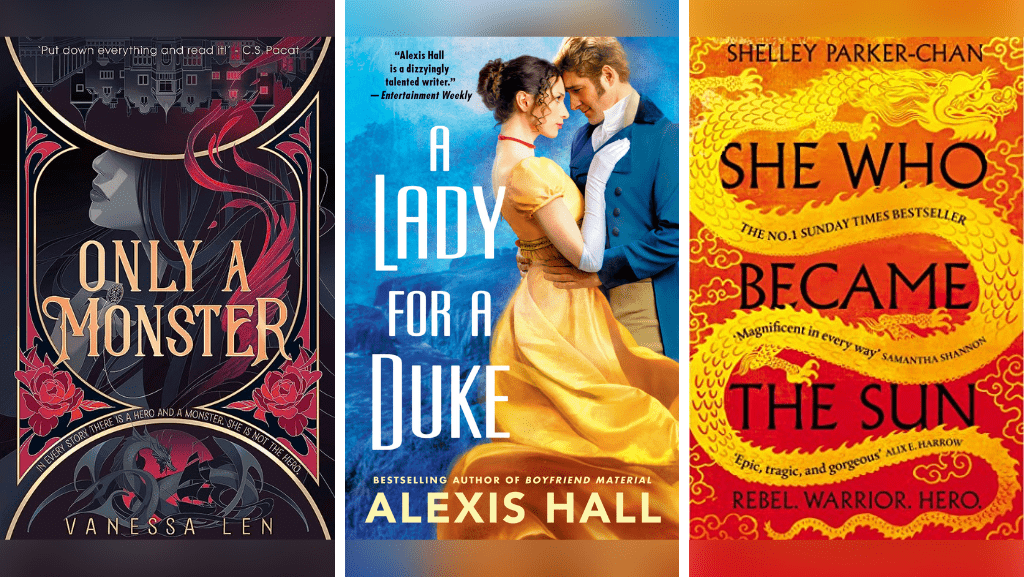
Similarly, in my own historical fantasy novel, She Who Became the Sun—a reimagining of the rise to power of the Ming Dynasty’s founding emperor—I layer a classic farmboy-to-king heroic progression over real historical events, but fill the narrative with defiantly queer characters. The structure of the story tells us who must become king (the ‘farmboy’), but we know from our previous encounters with similar stories what a worthy king is like (not ‘she’, not queer, not a child-murdering antihero). It is this gap between these two understandings, and the gap’s gradual narrowing to collapse, that provides dramatic tension and does the story’s subversive work. We are forced to understand that in this version of the world, the impossible is possible. (And then why not in our own world, too?)
My writing belongs to a rich canon of works that push boundaries and raise questions about ourselves and our world. Some global book markets recognise these qualities of genre fiction more than others. In the US, genre fiction is a second-class citizen when it comes to review coverage. In all but the most exceptional cases genre books are consigned to the major newspapers’ less prestigious monthly roundup columns, rather than receiving individual reviews. In Australia, there is so little book coverage that there are no genre-specific roundup columns at all. Both of these markets stand in stark contrast to the UK, which has a robust appreciation for genre on its own terms. Even debut fantasies such as She Who Became the Sun receive thoughtful individual reviews in major newspapers.
Formulaic fiction, by presenting its subversions without irony, asks us to internalise its subverted structures in place of the old.
How can we shift Australia’s literary culture towards that of the UK, where the intellectual work of genre fiction is recognised as deserving of critical engagement? I know from experience that foreign genre-specific awards, such as the Hugo for science fiction and fantasy, or the Gold Dagger for crime, mean little to the Australian public. Local literary awards can have a more legitimising effect. Although many of these awards skew towards literary fiction, a welcome exception is the Victorian Premier’s Prize for an Unpublished Manuscript. The award of this prestigious prize in 2015, to Jane Harper for her crime novel The Dry, and in 2022, to Keshe Chow for her Chinese young adult fantasy, The Girl with No Reflection, is our long-awaited recognition of the fact that genre fiction can be exceptional not in spite of but because of its fidelity to genre rules.
We could also boost genre fiction’s aura of legitimacy by increasing its representation at Australian writers’ festivals, as was notably done by the Brisbane Writers Festival this year. These festivals mark not just who counts as a ‘notable writer’ but who counts as an Australian writer. Genre fiction authors may set their work in fantasy worlds, in space, during the Regency era or even in imperial China, but it’s a misconception to think that these works are somehow not Australian, or that they’re irrelevant to Australian readers. Their passionate readerships say otherwise. The work these stories do through genre structures reflects and addresses not just our society but us: our fears, our dreams, our desires. From ancient folk tales to that bestseller that gets people excited about reading again—this is the work that genre fiction has always done.