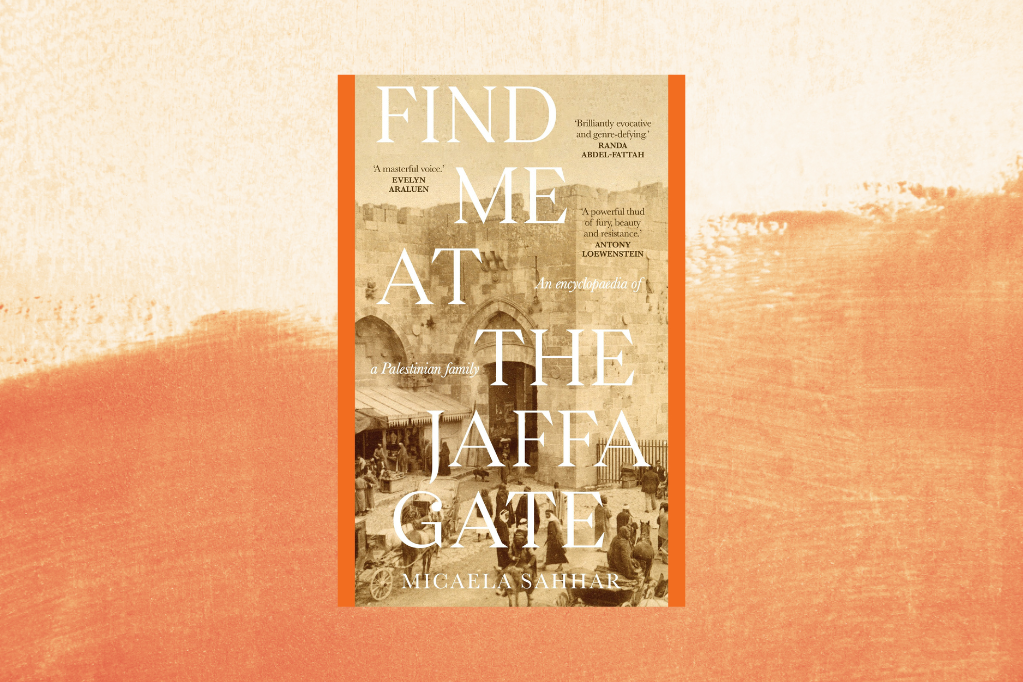
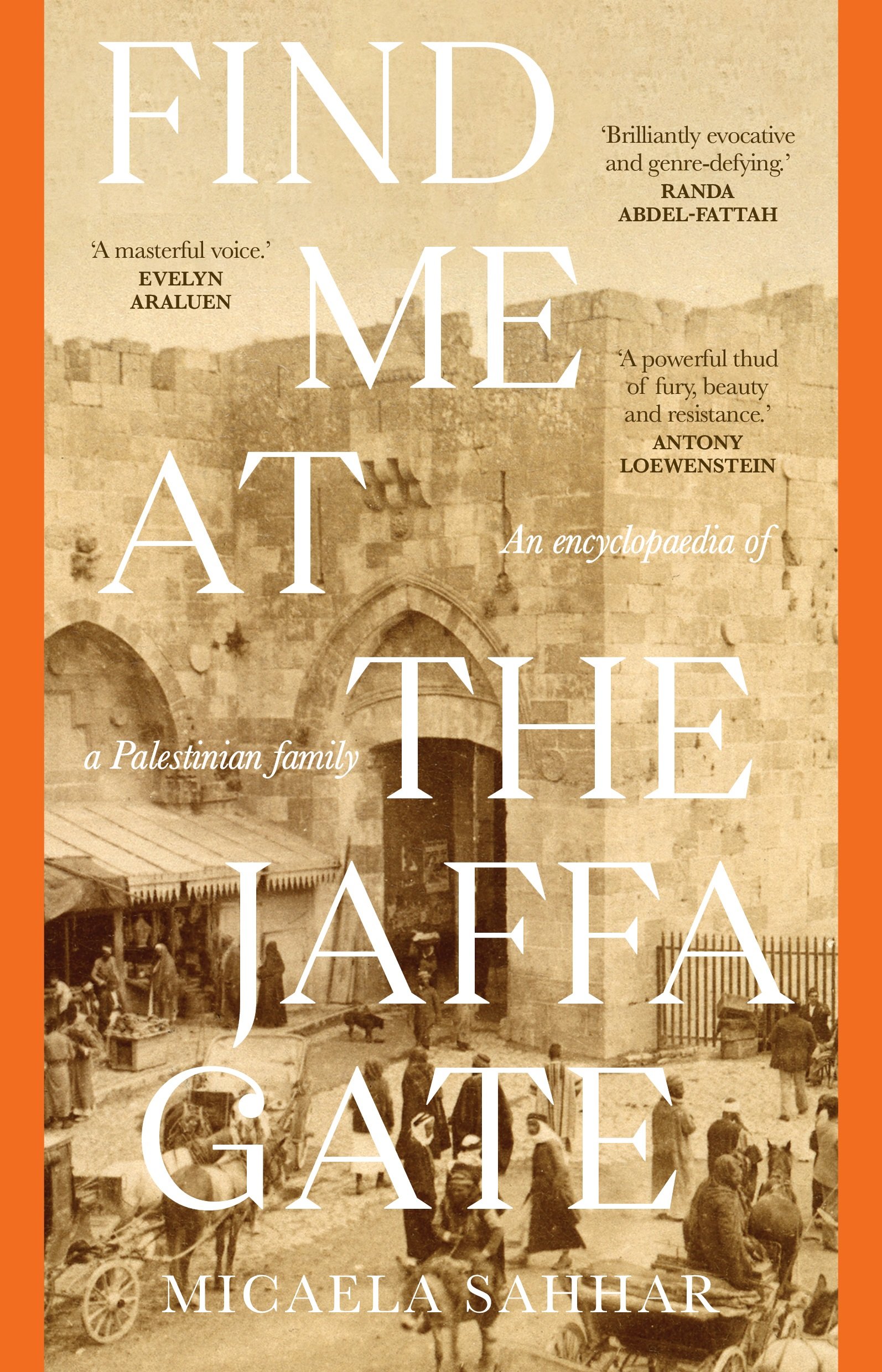
Find Me at the Jaffa Gate

Micaela Sahhar

Extracts

Who has a plot: a rhetorical question. We all have one. Your family is already a story before you are born. Do you ask the question—do you live inside this plot or step outside of it? Is it possible to step out of a plot when you are a plot point arriving?

One day, when I am an unremarkable bald baby and my Pa is a remarkable old bald man, he hands me his greatest love while I am sitting on the shoulders of my father. This is captured in a photograph, you can see how he passes it to me with his eyes and exhorts me to tend it for him in his inevitable absence. My own dear dad, Joey, will help me with this. He has heard each word of my story and told me his own, my life through, and on the phone while I wrote this, and while we searched for the story of a diaspora uniquely our own.

The loss of a homeland is no small thing. It is a yawning chasm and each of us is delivered to its precipice, struggling against the crumbling edge, against being swallowed whole. What does it mean to be exiled and how do we take our revenge? What intimacies lie in these wreckages and may we lay our burdens down? If we were different people, to write down these words might be to leave them behind us. But words are our artifacts, and I am seeding a trail for the journey, home.

We are far from home here. But we are long past started. Already the story-holders are mostly gone; I know their luminous names, but I have known too few of them. I am never so happy as when my young cousin says to me in the saloon bar of the Stag’s Head in Dublin, ‘You really do look like Ellen’, and it is the second time I am honoured in this way after dear Najla has said the same thing at her home in Phoenix, Arizona ten years earlier. The story-holders are slim as reeds in their childhood, and dark-eyed as adults with small but definite noses and close- lipped smiles, so it is clear to anyone how they were cut from the very same family.

The loss of a homeland is no small thing.

If not knowing is a problem of time and of space then a restitution of sorts is an invitation. That these loved names and the bodies they described might dwell here together on my page. These are the reunions a Palestinian might spend their life dreaming about but never living. Do I believe that words can effect such a meeting?

As I stitch the fragments together, I must try.

Juju asks, ‘Whose story are you writing?’. And in truth it is a story that is not mine nor hers; I am searching for the shape of what is ours. We are the amber beads of a broken wedding necklace, a diaspora who fight at the precipice and who are lost to our home and if we are not careful, lost twice.

Most of all I must fight against errors, and I will correct them if I can. This was an early lesson in my first published poem, when I swapped one location for another and the aunts called my father, my father called me, his quiet disappointment palpable—wicking up the joy of a first poem published. I see after twenty years that errors are errors and that no story is better than the truth of it. I understand that the truth, then as now, was more beautiful than my error. Why did I make it?

Because truth stabs painfully, glitteringly, a fluid on the surface that forms and re-forms in liquid pools. Sometimes truth is too big to bear; it is happening to us, happening still, happening now, was happening to me and to you before we were born. It is not an explanation, but at least if you cannot understand it, then try to feel it.

In a psychoanalytic sense, I have read that wounds are impossible to heal when the wounds remains unacknowledged. Here they are in plain sight, terrible and ignored. So much psychic wounding, is there room to also be whole?

I have read that wounds are impossible to heal when the wounds remains unacknowledged.

Except this is not a story about wounds but about the preservation of something all its own. We are not artifacts or fables, not inventions or ideas. We are sumud and survivance and life life life is among us and we are not a duality, a binary, a dichotomy, but a story of our own.

What is the task but to find my way back to the unfragmentation of the world as we knew it; to collect the uncollected, to make the unmade? To refuse victimhood even when annihilation seems to insist on it. To make a thing out of nothing, to make a diaspora into something, real enough to share.

This is a true story though it is made of things I do not know alongside those I do. It begins with two true words. Poetry is an uncontested word that is true and through which one might feel a truth they do not understand anew. Palestine is a true word too, but it is contested. About both these words, I assure you, I am not in error.

How the light will bend about me I do not know, but I will always try to show you.


This is an extract from Find Me at the Jaffa Gate by Micaela Sahhar (NewSouth Books), available now at your local independent bookseller.
Latest

Should We Be Publishing Fewer Books in Australia?

Projected Changes in the Frequency of Extreme Precipitation Events

Benjamin Hickey 

Rat Daniels

Alex Sawyer