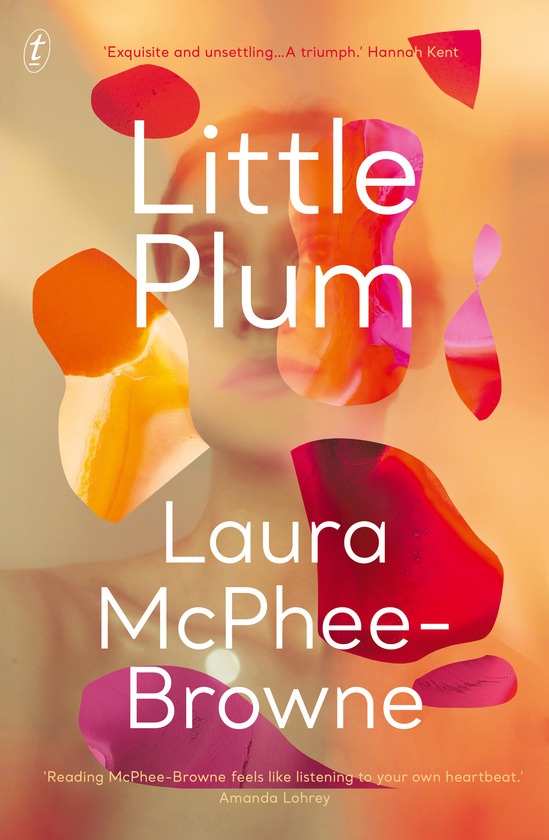
Coral’s epicurean sensibilities strike the perfect register for a chronicle of pregnancy with its hungers and excretions; though the events of the novel are not quite narrated by Coral herself, but rather by some omniscient consciousness occupying a space a few degrees to the left of her. ‘This story is about Coral’, the novel begins, and I feel my limbs grow heavy, feel some part of myself opening up, ready to be told a story, as in childhood, in the minutes before the lights are turned off.
The carnality of her fantasies reproduces the fairy tale’s sense of infinite possibility.
Little Plum shares much of the original fairy tale’s charm and grotesquery. All of the characters in Coral’s orbit—her mother, Topaz, her friends, Amber and Ruby, Jasper, and Coral herself—are named after gemstones. Coral’s uncanny dreams of her mother, the parenthesised snatches of internal monologue ‘(slurp slurp)’ and the carnality of her fantasies reproduces the fairy tale’s sense of infinite possibility, as well as the concomitant and paradoxical sensation of being carried forward by events over which the characters have little to no control.
*
It is always a relief when I climb into my son’s bed for his bedtime stories. For a few minutes each night, both of us are wholly absorbed by a book, our attention directed not at each other, or the thing I want him to do that he has no interest in doing, or the wailing of his younger brother, but at this picture or that character. For a few minutes, we drift peacefully on the stream of the narrative towards the end of the day, at which point I can finally sit down in a chair and weep.
*
Coral’s story is not the dominant story of motherhood. Not only is Little Plum one of the only works of mother-fiction I have read that is more concerned with the gestational period than the first frantic months following the birth, but Coral is not in, nor does she have any interest in pursuing, a relationship with Jasper. As the pregnancy progresses, Coral is increasingly caught up in cycles of obsessive thoughts and compulsive behaviours. She ‘taps one thigh’, ‘taps her palm against the toilet wall five times, to make sure’, and ‘taps the underside of the table for luck…for luck that she can keep living, that she won’t do something wrong’.
More and more, the dailiness of the book is interrupted by intrusive thoughts in which the baby growing inside her is variously poisoned, suffocated or stabbed. While these images do not shock me in and of themselves—for many parents, the ability to imagine these violent scenarios is an integral, if unpleasant, aspect of the protective instinct—it is shocking to see them printed on the page, there for everyone to see.
The often-startling quality of McPhee-Browne’s writing of pregnancy and motherhood is one of the many gifts of Little Plum. As in her debut novel, Cherry Beach, McPhee-Browne writes into the rifts and breaches of life to capture the thrill of those moments when we are at once estranged from ourselves, and yet more ourselves, than we have ever been. The way Coral’s voice falters and turns in on itself, the frequency with which she questions her perception of events and the readiness with which she contorts herself for the comfort of the people around her so effectively emulates the dissociative experience of extreme anxiety that I often have to pause between chapters to ground myself. As Amina Cain asks of Anne Carson’s writing in A Horse at Night, ‘how can I feel cradled in something so difficult? … It’s the writing itself that does that, the details, the setting, the cutting through.’
The often-startling quality of McPhee-Browne’s writing of pregnancy and motherhood is one of the many gifts of Little Plum.
But in Little Plum it is also the care that emanates from author to narrator—McPhee-Browne’s solicitude and her desire to understand is evident in the pride that she grafts onto Coral’s illness:
She’s never felt ashamed of the illness, and she’s not sure exactly why, because she knows it is stigmatised. Perhaps it’s because Topaz has always held her head high, and encouraged Coral to hold hers high too, even when she’s being critical. Coral truly doesn’t believe that mental illness is something to be ashamed of. She tells people if they need to know, and doesn’t if they don’t. If they see her tics, she brushes it off internally—the tics are a symptom, they don’t define her. Maybe she is in denial about her shame, but it doesn’t feel like it.
Both Coral and Ness of Cherry Beach make unusual narrators in their uncertainty and passivity. Unlike, say, Elena Ferrante’s defiant mother-narrators, Coral and Ness are disempowered by circumstance and disposition, and so both novels offer an uncommon representation of the lives and consciousness of those living around the margins of acceptable society: the anxious, the mentally and chronically ill, the addicted.
*
This is not that. My support network is extensive—I can speak to my husband and my friends about whatever is on my mind, I have help with the boys two days a week. I have a house. I have a job that I love waiting for me whenever I am ready to return from maternity leave. When I call the Perinatal Anxiety and Depression Australia (PANDA) Helpline—where McPhee-Browne herself has worked—the woman who picks up the phone listens in silence as I cross off the risk factors.
‘Have you recently had thoughts of harming yourself or others?’ she asks.
Yes, I tell her, but I don’t have any definite plans. This makes her chuckle.
‘No definite plans,’ she laughs. ‘Oh that’s good. You’ve done this before.’
My experience of postnatal anxiety and depression appears pallid and shrunken beside illnesses like that experienced by Coral. Yet as an editor who is also a mother notes in our correspondence, it’s hard to read or think or write about motherhood books without connecting to your own experiences.
Something lodged in the body thrums with resonance.
*
The transformative experience of becoming a mother has inspired volumes of what Maria Tumarkin refers to as ‘momoir’ (a genre, I suppose, which includes this review). Yet as Tumarkin worries towards the end of her essay, ‘Against Motherhood Memoirs’, ‘It could be that memoir in its present iteration is not strong enough to blast things open’. In order to politicise, rather than capitalise on the experience of motherhood, Tumarkin calls for ‘formal innovation, hybridity of form, opening up of language, a getting at and through motherhood in unexpected ways’. Since falling pregnant with my first son, I have been drawn to fictional depictions over personal accounts of motherhood, and this, I think, is exactly what fiction offers over memoir: it slices open the quotidian to reveal its gruesome viscera.
It’s hard to read or think or write about motherhood books without connecting to your own experiences.
Though Little Plum is largely set in Melbourne—with a brief, somewhat mystifying stint in Poland—the true site of action is the body. The novel is both a record of the transformation of the body in pregnancy and of society’s response to the pregnant body. Just as it becomes steadily more difficult for Coral to ignore the demands and impulses of her ‘ravenous’ and ‘anguished’ body, the incidents in which she is misheard, dismissed or completely ignored multiply, adding to a growing sense of unreality and dread.
Paranoia is symptomatic of many neuroses, which makes it difficult to determine what is real and what is imagined in the world of the novel. Still, the familiarity of the doctor who ‘goes straight to Coral’s open legs and moves them apart a little more with cold, gloved hands’, who ‘doesn’t say anything’ and ‘doesn’t look her in the face’ gives rise to a chicken and egg dilemma: how to distinguish pathological anxiety from the apprehension that naturally follows experiences of disregard and neglect?
This is not that, and yet what Little Plum dramatises so potently is the gristle of pregnancy and motherhood, how it can burrow into you and rearrange you so that it becomes impossible to distinguish between safety and peril, an offer of help and a threat.
*
I stopped speaking with my psychologist in the week after calling the PANDA helpline. The inextricability of maternity and mental health feels obvious, in hindsight.
I am sleeping more, and some mornings I feel so good I begin to worry that something is wrong before I recognise the ringing in my ears and the twist of my stomach. I listen to the whine of my anxiety until it slowly merges with the ambient hum of life.