Natalia Figueroa Barroso brings the Uruguayan diaspora and Western Sydney’s melting pot to the page. In this interview, she discusses her debut novel Hailstones Fell without Rain, a pacy, multi-generational story about a migrant struggling to raise her three daughters.
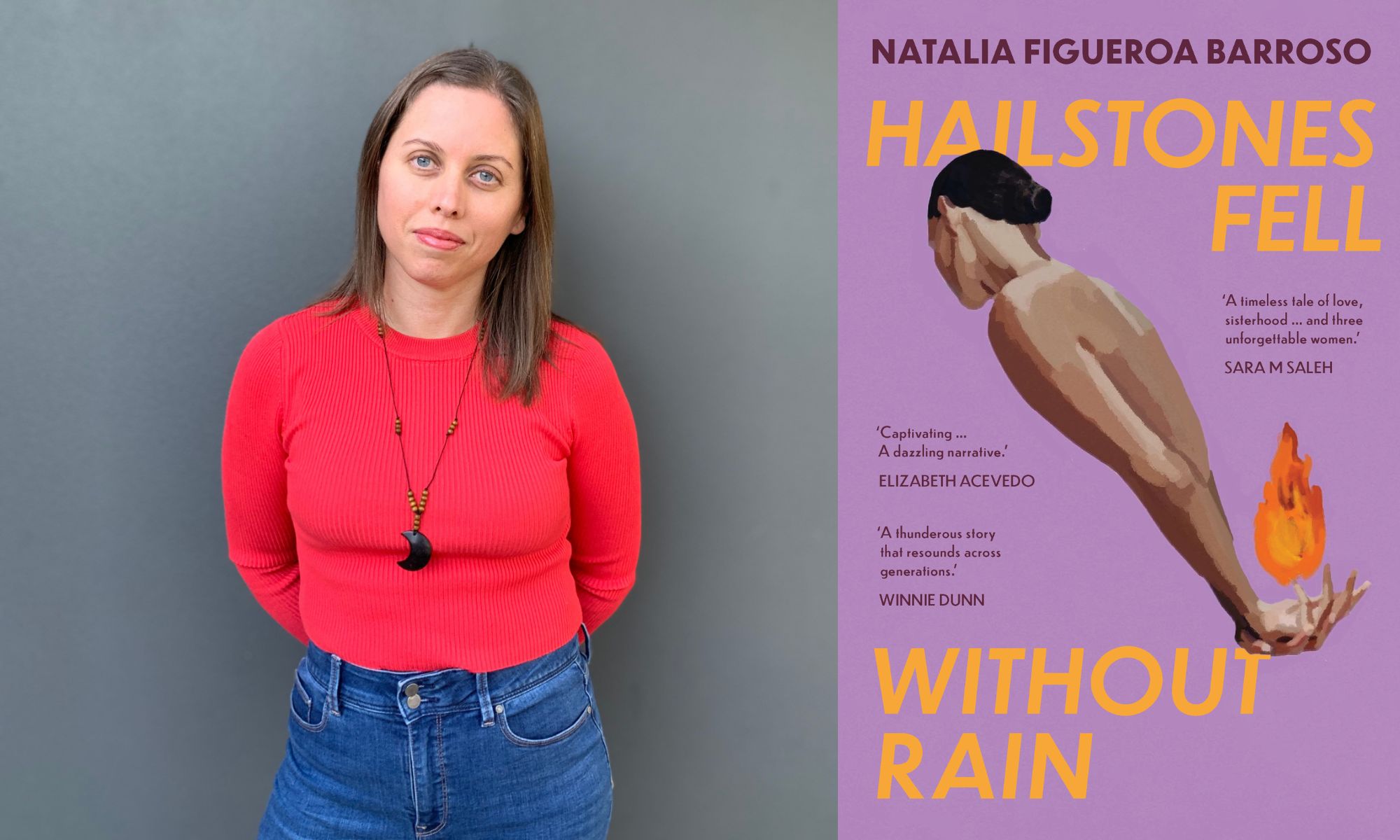


Congratulations on the release of Hailstones Fell without Rain. Could you tell us a bit about your journey to publication?
I’ve been part of Sweatshop Literacy Movement since 2018, where I learnt the craft of creative writing. Through that mentorship, I found literary casas for over twenty pieces I published in journals, anthologies and magazines. In 2022, I drafted my short story Back to the Red Earth, which was picked up by Griffith Review in 2023. After reading it, el Mohammed, aka Dr Michael Mohammed Ahmad, told me, ‘I have very little doubt that you can go all the way with your writing.’ He didn’t just say it, he backed it up, pushing me (in the best way) to finish my manuscript and checking in often. When it was ready, I asked Mohammed to send it to my dream publisher, Aviva Tuffield at UQP. To my surprise and joy, she accepted it within two weeks. That moment felt surreal. It reminded me that sometimes la first casa you knock on opens its doors.
The novel is partly set in Uruguay and explores the effects of the 1973 military coup. What kind of research did you do in the development of the story?
When I started researching Uruguay’s civic-military dictatorship, which lasted from 1973 to 1985, I expected to hear stories of censorship, enforced disappearances and police brutality. And I did. But what stuck with me most was how many people also spoke about meat. Uruguayans eat more meat per capita than nearly anyone else, and from 1967, there were periods when butcheries in Montevideo could only sell meat three times a week. For many this was torture. I heard incredible stories: girls hiding meat under their skirts, families posting steak from the country, an ambulance that was used to smuggle a whole cow carcass into the city. I wasn’t there, so to write those scenes I turned to fiction. I used versions of myself, my mamá, my sister. Made up, yes, but grounded in emotional truth. Fiction gave me a way to honour those memories and history while imagining what it felt like to live them.
Your story is also set in Western Sydney, a place with a vibrant literary scene. What was important for you to capture about this area?
I wanted to honour the many countries that live within Western Sydney. Each casa carries both their homeland and their birthland inside it. That’s something I see every day: people blending languages, cooking hybrid recipes, raising kids who are both ni de acá ni de allá. I wanted to speak back to the myth of the assimilated migrant. The truth is, we don’t assimilate the way the system wants. We don’t erase ourselves. Instead we create new forms, new dialects, new homes. That’s what makes Western Sydney so powerful to me—it’s not a melting pot, it’s a mosaic. A place where you can hear Arabic, Spanish, Samoan, Tamil and Dinka all on one street. That’s not chaos, that’s community. That’s what I wanted the novel to feel like: stepping into the anew. A space where multiple truths can live at once and where every street holds a different story waiting to be told.
I wanted to honour the many countries that live within Western Sydney. Each casa carries both their homeland and their birthland inside.
What did you learn from the publication process?
I learnt more than I can fit in one hundred words, but one lesson stands out. Aviva Tuffield taught me that less is more. At times, I overwrote. I filled pages with similes, allegories, wordplay and poetic flourishes. But Aviva reminded me that one strong literary move per page is more powerful than five. That letting the story breathe can create greater impact. She didn’t try to change my voice; she helped me shape it. Through her guidance, I learnt to trust the silences, the pauses, the restraint. Eso fue clave. I began to see editing not as cutting back but as carving closer to truth. Working with her taught me not just how to polish my novel but how to listen to it. And how to let it speak without shouting. That changed everything for me as a writer.
You’ve also written poems and short stories. What did you enjoy about writing a long-form work?
Writing any kind of story feels like braiding my fidgety gurisa’s hair. Every strand—poetry, prose—needs to be placed just right: beginning, middle, end. But writing a novel made me slow down. I had to be patient. Yelling at a fictional novel-child doesn’t get her hair done faster, it only makes more knots. I had to gently and creatively weave everything together: narrative arcs, character shifts, evolving metaphors. The braid had to be strong enough to survive a full day of play, sweat and life without falling apart. Some mornings, I didn’t know where to start the parting or how I’d reach the final twist, but I kept combing through. And when it finally held—clean, tight, solid—it was a huge relief. A little vamo’ arriba.
You can pick up a copy of Hailstones Fell without Rain at your local bookstore today.
Debut Spotlight is a partnership with Australian publishers to highlight the release of local books. All titles are selected by KYD and we retain editorial independence.