Music has been a sovereign aspect of being for tens of thousands of years. As I recalibrate where and how to place my music, I am trying to prioritise spiritual wellness and affirm pathways for generations ahead to follow in.
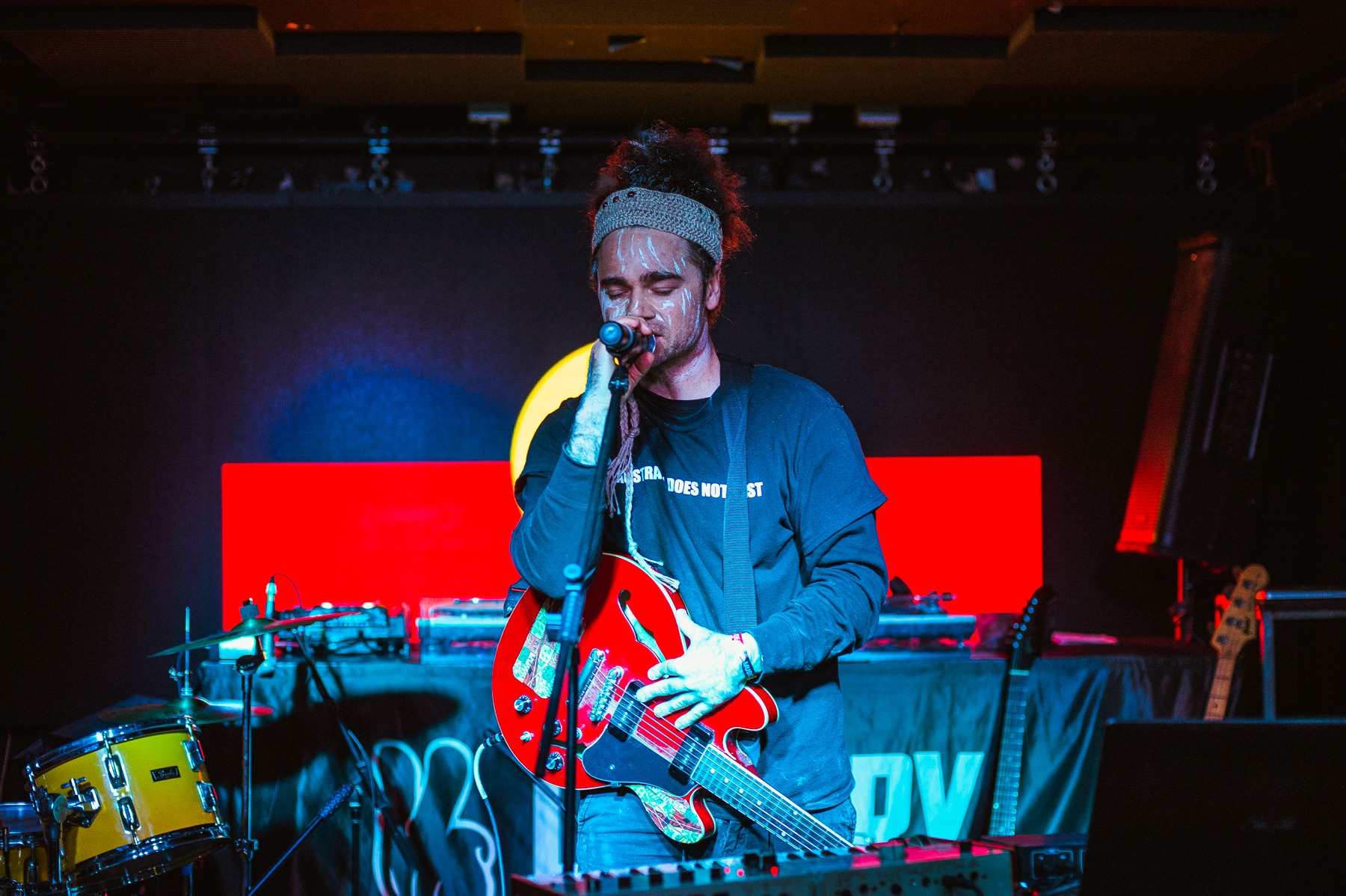


Music has been a sovereign aspect of being since we first ever lived and breathed on our sacred lands tens of thousands of years ago. It plays roles within kinship systems, continuing cultural practices and ways in alignment with Indigenous ontologies. Ways of being and doing are intrinsically tied to Indigenous values relating to care for Country and community, through engaging knowledge systems intergenerationally—passed down orally, and through learning processes that inform how we move. We always consider how our footprint now must be one that countless generations ahead have the opportunity to follow into. Progressing into a path of sound can facilitate growth and transformation for the individual, community, Country, and all living beings.
I grew up with many cousins in Shepparton, and all around Yorta Yorta Country. The first music we heard were records our parents had—Michael Jackson’s Thriller, Guns N Roses, Midnight Oil, Blondie—and music played at weekend gatherings. ‘Under The Boardwalk’ by The Drifters comes to mind. One of my mum’s cousins lived in a bungalow in my great-aunty’s backyard. She exposed me, my brothers, and cousins to hip-hop through Run DMC’s collaboration with Aerosmith on ‘Walk this Way’. It was transformative. Finally, there was something relatable, something palpable, both invigorating and powerful. It was Blackness that was brash and confident, and successful. At that point, Blackness hadn’t necessarily been deemed as appropriate or supported for behaving in such a way. Often when we were confident, it would be demonised. I saw this while walking the streets, police finding reasons to pull up on us. When playing basketball at the local sports stadium, it often felt our Black exuberance got under people’s skin. Black confidence was not accepted from us. To hear Run DMC was affirmation that we were well within our rights to keep on being us; how we wanted, and not how broader society wanted. They wanted us stay in a particular lane that was more suitable for them, easier for them to navigate than being confronted, and interacting with us.
Music guided me. Growing up in a regional area, I naturally fell into sports, which I loved, although I knew I wanted music in my life much more. Playing basketball with friends, sharing and listening to portable ghetto blasters, we began to slowly build our own music collection. We bought and collated hip-hop cassette tapes: Ice-T, N.W.A., Ice Cube, De La Soul, A Tribe Called Quest. When Wu Tang Clan came along, it was extremely pivotal; a group of nine MCs. As a big mob, up to twenty of us hanging out, we could relate. Again, the confident lyrics resonated, they were also uniquely provocative, that further encouraged us to deep dive into our own individually and identities. That had a magical hyper-empowering liberative impact.
Ever since I started heavily exploring hip-hop, my lyric writing has been anticolonial, and focused on sovereign spiritual approaches and solutions.
We began to write rhymes and formed our own hip-hop group, Unknown Posse. To participate in music as a 13-year-old was extremely empowering. I created worlds with words under the MC name MYSTICAL. Ever since I started heavily exploring hip-hop, my lyric writing has been anticolonial, and focused on sovereign spiritual approaches and solutions.
By the end of high school, I had lost direction. As I got older, spending so much time in these environments, I began to feel somewhat hollow; there was so much pain in the world, and other things that needed attention. This uneasiness led to confronting moments. I fell into a tough patch—self-destructive behaviours, namely marijuana use, intermittently for the next couple of years. I was feeling so much pain and grief. I loved how it numbed me and took me to a place of different feelings, away from the confusion and intergenerational pain I felt growing up as a First Nations person. It took me to a deeper place. I asked myself: how can we have a truly just, equitable world, on Indigenous lands of so-called Australia?
In 2001, I moved to Wurundjeri Country in the northern suburbs of so-called Melbourne. I was studying a Bachelor of Arts with a focus on creative writing, writing lots of poetry and rhymes. I was interested in pursuing hip-hop again and driven by a strong fire to pursue opportunities. I couldn’t find any clear pathways into the music industry. I crossed paths with hip-hop artists in the city, DJ Dexter from the Avalanches and N’fa Jones from 1200 Techniques at hip-hop nights at the Mercury Lounge, Club Odeon, The Metro, and Silver. I was daunted and didn’t want to be a nuisance to ask or hustle these amazing artists. I got to know other younger folks with a similar passion for hip-hop. None of us had access to anything more than each other. I hoped a path would open and I could get studio access to record and perform, but it didn’t happen, and before too long I ended up homesick.
By the end of 2002, I had come to a point where I was deeply immersed in suicidal thoughts. Standing on the very cliff of maybe no longer being here is a scary place to be. I feel though that something was with me, not from this time and place. It gave me an experience of what it would be like, and why I should continue to be here—to live in love, connected to the truest essence of who I am.
Through my twenties, I was trying to live my life in ways that avoided the western colonial system as much as possible. A big part of this was to work close to the land, to be outdoors and not be locked into a nine-to-five, 40 hour a week job. I did a Conservation & Land Management traineeship and spent a lot my twenties travelling and working seasonally in various farm-based roles. In between I’d rest and grow myself through creative practice and engage with developing my sense of spiritual self as an Indigenous man.
There were long periods of time where I didn’t feel compelled to enter the music sector. I was, however, gradually cultivating my artistry in my own time and space privately. Sitting on the river, jamming with friends, developing production skills, learning how to write and compose songs, and most importantly being with all the things that bring song into my life—the energies from the old people, the creator spirits, my lived kinship networks, and my own experiences. It all guided my creative practice development. A pure place. A place where there may be answers. A place where there is peace. Music saved me.
The energies from the old people, the creator spirits, my lived kinship networks, and my own experiences all guided my creative practice development… Music saved me.
I really started to make music myself when I began to play guitar in 2005. It was deeply empowering. I had first tried guitar when living in Melbourne with my cousins Gary and Leigh. They were gifted brothers. Leigh tried to teach me chords, but I just couldn’t get it. I felt a sinking feeling that maybe I’d never get there. By 2005, my sister had been playing for two years and my older brother started playing also—having it around me made me give it another try. My brother and I took on the task of learning ‘Come as You Are’ by Nirvana. It took a while, but we got there. Something was unlocked. I realised that if I could do that, I could do more.
Years later I began to learn and speak in Yorta Yorta language. I felt that if I was going to write songs, intuitively it felt that singing in the language of my people and land should be prioritised. The more I played, the more these feelings intensified. By the time I started performing on stage in 2015, I was adamant about singing in Yorta Yorta language. I felt fully charged with a cultural responsibility: If I was to have such a platform with Song, to use my song in public spaces, I owed it to my songlines and old people to ensure that their representation through my mother tongue was central to how I moved and presented myself. I began to pursue a path into the music industry and felt I might want to place my music in these spaces after being unsure.
I had been working with my Yorta Yorta mob in community, I’d sat in different spaces including the corridors of federal politics for First Nations people. I was a Chairperson of a Nationwide Coalition of Emerging Leaders in 2013. I saw many of the limitations I had felt, and thought I could impact on, in a different way. Firstly, for my personal healing, but furthermore for community, who in so many ways were limited in the ability to take stances in ways that could be heard. Awareness around Indigenous participation and value was something I felt to be lacking. When I wanted to perform an Acknowledgement of Country as part of a regular event I was participating in, I was met with confusion. At another space, a hip-hop show opening for legendary American rapper Masta Ace, I did an Acknowledgement of Country and someone in the audience abused me, yelling, ‘I didn’t pay to come watch this shit! What the fuck is this?’
| STAY IN TOUCH WITH KYD | SIGN UP |
| New reads, giveaways and writing opportunities free in your inbox each week | |
| SIGN UP |
In 2015, I sat in a room directly behind Tony Abbott as he spoke to a group of Indigenous community leaders about the forced closure of Aboriginal communities—claiming that First Nations peoples living in rural communities were making a ‘lifestyle choice’, and that taxpayers had no obligation to support them. Being in that moment filled me with an intensely deep sense of unease—painful distrust came over my body and spirit about what was to come. His speech completely missed the mark, uninformed and patronisingly assimilative. A tone of ‘we will help you be better by indoctrinating you into our ways’ prevailed. These remarks set me in motion to make strong statements around the reality of who truly legitimately has the overarching right to a Sovereign voice, and determination of what should or shouldn’t fly in this land. This prompted me to leave my work in community, move to the city and pursue my music in a professional sense. Being from the Yorta Yorta people, I was sparked to speak my mind in a Sovereign way—we have always done this.
In 2015, I sat directly behind Tony Abbott as he spoke about the forced closure of Aboriginal communities—a moment that filled me with an intensely deep sense of unease about what was to come.
Releasing my track ‘Australia Does Not Exist’—a sentiment I had sat with going all the way back to when I began exploring identity, societal constructs and national identities and agendas under global capitalistic systems—was about smashing the illusions that Tony Abbott, and others before and after him, have reinforced. It was about the truth of this land through completely subverting any trace of illusions. I see many half-attempts (at best) at truth and justice. For example, changing the date of Australia Day. This exemplifies how far many people are still from grasping the fullness of Indigenous Sovereignty and Indigenous Nationhood, which is to acknowledge that ‘terra nullius’ was a lie. A nation founded on such falseness is one built on blatant darkness and evil intent. I ask, how can my music then extend into spaces whilst still holding this? I must align with who we are as Indigenous people.
Moving home, back to Country, forced me to reassess where I place my music. Aligning myself with energies of Country, old people, and kinship, told me what to do, how to do things, and fed my voice. My work is spiritual. Where I perform my work must be about its spirit. Doing shows for the sake of career progression and accolades, cultivating work to generate certain opportunities—it had begun to make me feel unwell. That was the sign I needed to recalibrate how I place my music. It’s not that I am no longer participating in music spaces, but I’m more selective; I will not jeopardise my spiritual wellness.
Doing shows for the sake of career progression and accolades, cultivating work to generate certain opportunities—it had begun to make me feel unwell.
It’s not so much about never being in these music industry spaces, it’s about factoring in the spirituality and cultural appropriateness for all decisions. I prioritise gigs that are First Nations led, that are curated by Custodians of Country where it’s located, community events, and work that encourages growth for our people, invigorating Song and Songlines. As a custodian I need connectivity. Being surrounded by my own peoples, Yorta Yorta, on a day-to-day basis, yarning and connecting, being present, we can move in good way with creative outputs.
Due to the severe erasure of our value that we feel, we must create. I try to keep on, despite all this, affirming pathways for First Nations artists to use Song as I have. To grow, which ultimately benefits mob as a whole. Community. Connection. We are Song, in as much as we are of body, we are of Country—of The Dreaming. New songs ever-forming in each moment—thousands of years ago, into the present, and onwards to the future—always with us. We are still here—Sovereign.
*
This piece was edited by KYD First Nations Editor-in-Residence Bianca Valentino, in partnership with State Library of Queensland’s black&write! Indigenous Writing and Editing project.
Aboriginal and/or Torres Strait Islander writers can submit pitches to KYD’s First Nations Editors-in-residence here.