Entertainment and politics have become so indistinguishable on social media that we respond to serious events in dangerously unserious ways.


In the late 90s, Australian scholar Graeme Turner used the term ‘post-journalism’ to describe what he saw as the decline of professional media standards due to commercialisation and the blurring of news with entertainment. Later, in 2010, he warned that the increased visibility of the ‘ordinary person’ in reality television and user-generated content signalled not democratisation and true political empowerment but further exploitation in the form of cheap content and new forms of commodifiable celebrity.
Now, in an era where anyone can become an influencer and any influencer can be an expert, this blurring has reached a point that perhaps even Turner couldn’t have predicted. Politicians currying favour with popular podcasters. AI slop and Palantir in the newsroom. Declining trust in traditional media. More Australians than ever before get their news from social media than any other source. But on these platforms, news is not just information—it is competition, and the prize is attention. With our interest monetisable like never before, our feeds have become a vertigo-inducing mash of genocide, dance trends, election predictions, fundraisers and paid product promotions—and that can all come from a single newsfluencer account.
I get it, we all have to make money somehow in this economy. But this melange has real repercussions for how we view and respond to global events. As Stan Grant noted two years ago as he quit the ABC due to vitriolic racism from viewers, ‘If you can shout the loudest, you can be heard over the din. When you start to shout, you stop thinking, and it gets louder and […] more nasty, just to be heard.’

As the progression of Turner’s arguments indicates, social media did not create these problems. The pressure to form a quick opinion and then double down on it was something I had already experienced as a regular columnist in the traditional news media as it adapted to the digital age. The rush to publish before the competition and secure those precious clicks meant that often, rather than wait for more information before putting their name to an opinion, writers were compelled to respond rapidly and forcefully, resulting in superficial commentary that prioritised short-term rewards over thoughtful analysis.
Subscribe to stay in the loop
Be the first to read new stories, discover publishing opportunities, and access resources. For people who love great writing.
Social media has only exacerbated the hot takes. Now instant—yet somehow definitive and usually unforgiving—opinions about events of drastic political and social importance appear within minutes as if preformed. When American conservative influencer Charlie Kirk was publicly assassinated in September, his death immediately became fodder for the so-called ‘culture wars’. The response, both on traditional and social media, seemed split into two camps: either his death was a national tragedy on par with that of Martin Luther King Jr, or he, with his adamant pro-gun views, brought it upon himself. Those who grieved were outraged at anyone who didn’t share their grief, and those who didn’t much care couldn’t conceal their amusement as they used his own words against him.
The trouble was, the discourse never really moved beyond this immediate and superficial reaction. The same conservative activists who mocked liberals as ‘snowflakes’ compiled dossiers on anti-Kirk commentators. People lost their jobs. A talk show host was suspended and almost as quickly reinstated. But amid this discursive melee, a floundering youth conservative movement saw an opportunity and grabbed it. Using Kirk’s assassination for their own advantage, they seized the chance to frame themselves as victims with Kirk serving as their (literal) poster boy. Divorcing his assassination from the wider problem of gun violence, conservatives cast themselves as long-suffering, innocent victims who, like Kirk, ‘only want to talk’.
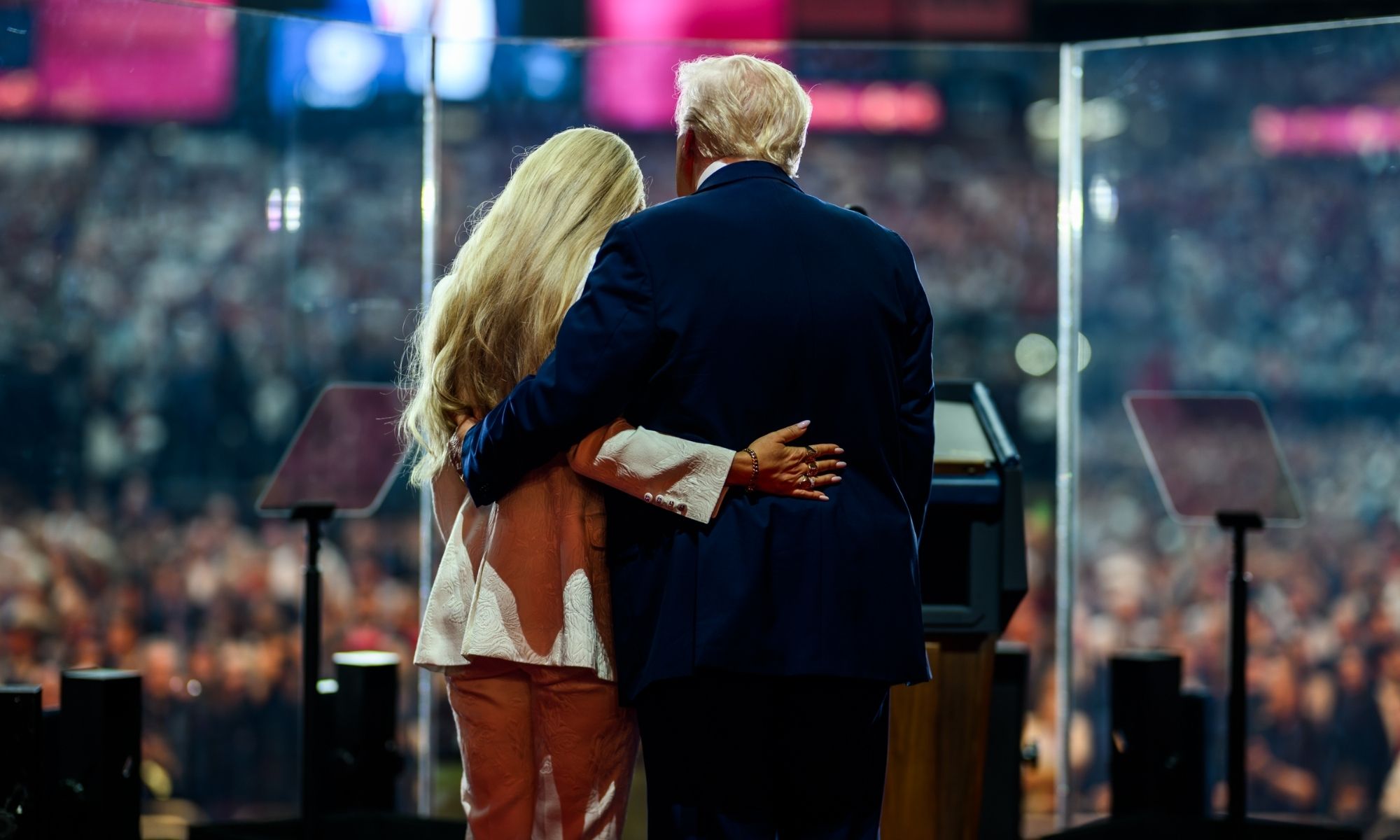
The paradox of victimhood is this: being oppressed can render you powerless and ruin your life, but playing the victim is a key tactic of the powerful. The martyrdom of Kirk was not pre-ordained. It was made possible because the reaction to his death provided the ideal conditions for white conservatives to confer Kirk’s victimisation onto themselves. Leftist opposition to the far-right values Kirk espoused was spun as ‘hate’ waiting to again turn deadly with everyone who refused to publicly mourn cast as a potential suspect. Threats to press freedom and civil liberties ensued.
Amid this bickering, Kirk’s widow Erika took over his organisation Turning Point USA, skyrocketed its public visibility and strengthened its ties to the Trump administration. With stunning speed, a movement that had been haemorrhaging support of young American women has been resurrected. It was frustrating to see progressives get bogged down in defending their right to feel apathy about Kirk’s death when it should have been clear there was something darker looming.
Being oppressed can render you powerless and ruin your life but playing the victim is a key tactic of the powerful.
Leftist writers have been trying to grapple with performative victimhood for a long time. The urgency to resist its appeal from within its own ranks, and to rise above the bait when it comes from the right, forms the subject of the 2025 non-fiction book Minority Rule. In this debut from British socialist commentator Ash Sarkar, the senior editor at Novara Media refutes the idea that minorities are trying to overtake majority populations (a fear that often sits at the heart of contemporary conservative politics). Rather, she argues, it is the powerful and the rich who benefit the most from fear and division.
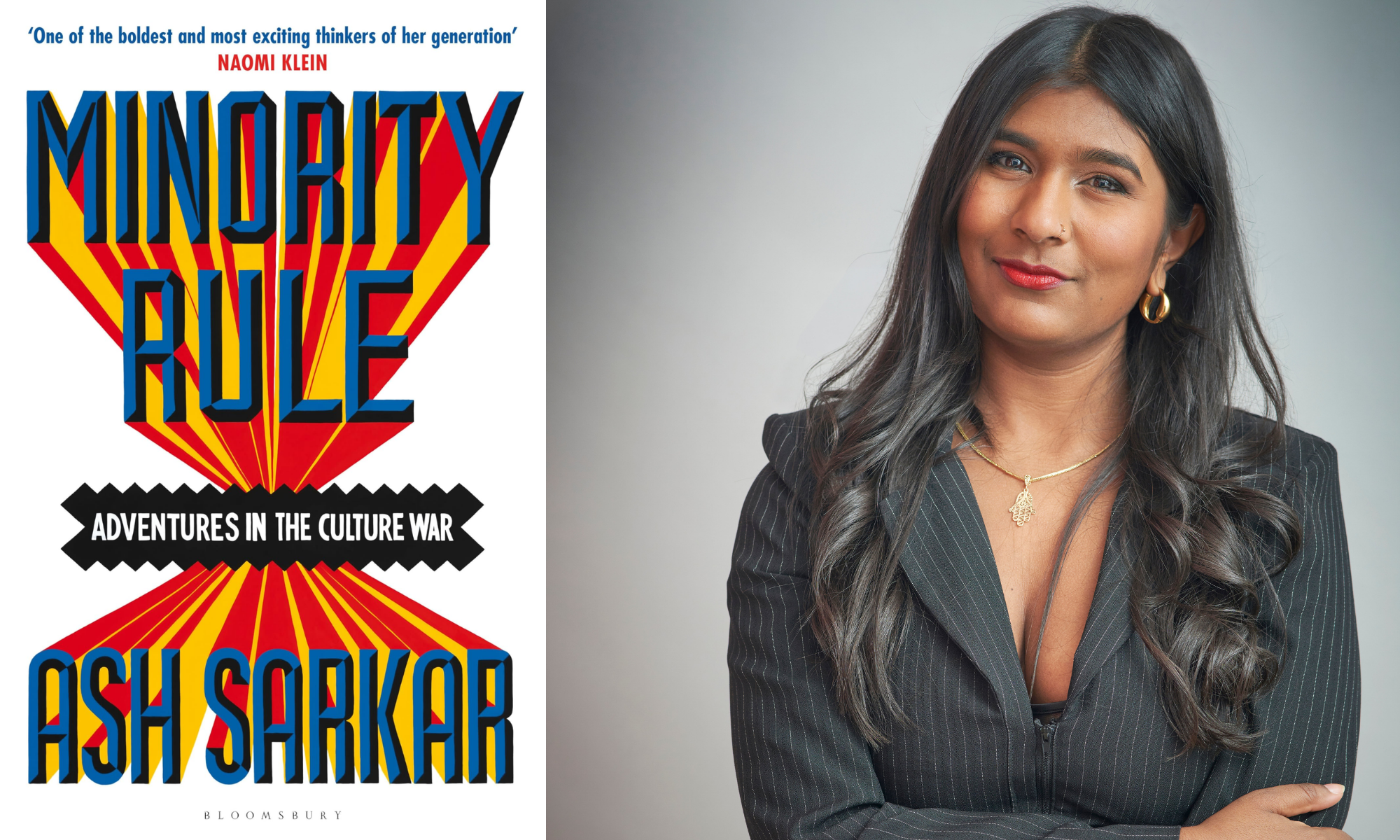
Sarkar’s contention with the left is identity politics, which she says has glorified victimhood and eroded the possibility of solidarity:
There’s a kind of perverse attachment to victimhood, to the condition of victimhood which isn’t just one of suffering, but one where your suffering is acknowledged and validated by others. It is a status which confers authority, and when socially, politically and culturally recognised, compels those in power to act on your behalf. Victimhood, therefore, can be used as a pretext to exclude, police, and even enact violence on other vulnerable.
I can’t argue with that. Victimhood and identity politics have been used in progressive circles to dictate who can talk about what and who should be excoriated for attempting to do so. But the problem with Sarkar’s thesis is in the very next line:
There’s an incentive, then, for those in power to co-opt the victim status of others – or conjure it up entirely – in order to justify their role in upholding a deeply unequal society.
In other words, Sarkar claims that conservatives have learned performative victimhood from the left. It’s quite excruciating to see her get so close and then somehow completely miss the mark. It is true that social media has given a platform to identity-based grievances. However, the notion that the right has only recently acquired this strategy from progressives is grossly ahistorical.
As I have argued elsewhere, performative victimhood has enabled the rise of the West. At the same time as decimating, displacing and massacring entire populations, Western colonial powers presented themselves as the victims of those they were annihilating.
We witness this play out in Gaza, where Israel, despite pummelling Palestinians for two years straight, has never let go of its claim to victimhood. It’s extraordinary to witness a military power drop bomb after bomb on families in tents while also claiming to be the party under existential threat. Yet this has been par for the course for Western powers for centuries. Identity politics as practised by progressives on social media then is—at most—an overcorrection, an attempt to challenge this notion of white innocence and perennial victimhood.
Nonetheless, Sarkar’s point is pertinent: the social media melee is hurting leftist organising, leaving us attacking each other rather than working together. Relatively minor political disagreements become feuds which devolve into spectacles that centre on personalities rather than issues—great for generating advertising revenue and building a personal brand but disastrous for good-faith debate and understanding. However, this is not so much because of identity politics and victimhood as Sarkar argues, but because, as Graeme Turner forewarned, social media blurs the line between entertainment and politics so effectively that we respond to serious events in unserious ways. Remember Hot Luigi?
The reaction buttons these platforms have bestowed upon us have warped how we see everything that comes across our feeds. Whether it is a comedy skit, a racist rant or a public assassination, we like, comment, share, argue, memeify and eventually move on, seemingly oblivious to any lasting effects of what we just witnessed and participated in.
Social media blurs the line between entertainment and politics so effectively that we respond to serious events in unserious ways.
Journalist Osman Faruqi outlines the danger in short-term thinking in his analysis of the recent anti-immigration rallies in Lamestream, an online publication he co-founded to ‘[tackle] the crisis in media’. He argues that the March for Australia protests in October, while mocked as a failure for ‘only’ attracting around 10,000 people in Melbourne and 15,000 people in Sydney (paling in comparison to the pro-Palestine march over the Harbour Bridge), should be treated not as the culmination but as the start of a resurgent white nationalist movement in Australia. ‘The fact the far-right was able to organise this number of people despite enormous amounts of chaos, confusion, internal dissent and mixed messages should be an urgent wake-up call.’
It is an astute observation by Faruqi. That the media—both the fourth and fifth estate—largely failed to understand these events’ significance exemplifies the dangers of post-journalism. Look around and you’ll see such failures everywhere. Rather than assessing their long-term importance, events and our reactions to them are treated as ephemeral: once they’re done, they are done. This leaves little room for scepticism, uncertainty or complexity. We don’t often look for patterns or the bigger picture. We sometimes fuel the fire. We don’t consider sitting this one out. What gets traction now is not so much telling people what they might need to know, or asking them to look at it from different angles, but getting in early and getting in loud to confirm to people what they already believe.
All year, Donald Trump and his acolytes had been gunning for the Nobel Peace Prize, pointing to his role in the ‘ceasefire’ deal between Israel and Hamas. The media made much of this informal campaign because Trump’s ego gets clicks. The significance of this attention was that it made the eventual winner, Venezuelan opposition leader María Corina Machado, much more newsworthy. Exemplifying post-journalism by putting personality over politics, her victory was framed as a humiliating snub for Trump.
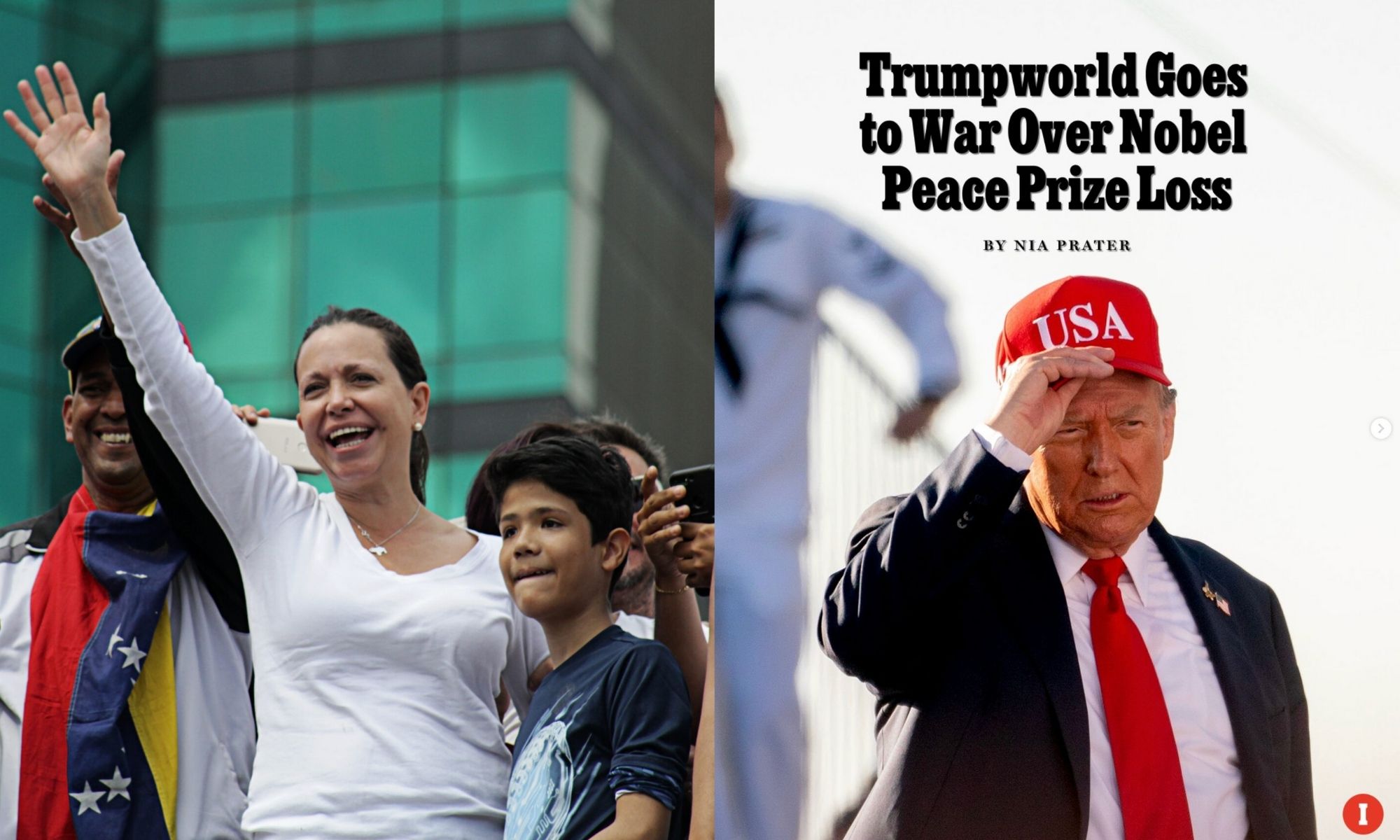
Oil-rich and strategically placed, Venezuela happens to be a nation that Trump has attacked at sea and has been cryptically threatening to launch a full-scale war against using the veneer of both the War on Drugs and the War on Terror by labelling the administration of socialist president Nicholás Maduro ‘narco-terrorists’. Cue jokes from administration officials about Venezuela becoming the 51st US state (a proposal for annexation that has also been extended in recent times to Greenland, Canada, the Panama Canal and the Gaza Strip). This week, Trump leaned into victimhood to justify his decision to close airspace over Venezuela, telling reporters it is ‘not a very friendly country’ that has ‘sent millions of people [from] jails, from gangs, from drug dealers [that] shouldn’t have been in our country causing a lot of problems’. He also claimed that each of the boats struck by the US, ‘is responsible for the death of 25,000 Americans’.
I say this not to defend Maduro’s military authoritarianism but to highlight that there are bigger things at stake than a vanity award. Unlike Maduro, María Machado is sympathetic to Western interests, having praised everyone from Benjamin Netanyahu to Trump himself in her efforts to oust Maduro and usher in a neoliberal administration in his stead. With its seal of approval, the Nobel Committee has conferred legitimacy on foreign intervention. Until now, Trump has largely followed Obama’s Yemen Model—fuelling wars with few US ground troops. However, at the time of writing, it’s reported that 15,000 US Marines sit waiting in the Caribbean. While unclear whether Trump will actually send them in, his decision to rename the Department of Defense the ‘Department of War’ might be a rhetorical play to his base, but it also sends an ominous signal.
Rather than assessing their long-term importance, events and our reactions to them are treated as ephemeral.
This is what we miss if we look at the Nobel Peace Prize announcement as just another entertaining post on our feed, one to like or share or laugh at and then scroll on. Machado’s victory is not the culmination of Trump’s attempt to nab the prize for himself but an escalation of the long, complex and exploitative history of US foreign policy.
The startling lack of context and continuity to our public discourse is cause for concern, but the answer is not to abandon commentary altogether. What we need is to prioritise considered analysis that is not afraid to take its time, is open to the prospect of changing its mind and aims to persuade with clearly articulated reasoning rather than by shouting louder than everyone else or telling us what we want to hear.
It’s not just that social media has made the 24/7 news cycle, as Grant suggested, nastier and more aggressive. It is that our own rush to be on the right side of the discourse splinters us not just from other so-called echo chambers but from the bigger picture, making us less likely or even willing to look for clues on where events might lead us or what they mean in context of what came before them. That might be good for some follower counts, but it does nothing for our future.