At turns entertaining and bemusing, rewatching ABC TV’s book show highlights a scarcity of televised arts criticism.


Digging up the long buried First Tuesday Book Club, I wasn’t sure what I’d find. The television show, which ran on the ABC from 2006 until 2017, retooled as The Book Club somewhere in the middle, is a bit like a forgotten relic. But it hadn’t disappeared completely. I was struck first by the fact that the episodes were still downloadable in MP4 format on the ABC’s website, not washed away like other parts of the broadcaster’s archive (although the available episodes only start at 2011). What can we glean from the last bastion of regular television book coverage? Having had friends and colleague publish terrific works that strained to get media attention, I was on a mission to know. The cynic in me thought I might find a lost kingdom of the middlebrow—a mass-market, mainstream-media pandering to the populist appeal of the ‘book’.
When a low-res episode sprang back to life on Quicktime, however, I was surprised to experience intense pangs of grief instead. It wasn’t that the show was better than I remembered—I barely remembered it in the first place—but it was immediately evident that nothing like it exists on free-to-air television today (or, indeed, on the subscription-based streamers). In fact, the only really strong memory of the show that I had was of Oscar-nominated actor Jackie Weaver bringing in Patrick White’s The Solid Mandala as her choice and wildly grinning while talking it up. It’s hard to believe we will ever hear the title The Solid Mandala spoken aloud on national television ever again.
Subscribe to stay in the loop
Be the first to read new stories, discover publishing opportunities, and access resources. For people who love great writing.
Others I spoke to were not so pleasant when it came to relaying their memories of the show. Most thought it was middling at best. But was it a ‘necessary evil’? Watching back episodes at random, an unthinkable amount of airtime was given over to discussing what could broadly be termed ‘literature’: roughly fifteen-minutes of prime time to each book—one a new release and the other a classic—with space for guests and critics alike to share their monthly reading highlights. The titles covered included a mix of popular and literary fiction, occasional creative non-fiction; Australian novels were yolked in with their international counterparts. What was immediately obvious is that there is no longer a program of this scale of publicity for books. The ABC’s lack of investment in this exact area could be partly blamed for the backsliding that is happening in book sales and reading rates in Australia. It feels like negligence.
It was so demonstrably clear that nothing like it exists on free-to-air television today.
Most will remember The Book Club for its trio of hosts. Jennifer Byrne—a career news journalist—sat centre stage, a necessary TV-ready glue to keep the show together. Then virtual unknowns, Marieke Hardy and Jason Steger sat by Byrne’s side with a ribbing sibling energy. There was often a feigned indignation at the other’s opposing opinion that frequently ended in a communal laugh. I was completely delighted with Hardy’s description of one title under discussion as being a ‘horrible, horrible nasty little scab of a book’. On Ayn Rand’s capitalist screed The Fountainhead, Steger fell back and sighed: ‘I love the fact that I finished this book… one of the most loathsome reading experiences I’ve ever had.’
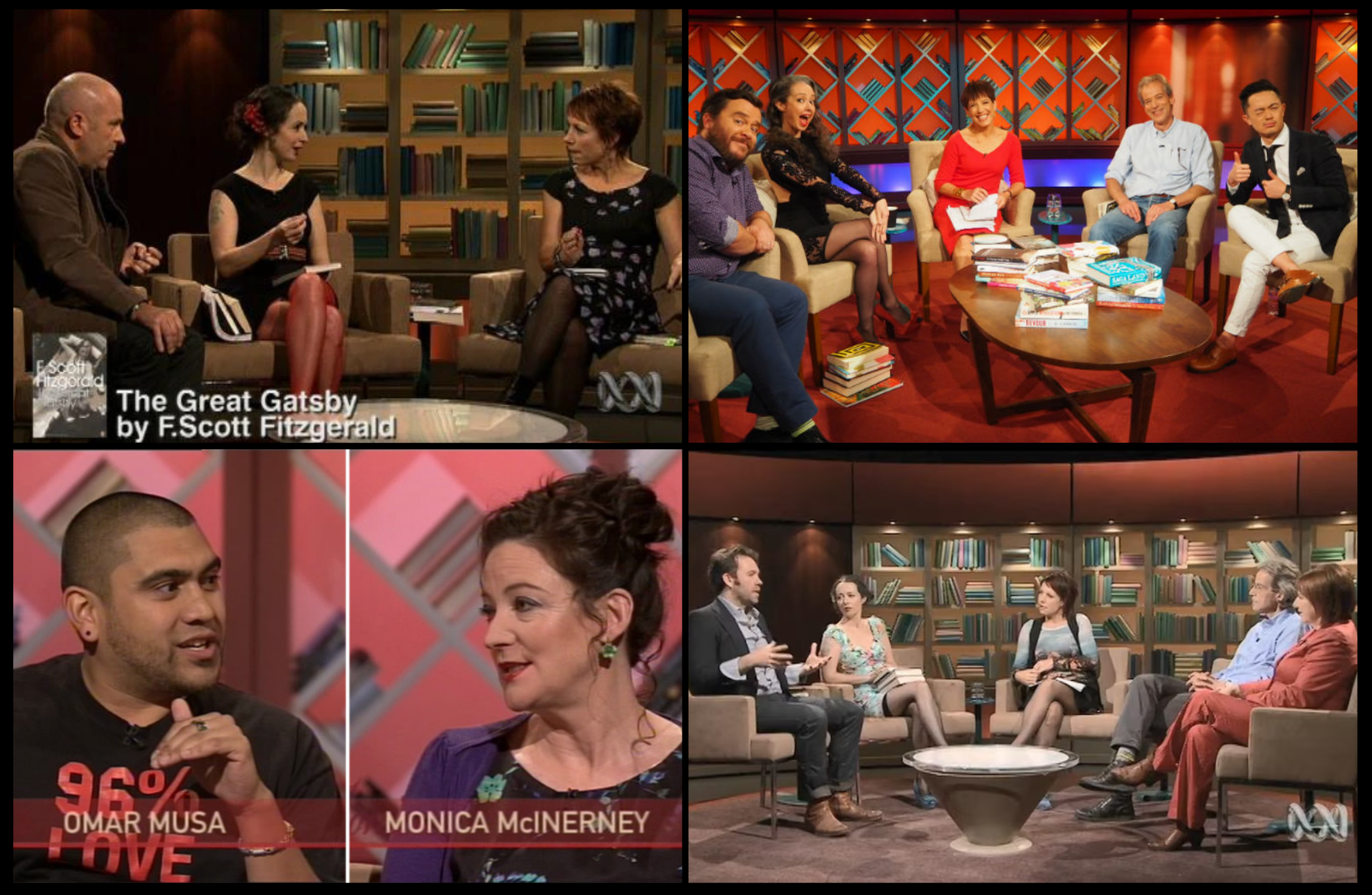
As well as the regular three co-hosts, another two guests—selected from a rotating pool of locals and occasional international guests when they could be pulled away from the writers’ festival—rounded out a club of five. The usual terminal ABC ‘talking heads’ were ever-present, including the likes of Germaine Greer, Miriam Margolyes and Jesuit priest Frank Brennan. The books and guests alike were, unsurprisingly, overwhelmingly white. There were slow changes to this as the years progressed. Just as there were occasional flashes of out-of-the-box casting brilliance. The very first episode matched the late much beloved Gardening Australia host Peter Cundall with Bret Easton Ellis’ American Psycho. Cundell looked at his fellow panelists and, flawlessly, delivered the line:
‘It’s about the most insignificant, useless, parasitical, self-centred, greed-driven people on earth. I’ve got great value for this book: I’d cut it up into small bits and it would make brilliant compost.’
‘Free and frank’ was the only directive given to guests, Byrne explained. There was a level of negative criticism aimed at books that you would struggle to hear on air today; puff and pleasantries have become the norm. Purely in an industry-sense it is worth noting that the most important inclusion to The Book Club was Steger as the in-house literary editor, handing over an astonishing opportunity to boost the profile of an arts journalist and so bolster the books pages he oversaw. The visibility surely gave Steger a level of authority in the newsroom that is now gone (indeed, Steger himself was named as one of eighty-four staff made redundant by Nine at the Age and Sydney Morning Herald last year).
When The Book Club disappeared from screens in 2017, the ABC had already lost their film reviewing program, At The Movies, when David Stratton and Margaret Pomeranz simultaneously chose to retire in 2014. The show had been running since 2004 when Stratton and Pomeranz migrated from SBS, where they had co-hosted The Movie Show since 1986. They had spent nearly thirty years arguing over cinema together. As was the case with The Book Club, critical dissent between presenters provided crackling fireworks (in comparison, there have been moments when I’ve appeared on critical roundtables, both in print and on air, where I have felt negative criticisms to be subtly discouraged and left deflated). The ABC was rumoured to be replacing their exiting cinephile stalwarts with Radio National regular Jason Di Rosso and comedian Judith Lucy, who briefly served as stand-ins while Stratton and Pomeranz were on leave, an artifice, surely, conducted to audition the pair in front of Australian audiences, but nothing was to come of it.
There was a level of negative criticism aimed at books that you would struggle to hear on air today.
The loss of both The Book Club and At the Movies was, and remains, a deep shame because there is a long history of film and book criticism on the ABC. The plainly titled The Critics predated both shows by more than fifty years and, in fact, combined their coverage of books and film. The Critics was copied from a similar program on the BBC and was broadcast simultaneously on radio and television. It featured a rotating line-up of three credentialed guests and a chatty host covering—typically—a film, a book and a third cultural work whose genre was regularly swapped out (an art exhibition, theatre or music, for instance). In his history of the ABC, K S Inglis laid out the format of The Critics and its importance within the TV and radio landscape of the 1950s and 1960s. The show featured:
…teams reviewing the arts in various capital cities and chaired itinerantly by Max Harris in a style part-larrikin, part-dandy. Some looked uncomfortable, and were, feeling pressed by the chairman and producers to keep it down with an audience presumed to be more lowbrow than themselves. For several years, The Critics was the only regular programme on television that recognised the existence of the arts.
Where have all our part-larrikin, part-dandies gone? Who, indeed, remembers Max Harris outside of his being duped by the Ern Malley hoax? The Critics was smart to alternate between Sydney and Melbourne as shooting locations, and smarter still for hosting special episodes at the Adelaide Festival. Not everyone was a fan though. One critic of The Critics begged the panel to ‘say what they think in plainer language’ and to avoid ‘textbook talk’ (even the audience was asking to be talked down to). In 1962, after the show returned following a hiatus, Mungo MacCallum reviewed The Critics on much the same terms. Suggesting the Melbourne rotation was stronger than the Sydney one, he wasn’t impressed by either the posture or the talk of the guests in the latter, suggesting their review of ‘Patrick White’s Riders in the Chariot disappeared in a verbal fog’. If a novel by Patrick White were discussed on national television today—whether The Solid Mandala or Riders in the Chariot—we would surely breathe in the verbal fog openly.
The Critics was—consciously or not—revived on the ABC in the early 2000s, serving as a model for Critical Mass. A single episode of Critical Mass uploaded and available to watch on YouTube demonstrates the diversity of what went under review: Spike Lee’s 25th Hour, Brian Castro’s novel Shanghai Dancing and Meryl Tankard’s first full length work for the Australian ballet, Wild Swans. Hosted by Jonathan Biggins, I watched the show religiously at the time (partly due to an inexplicable para-social crush on the show’s regular critic Stephen Armstrong). Indeed, in 2011 when I launched The Rereaders podcast—again mimicking The Critics format of three cultural topics under roving review—many might have guessed that the Slate Culture Gabfest was its main inspiration, but it was, in fact, Critical Mass I was chasing.
Imagine a novel by Patrick White being discussed on national television today.
The less said about the arts and culture programs that followed Critical Mass the better. (Does anybody remember Richard Fidler’s Vulture? Amanda Keller’s Mondo Thingo?) At least it was a time when the succession of arts coverage was on the ABC’s mind. In the years after the demise of The Book Club, I had coffee with one ABC contractor to offer feedback on potential replacements for the program. I was shocked to find they were planning a standalone documentary rather than a new critical panel (Claudia Karvan’s critic-free caravan ride of Australian ‘classics’—The Books that Made Us—landed on screens many years after that coffee had cooled). More exciting was hearing whispers of friends being screen-tested for a potential replacement program for At the Movies. The names being bandied about gave a sense that the powers that be might take a youthful turn for a replacement show. (I’ve also oft argued that Triple J should have its own book reviewing segment—a gateway drug dealer to get teenagers and young adults hooked on reading—but they excised even their movie review segments a long, long time ago).
What arrived, instead, was Screen Time. I went along to a live taping of an unaired pilot curious about what the ABC team had concocted to replace Margaret and David. Sitting atop the tiny bleachers in the Ultimo studio there was a sense of disaster unfolding in front of us: I now possess a scarified memory of The LEGO Ninjago Movie being discussed alongside a critical retrospective of Jane Campion, in which everyone talking sounded out of their depth. Screen Time wasn’t a bad idea to retool At the Movies, updating it for the digital age by merging reviews of television, films and their streaming equivalents. The show, however, was burdened by being hosted by Chris Taylor, an alumni of the frat-boy political prank show The Chaser, hanging onto the ABC for dear life years after its relevancy had expired. Screen Time didn’t live to see a second season.
The real issue with Screen Time was that it didn’t hire practicing critics for its line-up of guests. The ABC may not want to hear this, but criticism is a highly trained discipline. Despite dwindling space—both in print and on air—it thrives in Australia, with many thanks to James Jiang’s exemplar stewardship of the Sydney Review of Books and various storied literary magazines that continue to persist. Scrolling the contributor lists of these publications, one can easily imagine The Critics being resuscitated with great ease. Any combination of Dan Golding, Rebecca Harkins-Cross, Michael Sun, Cher Tan, Patrick Mullins, Imogen Dewey, Declan Fry, Ellen O’Brien, Eda Gunaydin, Leah Jing McIntosh would work (the list could, and truly should, go on). It’s easy to imagine any of them inspecting the launch of HBO Max in Australia, furiously debating Bong Joon Ho’s return to cinemas with Mickey 17, before dissecting the Stella Prize longlist in the very next breath. Twenty-two years after the Critical Mass panel discussed Brian Castro’s Shanghai Dancing, these new recruits could review Castro’s latest novel Chinese Postman.
The ABC may not want to hear this, but criticism is a highly trained discipline.
How much could all this possibly cost? A small number of salaries for the critics, plus a desk and a few chairs (surely those plush At the Movies armchairs are somewhere in storage ready to be shuffled back out)? That other kind of ABC chair—the broadcaster’s incoming chairperson, Kim Williams—might be willing to fund it. In a speech at the State Library of Victoria, timed with his coronation, he signalled a desire to see ‘more coverage and coherent programming for the arts’ that included ‘books, theatre, dance, music…’ Many, both inside and outside of the ABC, are aware that Williams has an interventionist bent as a chairperson—he long coveted the managing director role of the organisation, having confidentally applied at just twenty-eight-years-old—and we have, very recently, seen just how disastrous this overreach can be (the alleged influence of operational lobbying on Ita Buttrose in the firing of Antoinette Lattouf—with Buttrose cruelly wishing COVID-19 upon the journalist—has led to a costly court case.) Perhaps, however, we can permit benign public campaigning from Williams for increased investment in the arts on ABC given its dire absence.
The ABC’s new managing director, Hugh Marks, has certainly sat down with the corporation’s charter. Hopefully Williams has underlined the sections for him that refer to ‘cultural enrichment’ and the encouragement and promotion of ‘the musical, dramatic and other performing arts in Australia’. Neither of these mean much without a critical voice to go along with them. It’s unlikely Marks, coming across from Fairfax and Nine, will have a strong interest in these areas, but if it’s possible to sit him down with that old Quicktime player, firing up an episode of The Book Club, he might be able to see how much critical culture we have lost since its demise and how cheap and easy it would be to revive.